



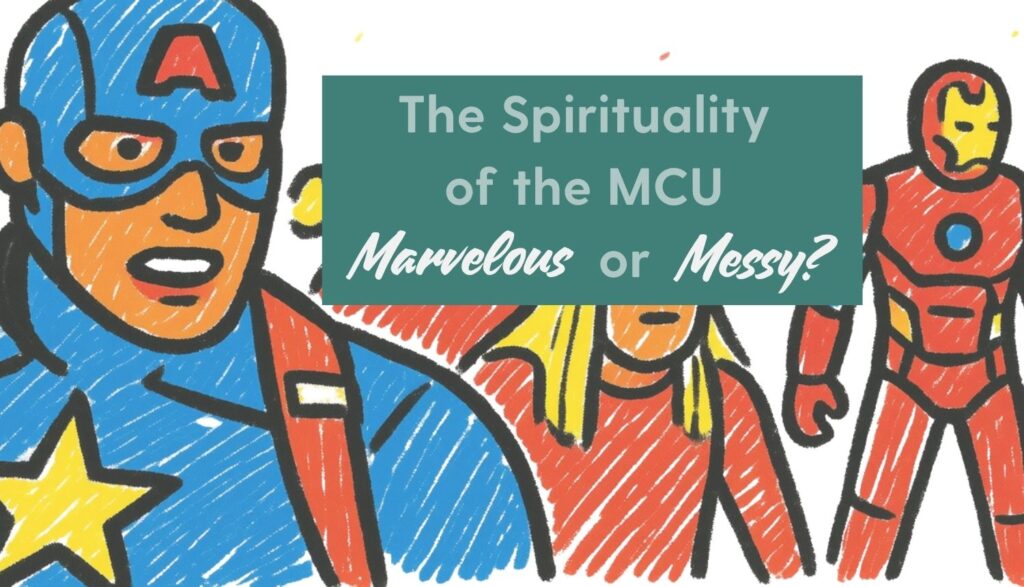
The Marvel Cinematic Universe began in 2008—and without a lot of overt spiritual content. The original Iron Man is really the story of a brilliant, but selfish, tech mogul (Tony Stark) who escapes an Afghan cave thanks to a hastily-built suit of iron. He then decides to build a much better suit and become a superhero. We don’t see churches. We don’t hear prayers. God? Not an overt player in Iron Man.
But let’s take a closer look: Look at Stark’s brush with death. The metal working its way toward his heart would surely have killed him long ago had it not been for the powerful magnet placed in his chest by a fellow prisoner named Yinsen—a man, it would seem, of faith.
Let’s consider Tony’s life, too—a fun, shallow haze of wealth and passing pleasures. “You are a man who has everything … and nothing,” Yinsen tells him. And Tony realizes that, despite his wealth, his power, his intelligence, Yinsen is absolutely right.
When Tony is safely back home, he tells his loyal assistant, Pepper Potts, “I shouldn’t be alive—unless it’s for a reason. I’m not crazy, Pepper. I just finally know what I have to do.”
In a way, Tony’s story takes the framework of a Christian salvation narrative: a man with everything and nothing. But then he’s “born again,” thanks to a salvific power. And with that power in his heart (or at least near it, in Tony’s case), he finds purpose, meaning, a sense of something bigger than the world’s passing fancies.
Make no mistake: Tony is no Christ-like avatar—not in the sense of a sinless soul sent to save us all. No, he is a sinner just like we all are. And, as we see in his very next movie, his sinning isn’t done. And yet, the purpose he carries with him seems to echo—in a small, imperfect and unintentional way—Galatians 2:20: It is no longer I who live, but Christ who lives in me.
The Sometimes Sloppy Spirituality of Superheroes
Iron Man launched a sprawling cinematic universe that, as of this date, encompasses 38 movies and more than 30 live-action television shows, depending on how you count them. The 39th film in the MCU, Avengers: Doomsday, is rolling out Dec. 18 this year.
And as the franchise has grown, its spiritual content has grown as well—though not always for the better. By definition, superhero movies feature characters who are superhuman. And they’re often referred to, flat-out, as gods.
But it all can get a bit murky.
Take Thor, who, like Iron Man, is one of the MCU’s original Avengers. Thor and plenty of other residents from the realm of Asgard are pulled straight from Norse mythology: Thor is referred to as “the god of thunder,” his brother Loki the “god of mischief,” etc. Asgard itself is sort of the Norse equivalent of Greek mythology’s Mount Olympus. But in 2013’s Thor: The Dark World, Odin, Thor’s father, specifically says, “We are not gods,” while acknowledging that they’ve “fallen into man’s myths and legends.”
And of course, in 2012’s The Avengers, when Natasha Romanoff tells Captain America that Thor and Loki are “basically gods,” Cap responds, “There’s only one God, ma’am, and I’m pretty sure he doesn’t dress like that.”
That’s perhaps the clearest nod we get to a traditional Judeo-Christian outlook in the MCU, at least in the movies. While we can assume that Cap (coming from the more overtly religious 1930s and ‘40s) was likely brought up in the faith, the only explicitly religious member of the MCU is Matt Murdock’s Catholic Daredevil—and he’s been mostly sequestered to the small screen (on Netflix and, now, Disney+).
Meanwhile, the MCU is replete with characters, both heroes and villains, that blur spiritual and supernatural lines.
Eternals—a comparatively little-watched chapter in the MCU—was, for me, the most bothersome. As I wrote in my 2021 review, “The movie is telling its own myths and weaving, if you will, its own religion—one that contains elements of ancient pagan beliefs and Eastern philosophy, but that still is very much its own thing.” It features god-like creator beings called the Celestials, who created Earth and pretty much every other planet. Given their roles as Earth’s literal creators in the story, they sprint well past most mythological gods and goddesses and build their own narrative tower to reach our true Creator.
But even outside that particularly troublesome film, the whole of the MCU can be difficult to navigate. Doctor Strange leans heavily into Eastern mysticism and magic, and Doctor Strange and the Multiverse of Magicadds another magic user, The Scarlet Witch. In my review, I wrote that “the magic we see in this film feels as dark and occultic as anything we’ve seen in the Marvel Cinematic Universe.”
The MCU television show Agatha All Along—featuring a character introduced in WandaVision—doubles down on all that witchcraft, introducing us to a coven with explicit ties to Salem.
Other films introduce quasi-spiritual elements into the mix, from Black Panther’s ancestor-filled afterlife to the Chinese-tinged spirituality found in Shang-Chi and the Legend of the Ten Rings. The worlds (and afterworlds) chronicled in the MCU are almost always fictional, but they come with elements plucked from real religions and spiritual systems.
And then we must make mention of the MCU’s biggest plot crutch: the multiverse. While the multiverse allows these superhero stories to engage in a host of fascinating crossovers (and, in Spider-Man: No Way Home, bring three cinematic Spider-Mans to the same screen), it has often been a way in real life for secular scientists to try to dismiss the need for God. Without the multiverse, and without God, physics suggests we shouldn’t exist at all—the odds are so astronomically, overwhelmingly against it. But when you have an infinite number of universes, then logically, an infinite number of them would have life, right? (Nifty math trick, that.)
And we’ll not even get into all those Infinity Stones, at least one of which seems to be partly conscious.
So clearly, the MCU’s sense of spirituality can be marvelously problematic. But for those so inclined, you can find messages in many of these movies that echo some of the deepest, most profound tenants of our faith. They don’t echo them perfectly, and they certainly don’t invoke God as they do so. But can you hear those echoes? Talk about them with your friends and family after you watch an MCU film? Absolutely. Here are a few to consider:
With great power comes great responsibility.
Verse: Everyone to whom much was given, of him much will be required, and from him to whom they entrusted much, they will demand the more. (Luke 12:48)
This line has been part of Spider-Man’s story since almost the beginning of the character, making its first appearance in the 1962 comic Amazing Fantasy #15. We actually only hear it once in the MCU though (because technically, Tobey Maguire’s Spider-Man isn’t part of the MCU): Aunt May tells nephew Peter Parker these words in No Way Home just before she passes away.
But these words have driven Spidey’s narrative, and the narrative of other superheroes throughout the cinematic series. Time and time again, you see these superheroes take on that responsibility—even at obvious risk to themselves. Perhaps one of the most poignant examples of this dynamic isn’t in a movie at all but in the finale of the Loki television show, when the self-proclaimed “god of mischief” takes on the grave responsibility of becoming a living anchor for the MCU’s multitude of timeline threads. (He’ll be a part of Avengers: Doomsday this December, so we’ll see if that inspiring capper holds true.)
Cutting pride down to size.
Verse: Do nothing from selfish ambition or conceit, but in humility count others more significant than yourselves. (Philippians 2:3)
Perhaps my favorite example of this is Thor in the original 2011 film. On his home realm of Asgard, the dude is all that, and he knows it. But when he disobeys his father and commits an act of war-triggering rashness, his father, Odin, casts him out and strips him of his power—most especially his hammer, Mjölnir. Thor crash-lands on Earth with nothing. But through that nothingness, Thor gradually learns what it means to be a true hero. A sacrificial hero. And he finds that heroism when he has no power at all. When he faces Loki (who clearly has a pretty complicated history) without his hammer, without his invulnerability, being in that moment entirely human, Thor says this:
“Brother, however I have wronged you, whatever I have done that has led you to do this, I am truly sorry. But these people are innocent; taking their lives will gain you nothing. So take mine, and end this.”
Finally humbled, finally ready to lay down his life for others, not simply take it, Thor becomes the hero, leader and son that his father wanted him to be. And he finds, in the nick of time, that he’s worthy to hold Mjölnir once again.
Family is important. Really important.
Verse: But if anyone does not provide for his relatives, and especially for members of his household, he has denied the faith and is worse than an unbeliever. (1 Timothy 5:8)
Not a lot of superheroes have families. Clint Barton, aka Hawkeye, is one of the few, and his bond with his wife and kids make for some of the MCU’s most understated, but powerful, moments. For many of our heroes, their partnerships with each other form the only family they’ve had. Natasha Romanoff (aka Black Widow) repeatedly says as much in various Avengers movies. The Guardians of the Galaxy is predicated on a bunch of outcasts finding a family in each other.
But for this, I’m actually going to turn to a literal family. Marvel’s “first family,” in fact: the Fantastic Four. In 2025’s The Fantastic Four: First Steps, The Four—including expectant mother Sue Storm—face Galactus, a literal planet-devouring force who has his appetite set on Earth. But Galactus offers a trade: He’ll spare the planet if Sue sacrifices her soon-to-be born son to him. This, obviously, has tons of spiritual and biblical resonance, but I want to focus on just that core sense of family at play. Here, the Fantastic Four are faced with an unimaginable choice. As Sue’s husband, Reed, suggests, the math points to an unimaginable end. But in the end, Sue and the rest of the team reject the offer, determined to find another answer. “We will face this together,” Sue says. “We will fight it together—as a family.”
Love never fails.
Verse: Love bears all things, believes all things, hopes all things, endures all things. (1 Corinthians 13:7)
It’s easy to lose the thread of love found in the MCU, what with all the zipping around and explosions. And yet, in so many movies, it’s love—love sometimes wielded by an overmatched superhero—that saves the day.
Already, we’ve talked about Thor and his unexpected love for the people of Earth, ready to sacrifice himself for the good of the planet. In First Steps, Sue’s love for her baby is what turns the tables on Galactus. But perhaps the most unexpected demonstration of love takes place in Thunderbolts*, where yet another motley band of flawed, humbled heroes face off against one of the MCU’s darkest enemies: Void. This enemy spreads darkness and despair, serving as a literal manifestation of nihilism. Regular tactics won’t work on this terrible, pain-filled force. So how do the Thunderbolts manage? By embracing the guy. They don’t fight him into submission: They love him into it.
Sacrificing for a Greater Good.
Verse: Greater love has no one than this, that someone lay down his life for his friends. (John 15:13)
I’d be hard pressed to think of an MCU film that doesn’t contain massive, self-sacrificial elements in it. But for this, let’s circle back to Tony Stark, aka Iron Man, in Avengers: Endgame (being re-released this month with a bit of extra footage).
Endgame was the culmination of a huge chunk of the MCU. Throughout much of the franchise’s history up ‘til that point, the villainous shadow lurking behind many a movie was Thanos—on a quest to gather up the universe’s six Infinity Stones and thus capture unlimited power. In the previous Avengers film, Avengers: Infinity War, he succeeds, eliminating half the life in the universe with a literal snap of his fingers.
Tony Stark fared better than most in the movie’s aftermath. His wife survived the snap, and they went on to have a child in the years that followed. His world, unlike so many others, was relatively intact. When the rest of the Avengers decide to try to reverse Thanos’ terrible deed (it’s complicated), Tony at first wavers to join. But ultimately, he does. And Iron Man, who had so much to lose, loses it all—and loses it willingly.
I shouldn’t be alive—unless it’s for a reason, Tony said in the very first movie. And now, at the end of Endgame, we see that climactic reason.
In many ways, that final action embodies all that we’ve talked about here: Tony had great power, and he used it responsibly. Throughout his MCU journey, he was repeatedly humbled, learning each step of the way. He found a family, both in his fellow superheroes and in a very literal one, too (and in Endgame, he even managed to talk with his father one last time). And after beginning his saga as a self-absorbed jerk, Tony discovered, time and again, the power of love—greater than all the weaponry or metallic suits in the world.
The MCU has a lot of spiritual issues connected to it. That’s pretty obvious. But dig a little deeper, and you’ll find something better at its core. Something, dare we say, more Christian. And for some, that may be worth exploring, too.
Want more on Iron Man and the MCU? Take a deeper dive with our Plugged In Rewind.

Recent Comments