


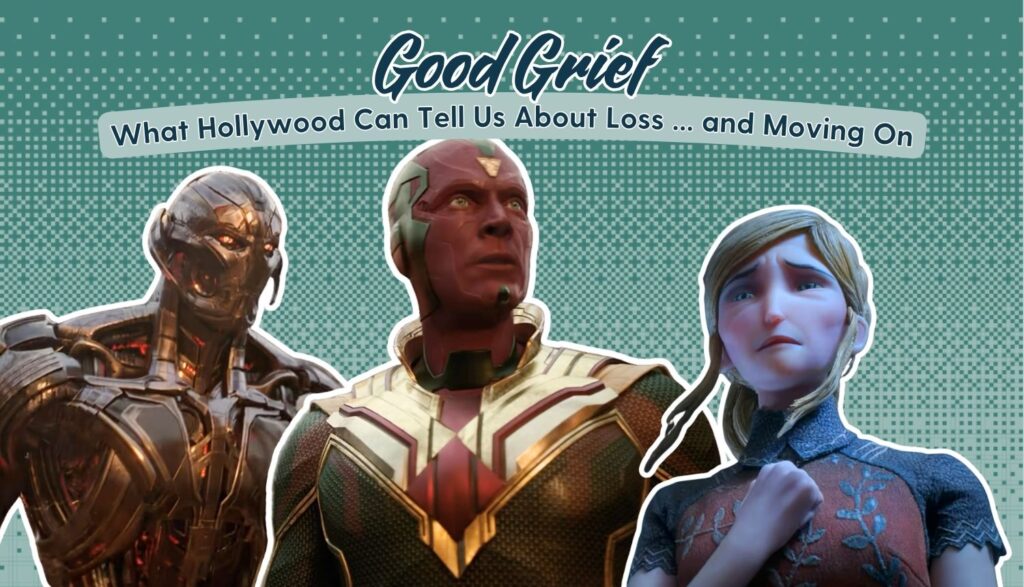
Everyone suffers from loss. Even if a person is not, strictly speaking, real.
In VisionQuest, we’ve watched as both the artificial intelligence construct Vision and his evil mentor, Ultron, struggle with what it means to lose a loved one. In Wildwood, the movie’s main villain isn’t so much evil as she is just very, very sad about the death of her son—and willing to do whatever she can to bring him back. Even in the R-rated Godzilla Minus Zero, a scientist is torn apart by the grief of losing his family. And he’s determined to exact the worst sort of revenge on the people he blames.
Why are stories about grief so popular right now? Perhaps because grief itself is so universal. So powerful. So awful.
And maybe some of us feel that grief as the holidays approach with a special sharpness. Maybe a chair at our Thanksgiving dinner will be empty this year. Maybe a stocking will go unfilled. Maybe, as the New Year turns, we’ll find we’ve lost the one we turn to. And even if that loss happened years or even decades ago, something unexpected can sneak into our lives and remind us: the smell of cookies. A favorite carol. A private joke. And suddenly, we find ourselves overwhelmed again.
Grief isn’t a simple, straightforward process. Sure, we’ve all heard about the five stages of grief—denial, anger, bargaining, depression and acceptance—but I’m not sure if we all just walk through those stages as much as stagger back-and-forth in the midst of them, tripping and stumbling our way toward acceptance.
And sometimes, like the characters mentioned above, we can get stuck in the process. And when that happens, we might not only suffer the loss of someone dear to us, but we might lose ourselves.
[Caution: Spoilers lurk ahead.]
Stuck in the System
Most folks don’t watch superhero shows for their depth. Those shows are supposed to be high-flying adventure stories, not ruminations on the human condition—particularly when some of our central characters aren’t even human.
And yet, the shows in Disney+’s WandaVision trilogy (WandaVision, Agatha All Along and VisionQuest) are as much about grief as they are about saving the world. And all three can be surprisingly poignant.
Wanda and Vision’s romance is one of Marvel Cinematic Universe’s most unusual and affecting relationships. Their time together was brutally extinguished when Thanos ripped an Infinity Stone out of Vision’s forehead, thus killing the living, loving automaton.
In WandaVision, the grieving Wanda can’t get past the denial stage, and she has the power to literally live in denial—well, at least a town made out of that denial. She creates, essentially, a fictional sitcom world where she and a fabricated Vision are living happily ever after … until reality shoves its foot in the door.
Agatha All Along was not the show that WandaVision was, and it certainly had plenty of Plugged In problems. But again, grief forms the show’s plumb line. In the finale, we learn that Agatha (who was a main feature of WandaVision as well) lost her child and got stuck, in a sense, in the bargaining stage of grief. But as was the case with Wanda, Agatha had the magical chops to truly bargain with death, finagling some extra time with her boy, Nicholas. But Death’s hand couldn’t be held forever, and Agatha’s attempts to avoid the grieving process power the series.
VisionQuest is filled with grieving characters. In Episode 7 (released Nov. 3), we meet Phineas Horton. In the wake of his son’s death, Phineas decides to build a new son—one with a heart built of “metal and motion.” But in his obsession to replace his son, he completely shuts out his wife and daughter, and he loses his family’s fortune in the process. While Phineas seems to be struggling through several grief stages, perhaps the most critical is that of depression: Shutting oneself off from everything else to be consumed by grief is a hallmark of this stage.
But the show’s most powerful manifestation of grief comes in the final episode: In VisionQuest’s Nov. 10 finale, Ultron finds the emotional wherewithal to experience grief himself—and he flies straight into the anger stage. That anger comes with some potential, and rather predictable, consequences for humanity. “If this is what they feel [when they’re grieving], then killing them is an act of mercy,” Ultron tells Vision.
I found myself within a forest dark …
In Wildwood—Laika Animation’s dark, much-heralded fantasy film—the film’s antagonist doesn’t get stuck in just one stage of grief: It seems she’s stuck in all of them.
Alexandra, once a wise and gentle ruler of the movie’s magical forest, loses her 12-year-old son in a tragic accident. In her despair, she can’t accept the loss, and she decides to build another son. Like Phineas’ own construct, her creation is a mechanical automaton. But rather than suffuse the construct with artificial intelligence, she uses the darkest of dark magic to infuse her creation with her dead son’s soul.
The resulting construct has no idea that he’s any different from any other boy—until he cuts himself and bleeds oil, not blood. And so he destroys himself as his “mother” desperately tries to stop him.
But Alexandra won’t stop trying to bring her little boy back. She can’t. She decides to take a different tack—one even darker and more horrible. Alexandra’s desire to resurrect the dead moves Wildwood’s story forward, even if the character herself is so tragically, horrifically stuck.
The stages of grief run roughshod across Alexandra’s soul: denial that her son can truly be gone. The anger she feels at the forest for claiming him. The bargains she makes through dark magic. The depression and despair she must feel in every hour. Again, like Phineas, she has isolated herself—exiled from her kingdom and trapped in a prison of her own making. She may be surrounded by coyotes and crows, but they’re hardly friends: They’re tools, one of many she uses to try and get her son back.
Finding That Last Stage
Alexandra never accepts that her son is well and truly gone. She is so consumed by her grief that she can’t find a way out of it. As such, Wildwood is, on many levels, a tragedy: The story’s villain didn’t have to be a villain. If she could’ve found a way out of her own despair, Alexandra might’ve become its hero. Wildwood is a powerful examination of grief and how it can sometimes destroy us.
VisionQuest gives us a more hopeful, if bittersweet, outlook, as its characters imperfectly make their way toward grief’s last stage—that of acceptance.
In the final episode of WandaVision, the show’s version of Vision tells Wanda, “What is grief if not love persevering?” It’s a lovely little statement, and it helps Wanda accept (for the moment) Vision’s death.
That same statement is called out as a lie in VisionQuest.
“Grief isn’t love,” Ultron says. “It’s fear.”
And so it can be, at least in part. Fear of being alone. Fear that, without your loved one, you’re a lesser person. An unheeded, unworthy, misunderstood, lost soul.
Vision acknowledges that all of that can be a part of grief, too. And he’s right. Grief, like everything we feel deeply, is a complex stew of emotions. Toss Inside Out’semotional characters into that stew and each will have plenty to do—fear, repulsion, anger, sadness, joy.
Yes, even, ultimately, joy.
When I think about the people I’ve lost in my life, I often feel that most of all: joy. Joy of having known them. Joy of having loved them—and being loved by them. The joy of knowing that, one day, we may meet again.
The pain of the loss is still there, of course; it’ll never go away completely. I miss many people, and I still feel that vacancy at unexpected times. I regret how many conversations went unsaid, how many experiences went untried. But the gratitude, and joy, is there, too.
VisionQuest acknowledges that bittersweet sense of joy, framing it in its own melancholy pastiche.
“Love always leads to loss,” Vision tells Ultron. “Someone will change. Someone will leave. And someone will die.”
But for Christians, there’s a greater hope to consider. Yes, love always leads to loss. But that loss need not be permanent. Those who leave us may be found again. Those who die may live again.
I think a lot of skeptics and unbelievers would read that and have their doubts. Pollyannish, they might say. Perhaps even Vision would smile sadly at such a belief: “A thing isn’t beautiful because it lasts,” as he once said.
But if anyone knows about the impermanence of death, it’d be Vision. He—like ever so many superhero characters—is and was and is again.
In many a movie or television show, Hollywood reminds us that there is life after loss. Grief can nearly crush us, but there’s hope beyond its teeth if we can just hold on and, slowly, move forward. But those shows rarely tell us about the greatest hope of all—that while things invariably change and leave and die, death need not be the end.
A thing isn’t beautiful because it lasts. That is true enough. But some beautiful things do last. They last forever. And one day, grief will unfurl into a joy beyond imagining.

Recent Comments