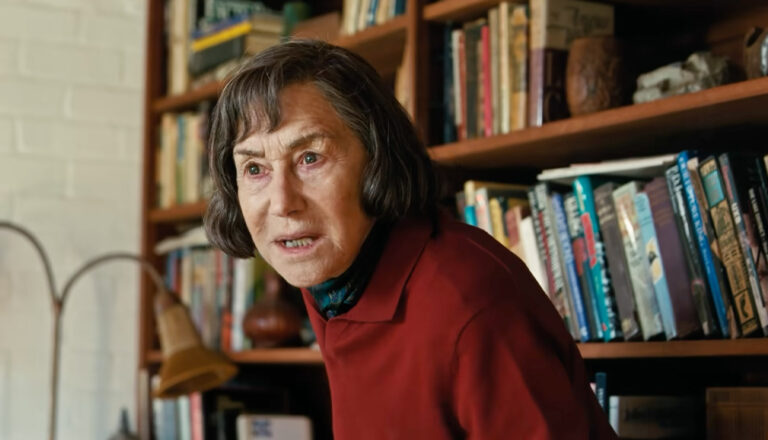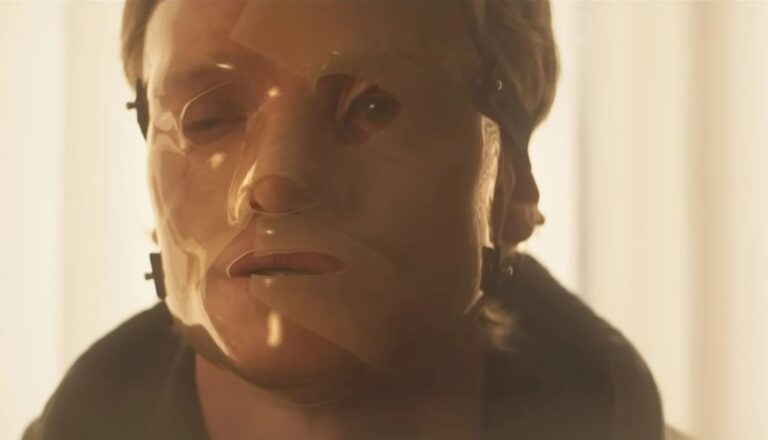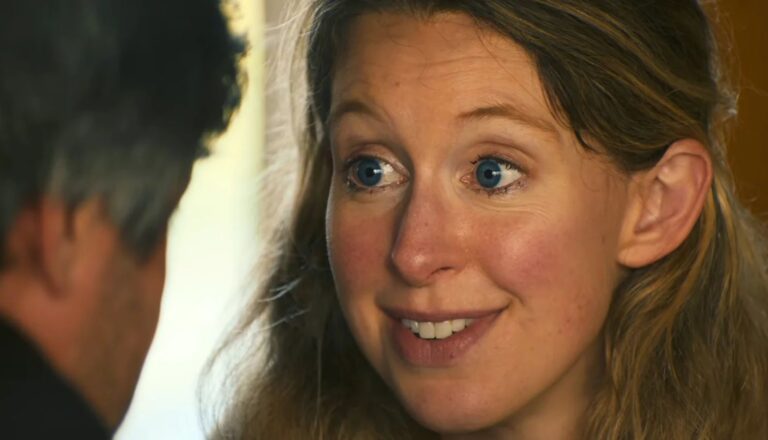


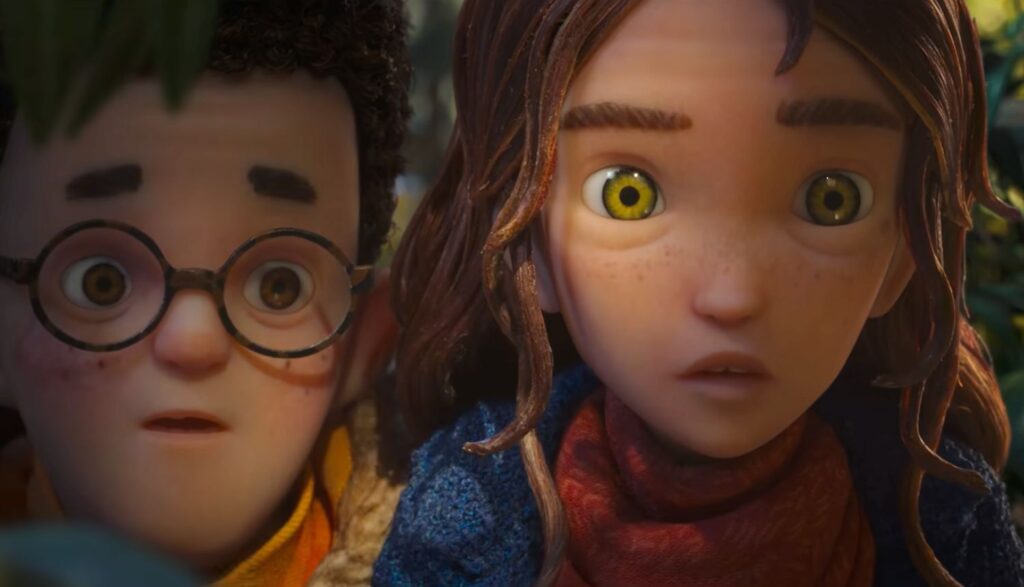
After her brother is abducted by crows, a teen girl dives into a forbidden forest outside Portland to find him. But she—and moviegoers—will find plenty of peril inside these woods, including murky spirituality, amplified levels of violence and an allusion or two to LGBT relationships.
Gone.
He balanced on the balcony, vulnerable and naked in the night air. He tore into his chest and ripped a gear from place. He took a step as his mother watched—rushing to save the little boy she’d made.
But too late. Too broken. Too gone.
The mother, Alexandra—the dowager governess, as she’s known—was banished for this ill-wrought work: this boy who was twice dead, a boy who should’ve never lived at all. The gear-powered doppelgänger was a duplicate of the real son she lost so long ago, a boy who fell into the forest and was swallowed up forever.
But banishment or no, Alexandra’s grief remains unbowed. She will replace her son again, one way or another. Even if it means uprooting every inch of the magical forest in which she lives and destroying those that live there.
And what do the residents of Portland, Oregon, think of this drama taking place in the forest just across the St. Johns Bridge? Nothing. Absolutely nothing.
Such is the way with magical realms: They hide, lurking behind wardrobe doors, buried in rabbit holes, accessed via strange train platforms at King’s Cross. Magic is the key to enter them. And Portland is an unmagical place.
So believes Prue McKeel, a young teen living with her unremarkable family—Mom, Dad and her baby brother, Mac. The McKeels conduct their lives as most Portland residents might: They work and go to school; presumably, they might pour organic milk over their granola or wear homemade hats made with naturally dyed yarn. Magic? Prue’s never seen it and doesn’t believe in it—no matter how many creepy bedtime stories her father spins.
Granted, Prue’s parents seem suspiciously eager to keep Prue away from the forest and to keep Mac locked inside for, oh, the rest of his life. And when Mom and Dad announce they’re going to a craft fair tomorrow, they exact a promise that, under no condition, will Prue take her baby brother outside.
Naturally, Prue takes her baby brother outside.
The McKeels can’t keep the kid locked away forever, right? So Prue reasons. It’s not the first time she’s taken Mac to a nearby school park to waddle around in the dirt. When her geeky classmate, Curtis, shows up, he proves to be unwelcome company. But Prue’s too polite to shoo him away.
But as Curtis prattles on about his latest role-playing game, a crow alights on a jungle gym. Another joins. And another.
Soon, the playground is covered with birds, all black of feather and beady of eye. And those beady eyes are fixed on … Mac.
Prue lunges for her baby brother, but it’s too late. The crows sweep him up and carry him east, where the bridge looms. Prue hops on her bike and peddles like mad, accidentally knocking Curtis into the red wagon it tows behind. They careen down hillsides, over boulders, across the bridge—following the cloud of crows. But to no avail. The crows flew too far, too fast, and they disappear into the forest. Mac is nowhere to be found.
Gone.
But Prue’s not done with her pursuit. Somehow, she and Curtis burst through the magical membrane separating Alexandra’s forest from Prue’s Portland, and Prue is determined to find her brother, no matter the cost.
That pursuit forms the spine of Wildwood, and Prue exhibits incredible reservoirs of courage and creativity as she tries to rescue her brother.
Curtis is not so brave. But when he discovers where Mac is being kept, Curtis is determined to help reunite him with Prue, risking his own life and well-being to do so.
Plenty of other folks in the forest help Prue on her quest, which is inextricably entwined with forest-based tensions. Though Prue is clearly an outsider, she’s helped by the forest’s avian faction—most especially a wise old owl and gigantic eagle general. (Both sacrifice a great deal to help her.) Other allies swing into view, too. And while these allies all have their own axes to grind against Alexandra and her followers, they still risk and sometimes sacrifice their lives to help Prue find Mac.
Finally, we should note that while Alexandra is definitely the bad guy here, the story is not without sympathy for her. It seems that, once upon a time, she and her husband essentially ruled the forest—and ruled it wisely and gently. Wildwood serves as a profound rumination on how loss and grief can twist us, turning us into something nearly unrecognizable. It’s a cautionary story, in a way, about the importance of grieving well … and moving on.
[This section contains spoilers.]
Let’s begin with the obvious: Wildwood has plenty of magic about it. It takes place in a magical realm filled with magical creatures. Animals walk and talk and wear clothes. Druids try to talk with wise old trees. And the only way to get into this forest is by having a whiff of magic about you—or be with somebody else who does.
But for all that, Wildwood is not filled with casual magic, where people go around waving wands and casting spells at the least provocation. In fact, most of the good guys here don’t really use magic at all (even if they happen to be talking bears). The film draws a strong line between the land’s inherent magical properties and the dark magic that Alexandra engages in. (We’re told that there is “good magic in the world, and there is its shadow.”)
We’re told that Alexandra turned to that magic—the blackest sort of magic—in grief after she lost her 12-year-old son, Alexei. While the boy’s replacement was largely mechanical, it was infused with the soul of Alexei himself (drawn from a baby tooth that Alexei lost and handed to his mother when he was, it seems, too old to believe in the Tooth Fairy anymore). Someone says that Alexandra learned these magical secrets from a “dark convent,” and her exile was based on her trial and conviction as a witch.
Alexandra’s new plan is even darker: She hopes to sacrifice Mac (with a special sacrificial knife) in order to awake the forest’s slumbering, destructive ivy (which covered Alexei’s body and made it impossible to recover) and force that ivy to cough up her son’s remains—presumably so she can create another facsimile.
But Mac is not just some random kid. (This gets into some very spoilery territory, so proceed with all due caution.) Before Prue was born, the McKeels struggled to have children. The granola-style McKeels say they tried “everything,” including acupuncture and even “Western doctors.” In desperation, Mrs. McKeel (with Mr. McKeel in tow) visits a witch, whose tent includes suspended bones and arcane symbols. (“Those are satanic symbols,” Mr. McKeel says, though it’s hard to know whether he would know such a symbol if he saw one.)
The witch asks the McKeels how far they’re willing to go. “Whatever it takes,” Mrs. McKeel says. The witch gives them a bell, which summons Alexandra. And Alexandra tells them that she can give them a child—with a catch.
“The first child is yours to raise and hold and cherish,” Alexandra says, touching the woman’s abdomen. “But the second child belongs to me.”
All this illustrates just how Prue was able to get into this magical realm: She was the product of a magical spell. She has powers imbued in her very blood. When she cuts a finger, some of that blood inadvertently nurses a houseplant back to health, for instance, and it can seriously impact other plants as well.
Prue, in spite of the evidence, professes a skepticism toward magic throughout much of the movie. “I don’t believe in magic,” she tells an owl in a waistcoat. (The owl comments on her illogical incredulity.) When Prue’s father tells a scary story about the forest beyond Portland, the characters of his story are shown with glowing red eyes.
When Prue hears about “mystics” in the woods, she asks, “Are they hippies?” Someone explains that they commune with an ancient tree whose roots connect us all. “Hippies,” Prue decides.
The mechanical doppelgänger in the introduction, meant to resemble a 12-year-old boy, is completely naked during his last moments of life. I don’t think we see any genitals to speak of—his body would more or less resemble a naked Ken doll—but we do see the lifelike automaton from the back, side and front (the latter from a distance). And while the boy’s genitals may be indistinct, his backside is not.
The movie also comes with one, and likely two, nods to LGBT issues. When Prue argues that Mac will need to go outside sometime—perhaps when he gets married—Prue’s father says that Mac’s partner, be it “she, he or they,” can live with them.
When people and animals are set to go off to battle, we see two people kiss. One partner is clearly a man. The other is a bit ambiguous, and my guess is the filmmakers made the person intentionally so, giving this very ancillary character a masculine jaw but long hair done in a bun.
Wildwood’s climax is a frenetic, Lord of the Rings-style battle sequence. Participants are shot, stabbed, bitten and sometimes blown up. While we don’t see any limbs lopped off, or even that much blood, it’s quite obvious that this is war. A number of people and animals—including characters we get to know—die. (One very small character, in fact, is chomped on by a coyote and used as a chew toy.)
This isn’t the war’s first battle, either. Curtis and Alexandra find themselves in a field strewn with bodies—both men and anthropomorphic, uniformed coyotes. When they come across an injured combatant begging for help, Alexandra hands Curtis a sword and demands that he finish the guy off. Curtis refuses, and Alexandra runs him through herself, leading the man to jerk upward and expire.
Alexandra’s doppelgänger son seems to shed a red tear before jumping off a balcony to kill himself. He also slams his fist into his chest, cracking it like a piece of porcelain, and tears out a gear from the mechanism inside.
A character means to sacrifice a baby, and she carries a long sacrificial knife for the purpose. (When the baby tries to play with it, the would-be killer coos and tells him that it’s “mommy’s sacrificial knife.”) A bird is shot down and killed by an arrow. Another bird is essentially vaporized. Someone is skewered and killed by plant roots. When characters are arrested, it’s insinuated that physical abuse and execution may be on the table. A rat tells Curtis that she knew he was an outsider: “You didn’t try to eat me, for one thing,” she says by way of evidence. Prue is nearly killed several times. When captured by another woodland faction, she’s told that she is being detained against her will, “and you may or may not be roughed up a little if you resist.” We learn that Alexandra’s real son died after falling from a cliff. We see his body soon covered with ivy.
Prue cuts her hand, and her blood accidentally drips on a wan houseplant in her room. The houseplant revives from the bloody sustenance. Prue suffers another, bigger wound later. The doppelgänger cuts his own finger. And when he bleeds oil rather than blood, he knows that he’s not a real boy.
We see the gray corpse of Alexandra’s husband. Someone perishes while trying to kill someone else—and the character’s blood splashes across another character’s face. Several prisoners, hanging from suspended cages, are shot via rifles. (When some prisoners try to escape, they risk their lives from the fall on the stalagmites below.) Prue and Curtis are almost hit by a train.
One use of the word “b–ch” and another of “h—.” God’s name is misused about eight times.
A maid brings some tea to a captive Prue, along with a powder that the maid says will help Prue sleep. But, the maid cautions, Prue shouldn’t use too much of it. Prue doesn’t use the sleeping agent, but she later sneaks it into the tea of a couple of other characters.
The anthropomorphic animals we see here still retain plenty of their innate animal instincts. An officer in Alexandra’s uniformed coyote army scolds one of his “men” for urinating on the firewood, for instance. “Don’t deny it!” he says, adding that soldiers should be above “piddling all over base camp!” He’s very disappointed when he runs across another soldier licking his privates.
A rat scuttles in and partially eats a prisoner’s soup, offering to share it. There’s a reference to shoplifting. This magical land seems to be poorly run, judging by the number of bandits we meet and impoverished people we see on the streets.
The real story of Wildwood does not begin with the doppelgänger of a 12-year-old boy. It begins in 2011, when Colin Meloy—frontman for the Portland-based indie group The Decemberists—published a book with his wife and illustrator, Carson Ellis. The book, Wildwood, carries its fantasy influences on its literary sleeves, offering nods to The Chronicles of Narnia, Alice’s Adventures in Wonderland and Maurice Sendak’s Outside Over There, among many, many others. It embraced the vibe of Meloy and Ellis’ native Portland and set the tale in the real-life forest across the St. Johns Bridge.
Just a week after the book was released, Laika—the studio behind such movies as Coraline, The Boxtrolls and Kubo and the Two Strings—optioned the title. The resulting movie is the longest stop-motion movie in history and the most complex stop-motion film that Laika’s ever done.
And it shows.
Wildwood is a beautiful and brilliant piece of cinematic artistry. Sporting an all-star voice cast (including Oscar winner Mahershala Ali as the Bandit King and Oscar nominees Carey Mulligan and Angela Bassett as Alexandra and the General, respectively), the film gives us an intriguing story powerfully and poignantly told, and it fills itself with color, warmth and humor. Everything that Laika has done has snagged an Oscar nomination for Best Animated Feature—though its films have never won one. My bet is on Wildwood to be the first.
But while Wildwood has plenty of merits, parents will find reasons not to watch, too.
First up, the film’s inescapable darkness.
Alexandra (certainly inspired by C.S. Lewis’ the White Witch from The Lion, the Witch and the Wardrobe) uses the darkest of dark magic to achieve her ends, and this magic is presented as dark indeed. Peril lurks from every corner, and it’s clear that this fantasy—though made for children—doesn’t pull its punches when it comes to blood, violence and death. The fact that it opens with the apparent suicide of a naked 12-year-old boy will be a deal killer for many families.
If moms and dads can get past both the film’s spiritual issues and its violence, they must still navigate some peripheral LGBT content, a bit of mild language and a touch of crude humor.
The Wildwood movie, like its forest namesake, is both a beautiful and perilous journey, one that comes with some deeply satisfying rewards and inescapable concerns. At the outset, Prue’s father warns Prue to never set foot in this frightening forest. And, with reason, some real-world parents will do the same.

Paul Asay has been part of the Plugged In staff since 2007, watching and reviewing roughly 15 quintillion movies and television shows. He’s written for a number of other publications, too, including Time, The Washington Post and Christianity Today. The author of several books, Paul loves to find spirituality in unexpected places, including popular entertainment, and he loves all things superhero. His vices include James Bond films, Mountain Dew and terrible B-grade movies. He’s married, has two children and a neurotic dog, runs marathons on occasion and hopes to someday own his own tuxedo. Feel free to follow him on Twitter @AsayPaul.