

About a month before going to prison, tech tycoon Elizabeth Holmes invites a documentary crew into her house. Though a brilliant film, You Can See Everything comes with plenty of content issues, including genital exposure, lots of foul language and some very questionable behavior.
Elizabeth Holmes did nothing wrong.
She’ll tell you so if you ask. Her inventions could revolutionize health care, she’ll say. Her company, Theranos, was built on rock-solid science. She never intentionally misled anyone.
And yet here she is, 34 days away from a prison sentence for fraud.
She and her boyfriend, Billy Evans, have 34 days to set the record straight. What better way than to welcome filmmaker Nathan Fielder into their home? To give him unfettered access to their lives, their thoughts, their fears?
They promise Nathan a free hand—no pressure to create a bit of propaganda or gentle puff piece. He can tell the story as he sees fit. He can go anywhere, film anything. Well, mostly.
They’re confident that Nathan will find that Elizabeth is no monster, but a mother. A bright, conscientious entrepreneur. A woman you wouldn’t mind having coffee with.
And perhaps that’s who Nathan will find.
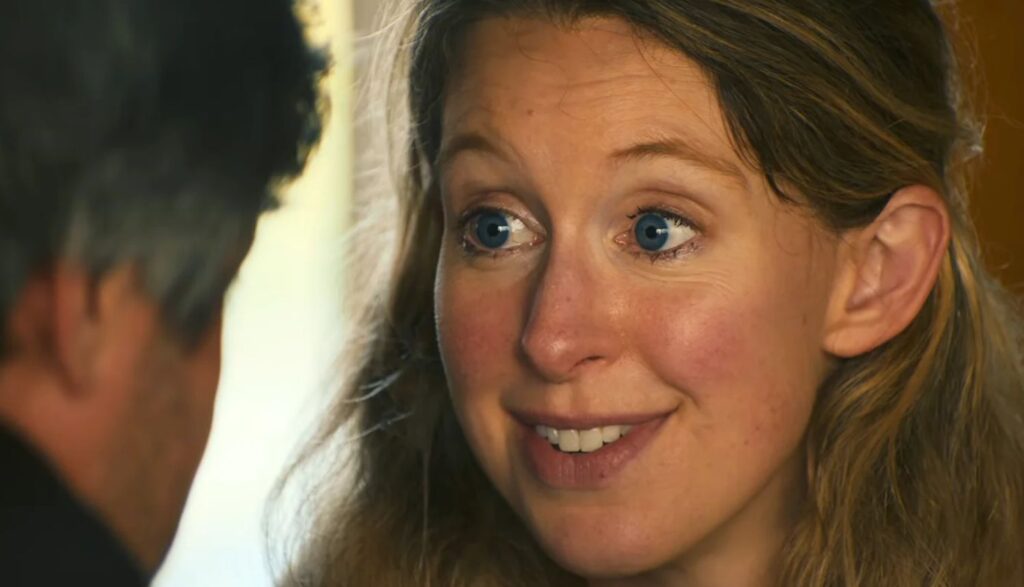
Or perhaps he’ll see a woman whose wide eyes and ever-present smile hide something more difficult. Perhaps he’ll find a liar, a cheat, a fraud.
Or perhaps he’ll find both. Or neither. Or something entirely other—neither hot nor cold, neither 1 nor 0.
Blood—the heart of Theranos’ work and Elizabeth’s aspirations—can say so much. It can tell you about your life, your genetics, your sicknesses, your medical predispositions. It does not lie. It does not mislead. It tells, always, the truth—if you ask it the right questions.
But throw some flesh and muscle around that blood, and things become more complicated. We’re creatures of haze, sojourners of ambiguity. Our truths can reveal the lies at our core. Our lies can unveil the truth. We’re consistent in our inconsistencies, stubborn in our whims.
Elizabeth Holmes welcomed cameras into her house to show the “real” Elizabeth Holmes. But sometimes the more we see what’s real in our own lives, the more reality seems riddled by inconsistencies; pocked by vagaries, half-told truths and deeply held lies, most especially the lies we tell ourselves.
Who is Elizabeth Holmes? This documentary seeks to answer that question. But in so doing, it asks more, and more, and more.
For all that Elizabeth Holmes may or may not be, she’s a conscientious mother. We see her attending to her children often, and she seems devoted to both. She says the most painful thing about the thought of being sent to prison is losing times with her “babies.”
And indeed, the documentary does an effective job of humanizing a number of the people it brings into its fold—not just Elizabeth, but her parents and some other players in this curious drama.
But above all, You Can See Everything is determined to uncover truth—and that’s more difficult than you’d imagine. Nathan (whose co-director, Lance Oppenheim, stays clear of the public eye) asks probing and sometimes confrontational questions, even as he shows moments of kindness and humanity to his subject. He rigorously defends his right to tell the truth as he uncovers it—and yet even as Nathan questions how truthful his subjects are, he encourages us to consider himself, too. Is our fact-finding director as unbiased as he believes? As he should be?
Billy suggests that he and Elizabeth’s love is the sort of love usually reserved for the “gods.”
Nathan’s cameras indeed go into some pretty unexpected places—including a bathroom where Elizabeth’s boyfriend, Billy Evans, is taking a shower. The stationary camera captures an extensive scene of Billy from the side, his genitals clearly exposed, as he brushes his teeth in the shower.
The day before Elizabeth is to go to jail, Nathan offers to take his cameras off the premises so that Billy and Elizabeth can have some, um, quality time together. He clarifies what, in his mind, “quality time” means: sex. Nathan (who’s known for his awkward on-camera persona) films himself waiting in his car for Billy and Elizabeth to reappear, and he makes a couple of awkward comments (“how was it?”) when they do.
Later, when Elizabeth is in prison, Nathan interviews Billy and asks about conjugal visits. Billy says there have been none, noting the time he’s been celibate since Elizabeth went away. He later quips that he does masturbate, name-checking a celebrity that, at least for the cameras, he admits to fantasizing about. Billy brags about his sexual prowess, as well. And he doesn’t quite know how to respond when a woman tells him that she’s lied to every sexual partner she’s ever had about how “good” that partner was. (She suggests that Elizabeth might be lying to him, too.)
Billy believes that Elizabeth is wildly in love with, and almost awestruck by, him—telling Nathan that their relationship is really about building “monuments of love” to each other (a quote that Elizabeth herself allegedly repeats later on). He says that the two are so well matched that, when Elizabeth’s in prison, he doesn’t feel the need to run company decisions by her or even speak in her name on social media: He simply knows what would be all right with her.
We hear about Elizabeth’s previous boyfriend, the Pakistani-born entrepreneur Ramesh “Sunny” Balwani. Though 19 years older than Elizabeth, the two were together for more than a decade, becoming business, as well as romantic, partners. (The same could be said for Billy and Elizabeth, too.) We see only a short real-life clip of Sunny, but we are treated to a longer, fictional scene from Hulu’s The Dropout (which stars Amanda Seyfried and gives viewers a fictional take on Elizabeth Holmes’ rise and fall), where Sunny (played by Naveen Andrews) encourages Holmes to look “sexy” for potential investors. But, he cautions as he buttons her shirt closer to her neck, she shouldn’t be too sexy, lest she not be taken seriously.
We see some women in alluring outfits, and a promoter shoots a video ostensibly in support of Elizabeth in a strip club (a fact that Nathan returns to again and again when questioning Billy on the wisdom of this decision).
We hear from Elizabeth’s father that Elizabeth was raped. Billy talks about how he carries a gun with him at all times, and he says that his heart is filled with a desire to take vengeance on those who’ve wronged he and Elizabeth.
“I know people who can do just about anything,” he tells someone threateningly. Billy also notes that if someone kills him, he has some safeguards in place to release a lot of revelatory information.
A shady promoter concocts a skit wherein a character playing Elizabeth is kidnapped and threatened.
We hear about 45 f-words and about a dozen s-words. We never hear Elizabeth herself use that sort of language, but when she’s imprisoned, Billy—who has control of Elizabeth’s social media accounts—swears often when masquerading as his girlfriend. We also hear about a half-dozen misuses of God’s name.
Characters drink wine with meals.
Obviously, Elizabeth Holmes’ honesty (or lack thereof) lies at the heart of You Can See Everything. Elizabeth claims that she’s never knowingly lied in her life (admitting that maybe she had when she was a “kid”), and Billy insists that she’s probably right—which, of course, might be a whopper of a lie itself. Nathan and others are bedeviled by this issue throughout the documentary, trying to suss out whether this otherwise very smart businesswoman is truly as guileless as she claims, or whether she just might be one of history’s most effective con artists.
Billy’s own conduct is under sharp focus, too. He does lie—the doc catches him in at least one bald-faced one. And while he and Elizabeth promised Nathan they’d keep their hands off the documentary, Billy does his best to cut off interviews, cut down the length of interviews and restrict Nathan’s access to Elizabeth at times. He comes across as incredibly controlling, and some speculate whether his relationship with Elizabeth is particularly healthy, with one person in the documentary wondering aloud if Elizabeth might suffer from something akin to “Stockholm Syndrome.” (“No woman wants to see another woman be controlled by that type of guy,” someone tells Nathan.)
Before Elizabeth leaves for prison, the two create a 3-D replication of her face and body and clone her voice so that she can still produce videos and—under Billy’s supervision—market what they hope will be Theranos 2.0 while she’s imprisoned. At times, Billy seems to use Elizabeth’s name and notoriety as a tool for his own enrichment. (The film asks whether Elizabeth might be unaware of Billy’s schemes, or whether she’s fully aware and is using Billy to keep her hands clean).
A horse lets out some gas. As a gag gift before her incarceration, Nathan gets Elizabeth some sunglasses and hair dye in case she wants to escape.
Our biggest decisions may define us. But it’s perhaps our small actions that tell the most about us.
The genius of You Can See Everything lies in those little actions: When Billy takes a bowl of eggs out of Elizabeth’s hands because she’s not whipping the eggs vigorously enough. When Elizabeth literally can’t understand the humor behind Abbot and Costello’s famous “Who’s on First?” sketch. When Nathan and Elizabeth, on the brink of goodbye, stare at each other for what seems like an incredibly awkward eternity, neither quite knowing how to cut things off—and, perhaps, not really wanting to.
You Can See Everything goes beyond an exploration of Elizabeth Holmes. Like a child prodding a beached jellyfish with a stick, it pokes at Billy Evans. At Nathan Fielder. At Amanda Seyfried and her portrayal of Elizabeth. At ourselves.
This is not a movie just about an incarcerated, scandal-ridden tech figure. This is a movie about truth itself, and about the lies we tell ourselves and each other.
And that’s what makes the film brilliant.
But the film is, of course, deeply problematic as well. A completely unnecessary nude scene mars the look of the film. A bevy of harsh profanities sully its sound. While few kids or teens will be that interested in seeing a three-hour documentary on a medical business scandal, parents should be mindful of these, and myriad other problems, for those that are.
In most documentaries, the movie’s makers try to slip out of sight as much as possible and cede the stage to their subjects. Here, Nathan Fielder becomes a part of the documentary he’s making, his objectivity slipping like a carnival mask. But that’s part of the point he’s making. When we see everything, we sometimes understand less.

Paul Asay has been part of the Plugged In staff since 2007, watching and reviewing roughly 15 quintillion movies and television shows. He’s written for a number of other publications, too, including Time, The Washington Post and Christianity Today. The author of several books, Paul loves to find spirituality in unexpected places, including popular entertainment, and he loves all things superhero. His vices include James Bond films, Mountain Dew and terrible B-grade movies. He’s married, has two children and a neurotic dog, runs marathons on occasion and hopes to someday own his own tuxedo. Feel free to follow him on Twitter @AsayPaul.