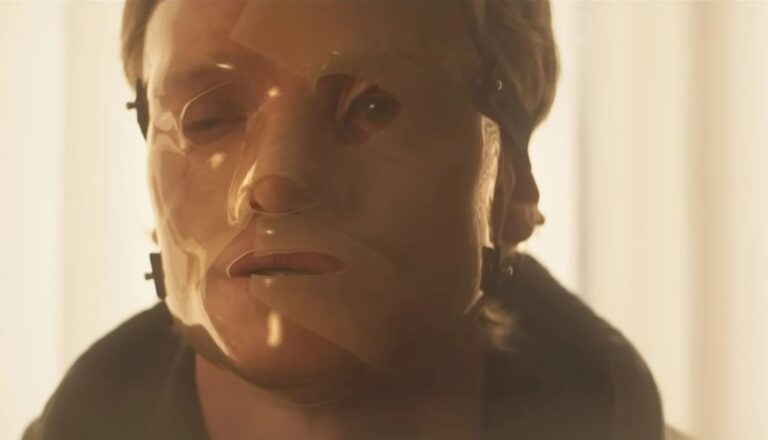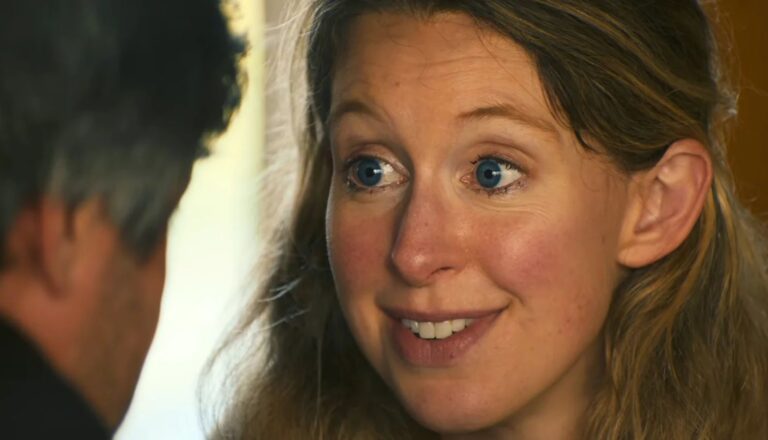


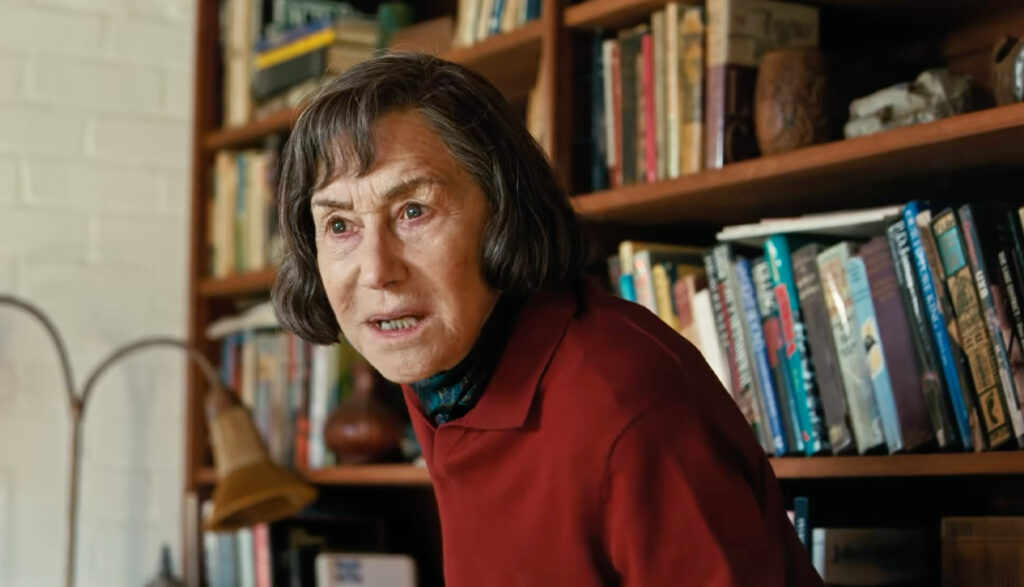
A publishing house editor attempts to convince Patricia Highsmith to write one more bestseller. There is an interesting twist to be found in this glacially slow-paced yet well-acted film. But it comes with bloody murder, heated sensuality and profanity in its story-building mix.
Edward Ridgeway is an assistant editor from a notable publishing house. It’s a good job, but Edward wants more. He’s been told that if he can succeed at his current assignment, a promotion may be on the horizon. But it won’t be easy.
In fact, the last man who accepted this task never came back. There are rumors that he was found running through the frigid Swiss streets dressed in nothing but his pajamas. Some locals suggested that he had gone quite mad—though they tended to chalk it up to his being an American. “You Americans are a little crazy,” Edward’s cab driver dryly notes.
But Edward isn’t concerned with his predecessor or why he disappeared, he’s only focused on using whatever tools he has to get a signature. If he can prompt an aging and cantankerous author by the name of Patricia Highsmith—yes, that Patricia Highsmith—to settle in behind her Smith-Corona and type out one more book, Edward’s own future will be made.
Highsmith has all but disappeared from society, holed away in some sequestered estate in Switzerland. And every attempt to goad her back into action has been wasted breath. It’s not that she’s gone senile with age, mind you. This fire-breathing dragon is as sharp-taloned as she ever was. But she proclaims to be uninterested in writing.
Somewhere in the back of Highsmith’s mind, though, she has to have been contemplating another adventure for her best-selling protagonist, Tom Ripley. All Edward has to do is attempt to jumpstart an idea, sink the Ripley hook in the author’s psyche, and the rest will be kismet.
Edward even believes he might already have an idea for Highsmith: He met a beautiful young woman on the last leg of his journey. She sat across from him—well-thewed, rich-looking, seductively lovely—on the train journey into town. Perhaps he can use the lustful thoughts that woman stirred in him to spur a story into place. Amoral and libidinous desires were always at the core of Highsmith’s writing, after all.
When Edward arrives at the author’s door, however, he is barely able to get past her front step. She seethes, smokes, growls and makes it clear that he is not wanted here. He only has a few minutes to somehow grab her attention and let him make his case.
What would Ripley do if he were standing here?
Someone falls earnestly in love. But there’s little else to point to in the positive column.
Highsmith proclaims that a number of different people—including Jews and Catholics—are “the dregs of humanity.”
Highsmith states, “I don’t believe in evil.” She adds, “We all have a dark side, Mr. Ridgeway. One day you’ll be looking in the mirror, and there he’ll be: the devil smiling back at you.”
Two people examine frescoes depicting a “battle between virtues and sins.” A wedding takes place in a church decorated with paintings and stained-glass windows of various saints.
Highsmith makes sexually tinged statements on occasion. For instance, she keeps a tank filled with hundreds of snails and talks about their “hermaphrodite” sexuality. “We could do away with lots of tedious seduction if we were more like snails,” the author declares. She uses sexual slurs to chide Edward about his sexuality: “Whether you know it or not, Mr. Ridgeway, you like men.” She then crudely talks about the authentic physical reaction that happens when women are attracted to “real” men. Another woman talks about her own college dissertation focusing on homoeroticism in ancient art. She then opines that our 20th century views of that sexuality may have just been a misinterpretation of 16th century norms.
A story that Highsmith and Edward begin to weave depicts a man targeting and stalking an attractive woman. He systematically seduces his target, and they kiss passionately. Then the two have sex against an alley wall. (We see the couple breathing hard and pressing against each other. The camera closes in on the woman’s raised leg and bared thigh.) A woman welcomes a late-night male intruder into her bed, and the two have sex. (She’s dressed in a silky, somewhat revealing, nightgown. And again, the camera presses in on her exposed bare thigh as the clothed man moves on top of her.)
We see Edward standing bare-chested and wrapped in a towel after taking a shower. We’re shown a painting featuring women with bared breasts. There’s also a statue of a semi-naked woman that the camera sweeps past.
Edward tells someone that Highsmith’s collection of weapons is her “pornography.”
Highsmith displays various deadly weapons on a wall in her study. Edward adds a shiny new knife to that collection.
Edward wakes from sleep to find a small cut on his neck. And he slips out into the dark, he finds Highsmith holding a large knife and chuckling. A man breaks into a woman’s room holding a knife. But he puts the knife on an end table after being welcomed in for a sexual tryst.
We are shown the murders of several people throughout the course of a story, all of whom are stabbed or impaled. The scenes feature the squelching sound of the puncturing blades. One of the murders takes time for the camera to closely look at a large knife protruding from the victim’s abdomen and the large pool of gore that results as the victim dies.
Someone tells the story of how he sabotaged his parents’ car when he was a child, leading to both of their deaths in a car accident. Someone claims that Highsmith poisoned a neighbor’s dog. Edward finds a shelf full of jars and bottles of various poisons in Highsmith’s pantry. And then, after the author unexpectedly fixes him breakfast, he discovers a container of arsenic on her kitchen counter.
Highsmith reveals that her mother tried to abort her with drain cleaner.
There are five f-words scattered throughout the dialogue, along with a few uses each of the words “b–tard,” “h—” and “b–ch.” God’s name and Jesus’ name are collectively misused a total of five times (three of those blend God’s name with “d–n”).
Highsmith nearly always has a lit cigarette in her hand that she puffs on regularly. She often pours and drinks glasses of scotch as well. (She is visibly drunk in one scene.) We see other people smoking and drinking beer, champagne and a variety of mixed drinks at several venues. (One such cocktail is surreptitiously laced with a sedative.)
Highsmith openly declares her pronounced prejudices against various races and creeds.
Highsmith is drawn into Edward’s history when he mentions his parents’ deaths when he was a child. “Anxiety and misery are energetic forces,” she announces with a smile.
Edward reads a hateful letter from Highsmith’s mother. It speaks of the woman’s unrestrained animosity toward her daughter (which is amplified by the fact that she tried to self-abort her daughter when she was pregnant).
As Edward and Highsmith concoct a story, it features many lies and deceptions.
As a study on the real-world American author Patricia Highsmith and her psychological connection with her most famous villain/protagonist, A Talent for Murder offers up a very interesting premise.
Helen Mirren plays the author with a cigarette smoke-fuming, squinting contempt and a knife-sharp bitterness that instantly makes viewers want to stick around to see what’s going on. And that’s probably a good thing for the film’s creators because everything else in this film moves at a glacial pace until enough of the story’s onionskins are peeled back to reveal the point behind it all.
I’ll warn you: If you’re going into this pic with the thought that you’ll encounter a taut mystery or a heart-thumping thriller, you’ll be distinctly disappointed. In fact, if you know nothing about the real Highsmith’s work or her celebrated, psychopathic literary creation, then this movie will likely leave you scratching your head and wondering what you missed.
A Talent for Murder is that kind of layered and specifically targeted film. If you get it, you’ll get it. If you don’t, you won’t.
All of that said, moviegoers who decide to steel themselves for Mirren’s nicotine-tinged barbs and the movie’s slow reveal will find a film that’s equally thoughtful and bloody, nicely acted but sexually rough-edged, well-structured but profane.
This is not a film that every armchair detective will enjoy.

After spending more than two decades touring, directing, writing and producing for Christian theater and radio (most recently for Adventures in Odyssey, which he still contributes to), Bob joined the Plugged In staff to help us focus more heavily on video games. He is also one of our primary movie reviewers.