


Tony Kiritsis is very angry with Meridian Mortgage. So, naturally, Tony decides to tie the company’s president, Richard Hall, to a shotgun until Meridian gives him what he wants: an apology. Based on a true story, Dead Man’s Wire gets is R-rating primarily for profanity. But you’ll see some cigarette use and threats of violence here as well.
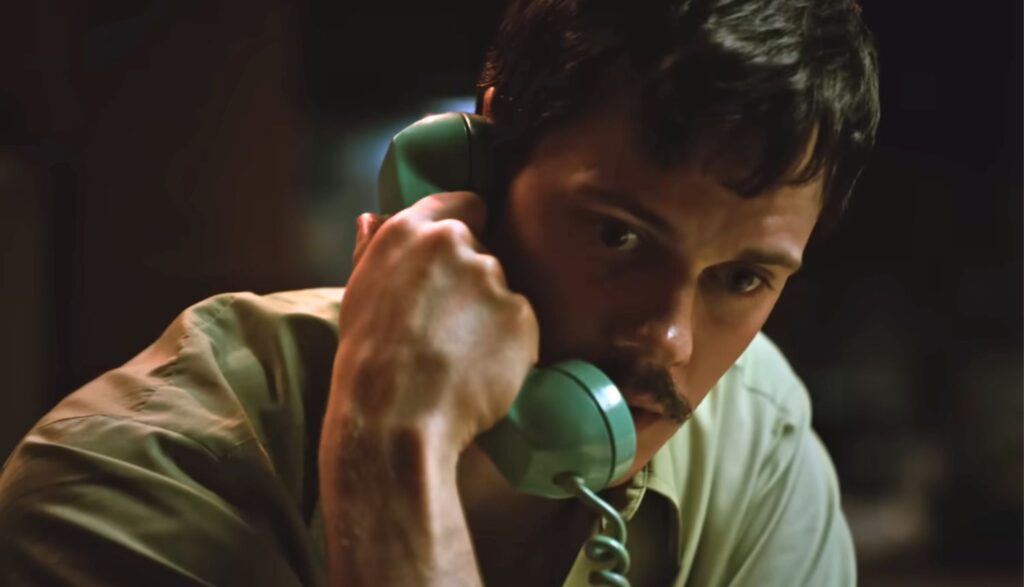
“I’m not a bad fella,” Tony Kiritsis says.
Richard Hall might disagree.
It’s hard to feel too generous toward a man who’s pointing a shotgun at you. More than that, really: Tony has fashioned a mechanism known as a dead man’s wire. One end of the wire is wrapped around Richard’s neck. The other end is around Tony’s. And in the middle, it’s tied to the shotgun trigger, with the barrel of the weapon pointed at the base of Richard’s skull.
“If you faint, stumble or try to run,” Tony tells him, “this will blow your head off.”
But that doesn’t make Tony a “bad fella,” at least in Tony’s estimation. No, the real bad guy in this scenario—according to Tony—is Richard’s father, M.L. Hall. That shotgun should be aimed at him.
About four years ago, around 1973, Tony bought 17 acres of land on the outskirts of his hometown of Indianapolis. He thought it’d be the perfect location for a new shopping center. All he needed to do was get a grocery chain and some retailers to bite.
Tony insists they would’ve. But M.L., head of Meridian Mortgage, wouldn’t let him succeed. M.L. steered prospective tenants to other properties, Tony insists. He’d use any excuse to hike up Tony’s mortgage payments on the property. M.L. wanted to swipe Tony’s land from under him—and send Tony tumbling to the poor house.
It’s not right, Tony says. But you can’t fight M.L.’s deep pockets or battalion of lawyers. For four years, Tony tried; he lost at every turn.
So on Feb. 8, 1977, Tony figures it’s time to do an end around—he’ll bring a shotgun to the negotiation table, one tied to M.L.’s neck. And when M.L. skips town for a conveniently timed vacation to Florida? Well, I guess M.L.’s son will have to do.
I’m not a bad fella, Tony insists. Richard might disagree. But what about the people of Indianapolis itself? Might they find more sympathy for the man behind the gun than the man who’s being threatened by it?
Dead Man’s Wire is based on a true story. And, as can often be the case with true stories featuring complicated people, it’s hard to pick out a “hero” here.
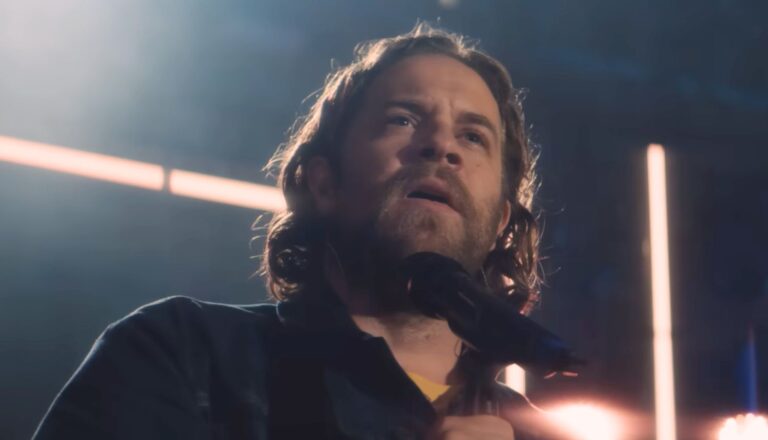
Tony finds an unexpected confidante in Fred Temple, a prominent Indianapolis DJ. Tony calls into Fred’s radio station to broadcast his side of the story. And when Fred talks to law enforcement about the situation, they encourage him to talk with Tony and broadcast the interviews. “Since he refuses to talk to us, are you willing to let him talk to you?” an official asks.
“To keep this poor guy [Richard] safe, I got no choice,” Fred says.
So he lets Tony talk. And while Tony believes that Fred’s in his corner all the way, the DJ remains noncommittal. At one point, he even encourages Tony to let go of his rage. “Holding onto anger is like drinking poison and expecting the other person to die,” he says.
Law enforcement officers themselves balance their sympathy for Tony (whom many of them know personally) with their desire and duty to bring this case to a swift, safe conclusion. Even the movie’s incoming FBI agent (often an antagonist in such movies) tackles the case with skill, professionalism and a certain understanding of the kidnapper.
As for that kidnapper—well, before Feb. 8, 1977, at least—Tony was indeed regarded by most of his friends and neighbors as a pretty decent fella. But even during what turns into a 63-hour standoff, Tony tries to be a decent host to Richard (under the circumstances). He sometimes feels bad for what he’s putting Richard through. And when a crank calls Tony and tells him to shoot Richard already, Tony hangs up, shaken. “There’s some sick, twisted people in this world, Dick,” he says.
When Richard and Tony walk out of the Meridian offices to Richard’s car—the two already tethered together by the wire—they’re stopped by a priest who tells Tony that violence isn’t the answer. The collared cleric then quotes a portion of Psalm 51 to him, suggesting that confessing his sins to God will “wash me, and I will be whiter than snow.”
“Nice try!” Tony says. “It’s Tuesday, not Sunday! Now, get lost!” In an interesting echo, another priest quotes a portion of that same psalm to Richard. (The movie may be suggesting that Richard’s own sins are the more serious of the two.)
When Tony compliments Fred on his “poison” line (noted in the section above), Fred tells him, “I’ve got to credit the Buddha on this one, brother.” Someone tells Fred (during his radio show) that Tony goes to her church. M.L. says that “We Halls are stoic people. Humble, God-fearing people.” Richard prays to God at one point.
Tony’s unmarried, but he insists to Richard that he’s had “no shortage of options.”
“I’ve had my fair shot at love,” he adds. “I’m a h— of a dancer, you know?” And shortly thereafter, he dances in his living room to prove it.
A woman calls into Fred’s show and says, “I’m not saying what he did is OK—but does he have a girlfriend?”
Obviously, Dead Man’s Wire is predicated on what would be an act of horrific violence: The rigged shotgun will kill Richard should he try to run away. And if Tony’s shot down by police, that’ll set the gun off, too. Tony totes around a handgun, too, by way of insurance. He sometimes brandishes it or—while watching Westerns on television—plays cowboy with it. He threatens to shoot Richard on occasion.
Tony has also allegedly rigged his apartment to explode should anyone enter it. (In the trailer, we see Tony working with what appears to be dynamite. In the film itself, we only see the telltale wires and hear Tony’s threats.)
Tony speculates that “radio hosts make good fathers.” They would “talk sense” into their children rather than beating them. It suggests that Tony’s own father may have beaten him—which Tony seems to confirm minutes later, when he tells Richard that his dad would “whup” him whenever he ever danced at home. Without getting specific, Richard says it wasn’t “all sunshine and rainbows” with his father, either.
Tony warns M.L. of the consequences of not admitting Meridian’s wrongdoing. What would M.L. do if the gun went off? Tony asks. “Well, I’ll mourn the loss of one of my sons,” M.L. drawls. “And we’ll all rue the day that you set foot in Meridian Mortgage.”
Law enforcement officials make contingency plans on how to take down Tony should the standoff go badly. (The FBI agent notes that the most humane way to kill Tony would be to shoot him in the back of the head.)
In a dream sequence, Richard (who’s sleeping in Tony’s bathtub) hears gunfire around the apartment, and Tony charges into the bathroom coated in blood. Someone is wrestled to the ground. Clips of old Westerns depict shootings, fights and one sexist paddling (where John Wayne’s character spanks a woman).
Tony apologizes repeatedly for using profanity, but he still uses an awful lot of it. We hear nearly 100 f-words, most of those from Tony himself. About 20 s-words are also used, along with sporadic uses of “a–,” “b–ch,” “d–n,” “h—,” “c-cks-ckers” and “p-ssy.” God’s name is misused about 15 times, most of those with the word “d–n.” Jesus’ name is abused twice.
We should note that Tony calls Richard “Dick,” a usage that Tony clearly means to be derisive at first.
Fred is rarely seen without a cigarette, either in his hand or in his mouth. Other characters, including Tony, smoke as well.
Tony brags that he only had six alcoholic drinks in 1976, and he’s been completely sober in 1977. M.L. sips on what appears to be whiskey as he talks to his son and Tony.
In a postscript, we learn that one of the characters struggled with alcoholism after the movie’s events.
When law enforcement officers discuss how to best kill Tony if the time comes, one runs out of the room to apparently vomit. (The scene quickly cuts to one of Tony spitting mouthwash in his sink.)
While captive, Richard tells Tony that he needs to use the restroom. When Tony asks whether it’s “number one or number two,” Richard refuses to say. “Well, I’m going to find out either way,” Tony says.
Tony asks Richard if he’d like some cologne before the two of them leave the apartment. When Richard says no, Tony tells his captive, “I can smell you from here, pal!”
We hear police referred to as “pigs” in a song.
As mentioned, Dead Man’s Wire is based on a true story. The real Tony Kiritsis spent 10 years in a mental institution following the events of the movie. And the case was allegedly instrumental in making it more difficult for a defendant to use an insanity plea in court.
Director Gus Van Sant’s film does portray Tony as a few marshmallows short of a s’more, a character unhinged by desperation and full of (sometimes charming) contradictions. But it also suggests that Tony’s not just this film’s protagonist, he’s its hero—just as Tony himself hoped he would be.
That seems underlined by the film’s tagline in the trailer: “Every man has his breaking point. Every movement has a beginning.”
Certainly Tony’s mortal enemy, the M.L. Hall we see portrayed in Dead Man’s Wire, is a jerk—and a super-shady jerk at that. And I get that our financial and legal system isn’t always as fair as we’d like it to be.
But it’s a pretty big jump from “bad people sometimes play the system” to “so we should pick up a shotgun and threaten largely innocent folks until we get what we want.”
We’re in an age of extraordinarily angry moviemaking—where it seems as though violence is portrayed as a legitimate conduit for justice. And in contrast to the vigilante-predicated “revenge” flicks of yesteryear (most notably represented, perhaps, by the Charles Bronson-fronted Death Wish franchise), many of these modern screes come with a more progressive tilt—and a critics-pleasing sheen. Dead Man’s Wire boasts Oscar winner Al Pacino, two-time Oscar nominee Colman Domingo and a 94% “freshness” rating on Rotten Tomatoes, suggesting Hollywood’s tastemakers currently have a taste for sticking it to the man.
But whatever your take on Tony’s character, the content issues that surround him are beyond dispute. The film is soaked in profanity from beginning to end, earning the film its R rating. Cigarette smoke blows thick and often. And, of course, the threat of violence—an inescapable part of the story—is just as inescapable onscreen.
Dead Man’s Wire is indeed a well-made movie—as taut and precise as a wire itself. But this movie is tethered to some real problems.

Paul Asay has been part of the Plugged In staff since 2007, watching and reviewing roughly 15 quintillion movies and television shows. He’s written for a number of other publications, too, including Time, The Washington Post and Christianity Today. The author of several books, Paul loves to find spirituality in unexpected places, including popular entertainment, and he loves all things superhero. His vices include James Bond films, Mountain Dew and terrible B-grade movies. He’s married, has two children and a neurotic dog, runs marathons on occasion and hopes to someday own his own tuxedo. Feel free to follow him on Twitter @AsayPaul.