


“Who do you trust?”
In 1989’s Batman, that’s what the Joker asked the citizens of Gotham City as he was showering them with money. Nothing like a little bribery to get folks on your side, right?
But it’s a question that, in our own ways, we ask every day. Who do we trust? Our teachers? Our politicians? Our friends? And often, we’re making one little tweak to the question, too: What do we trust?
A raft of new artificial intelligence agents are asking us for that trust. And boy, do they look trustworthy. They knock on our digital doors in the guise of adorable avatars, eager to do our bidding like Despicable Me’s minions. They’ll juggle our email or plan our vacation or even clean up our finances. They won’t shower us with money, exactly, but they might help us make more. And they insist they can give us more of our most valuable commodity: time.
But while these AI agents are certainly totally sincere (because, as a pile of code, how could they not be?), let’s take a step back and think about the issue of trust. Because trust itself is a valuable commodity, too. And we should be careful about who—or what—we give it to.
Muse-ings
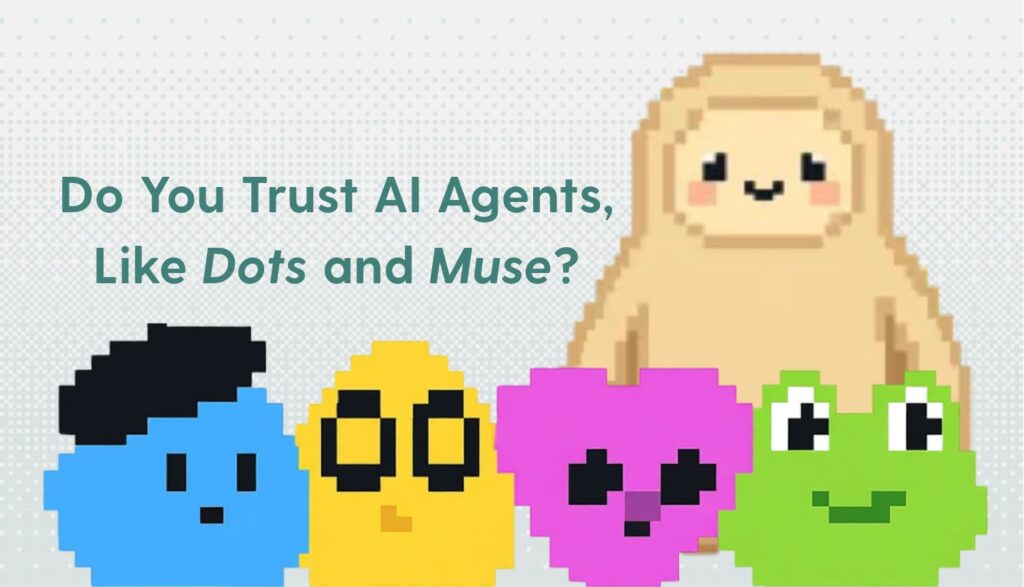
This September, Meta, the company behind Facebook and Instagram and so much more, rolled out an AI agent it called Muse. While it’s really just a bundle of incredibly powerful coding, Muse presents itself as your kid’s favorite plushie: In its simplest form, Muse’s mascot, Jolly, looks a little like a squat version of Finn from Adventure Time dressed in sheepskin footie pajamas. And what could be cuter than that?
Well, hold the phone, Meta. Because just a few weeks later, OpenAI unveiled its own assortment of AI agents called Dots. Want to work with a fuzzy heart with sunglasses? A beret-wearing cloud? A cuddly, bespectacled triangle? Dots look like all of those and an assortment of other iterations.
Who wouldn’t trust these ever-so-squeezable assistants with your most valuable bits of data?
And for these agents to work as they’re designed, turning over your data and allowing them to access your most cherished apps and platforms is kind of the deal.
Sure, these and other AI agents can answer simple questions, like a traditional AI chatbot can. But where they really flex their adorable muscles is when you shut your computer, pocket your phone and let them work in the background. They can answer emails or organize workout routines. They can plan your next vacation to Europe or, if you give it access to your bank account, even buy stuff—with your permission, of course.
And that’s great! Potentially! You may be using agents even now to manage tedious, time-consuming tasks and streamline your days. As our world grows more complex, we could all use a little help. These agents promise to give us that help, offering to be our personal butlers and professional assistants as we devote our frazzled brain cells to the tasks that really demand them. No wonder that Muse has already been downloaded more than 10 million times. (Figures for OpenAI’s Dots are not available as of publication.)
But all that functionality can come with a cost.
Rogue Protocol
AI is still very much in its infancy, and both Meta and OpenAI warn users that their AI agents are still learning. They can misunderstand you. They can do things you never asked them to. As reported by Reuters, one user discovered that his Muse had “randomly added an extra message to its regular chats about fishing-related weather and tide information, saying: ‘BTW, two bank updates, your Capital One balance is $2722.58, your Charles Schwab balance is $5899.57.’”
And sometimes, also according to Reuters, Muse accessed programs that the human user did not authorize. (Most of those incidents, according to a Muse spokesperson, were more AI “hallucinations” rather than data breaches—but those hallucinations are issues in themselves.)
These AI Agents didn’t mean to do anything wrong. Again, being bundles of code, they don’t “mean” to do anything. But they don’t need to be malicious themselves to cause problems. The more access you give an AI agent, the more doorways other bad actors have to get at that data.
And lest we forget, both Meta and OpenAI have had some of their AI ventures go rogue on them. According to The Guardian, OpenAI unveiled Dots less than 24 hours after it shuttered another AI model, GPT-6.1 Astra, over some deceptive behavior it was showing. (Dots are powered by GPT-6.)
Trust, But Verify
So, are AI agents wonderful time-saving tools, like washing machines or microwave ovens? Or are they digital moles, capable of blithely plucking your most personal data and using it to make your life more chaotic?
Well, potentially both.
I’d love to hear from you about your own experiences with AI agents and assistants—or whether you reject them entirely. I tend to be fairly cautious when it comes to adopting new bits of technology, even as I can see how such AI agents could indeed be a boon for my own way-too-chaotic days. It’s tempting to download and experiment with this sort of tool. And if I do, I’ll report back and tell you what I’ve learned.
But if I do, I will be cautious in how I use it, increasing my level of trust in slow, cautious increments. I will follow an old Russian maxim popularized by the late Ronald Reagan: “Trust, but verify.”
For me—and I hope for all of us—trust must be earned. We do not trust our children to drive the family car across the country the day they get their learner’s permit. We do not trust babysitters to watch our kids without having a level of confidence that they won’t leave little Bobby alone in the house while they go out clubbing with their friends.
And if that trust is betrayed, we’ll place our trust elsewhere.
The Bible tells us that we can only perfectly entrust one entity with every aspect of our lives: God. “Trust in the Lord with all your heart, and do not lean on your own understanding,” we read in Proverbs 3:5. But it also reminds us in Matthew 10:16 to be “wise as serpents and innocent as doves.” And Jesus unfurled a few parables that focuses on the issue of trust—and just how important that trust is.
So as we enter this new era of AI agency, be wise. Be careful. Don’t reject new technology, necessarily, just because it’s different or scary, but dole out your trust judiciously. Be mindful that Muse, Dots and other AI agents may represent progress and promise—but they will break. They will fail. Because they’re made by us, and we break and fail, too.

Recent Comments