
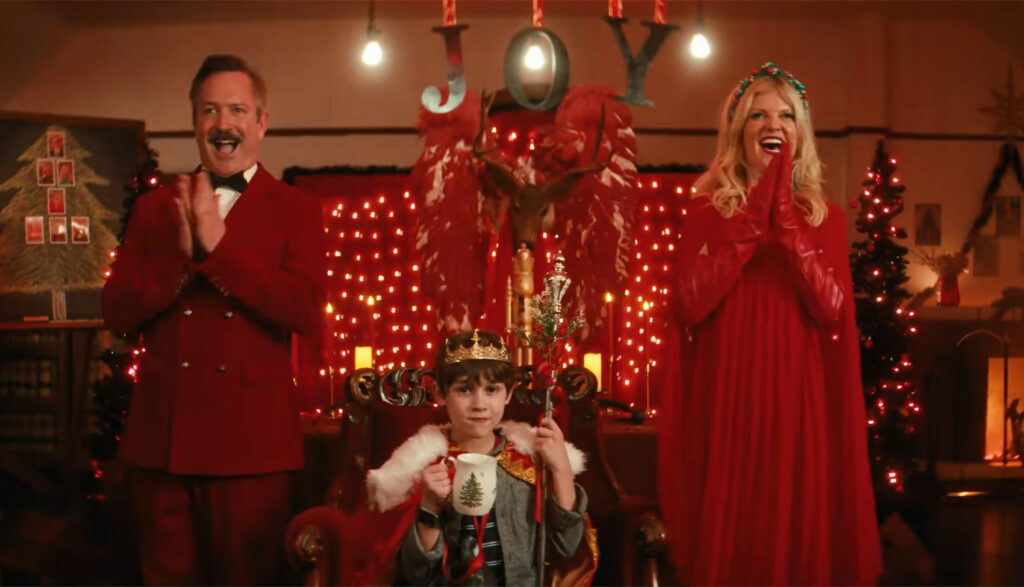
In Christmas at the Kringles, the Seversons could use some honest-to-goodness joy in their lives. The Christmas-obsessed Kringles promise to give it to them—but at what cost? Regardless of the answer, the cost to family viewers of this disaster of a holiday movie is high: It’s bloody, profane and more sexual than you might think.
The Kringles love Christmas.
I don’t mean that they love Christmas like most normal people do. They love it in the way that Galactus loves planets, or Marge Simpson loves hairspray, or a Kardashian loves publicity. For Noel and Carol Kringle and their three kids (Rudolph, Merry and Elf, of course), Christmas isn’t just a holiday: It’s a way of life.
Their front yard is festooned with inflatable Santas in July. Christmas carols are on their lips in April. Ebenezer Scrooge may have promised to “honour Christmas in my heart, and try to keep it all the year” at the end of Charles Dickens’ A Christmas Carol. But for the Kringles, keeping Christmas in their hearts is not enough. They need to disgorge their love of the holiday wherever there’s an exposed bit of grass or countertop. That’s their holly jolly jam.
The rest of the neighborhood is familiar with the Kringles. Oh, yes. They know all about them. But the Seversons are new in town—freshly moved from New York City.
Mark Severson’s not thrilled about the move. He liked Manhattan, what with all its fantastic food and fun entertainment options and neighbors that you’d never, ever need to talk to. The suburbs? Bah, he says. Humbug. And the Seversons’ little boy, Bobby, doesn’t love the change of scenery, either.
But Julie is all for the move. It’ll be great to get away from New York’s hustle and grime. It’s an opportunity for the three of them to reconnect as a family—something that’s sorely needed. And let’s face it: The movers and shakers that Manhattan tends to attract can be a little self-absorbed.
“Meeting normal people?” Julie says. “It’ll be great for [Bobby]. It will be great for us, too.”
OK, so the Kringles wouldn’t fit anyone’s definition of normal. But they do seem friendly. In fact, they feel committed to spread a little Christmas cheer wherever they can. “There’s no shame in seeking joy,” Noel says.
But perhaps there’s more in the Kringles’ metaphorical Christmas package than they’re letting on. Perhaps, if you shake it, a little blood might just ooze out the side.
[The following sections contain spoilers.]
You might think that Christmas at the Kringles is a gore-soaked mess of a movie that hooks its questionable, arguably blasphemous hilarity on a narrative holiday tree. And you’d be right! But strip away all the blood and language and inappropriate humor, and you have a strangely traditional Christmas story—one that Scrooge himself might recognize.
The Seversons are barely a family when they arrive in this unnamed town. Mark is the prime culprit for this dysfunction: He’s a self-absorbed, workaholic stockbroker who never has nearly enough time for his wife or son. But he comes to see the error of his ways and, through the movie’s antics, comes to see what he should really value: his family.
Julie and Bobby don’t need the sort of radical turnaround that Mark does. Because they’ve been largely ignored by him for so long, the “joy” that the Kringles are selling is tempting, and both are wooed by its promises for a time. But this faux Christmas “magic” doesn’t last: They come to see that their own family is, literally and metaphorically, worth saving.
Not only do the Seversons grow to value each other more, but they ultimately expand their nuclear world to encompass others in need of a family. And if Christmas is really all about giving, not getting, that’s a nice little takeaway.
Obviously, Christmas is a religious holiday—though you’ll have a hard time tracking down its Christian underpinnings here.
Sure, Christmas at the Kringles does include some religious Christmas carols. Why, the Kringles even introduce themselves to the Seversons by singing a rousing rendition of “Hark the Herald Angels Sing.”
But don’t let that fool you: The Kringles are hardly Christian. They belong to a Christmas cult that essentially requires its adherents to renounce all other religions and turn “one’s life over to the Yule log,” according to its Jim Jones-like leader. That worship of the Yule log may have more significance than just a throwaway joke: Yule was a pagan festival traditionally celebrated by Norse and Germanic folks back in the pre-Christian day (before most of its superficial trappings blended with Christmas), and neo-pagans still celebrate it. With that in mind, it perhaps is not too surprising that Noel makes a reference to “Valhalla,” the Norse semi-equivalent of heaven.
We also meet a Santa Claus figure that, while seemingly just a shabby, run-of-the-mill mall Santa, also supernaturally embodies the movie’s real spirit of Christmas. The guy, who just calls himself “Santa” throughout the film, claims that mall Santas share a bond that allows them to tap into a “sacred” energy. “I’m talking BSE—Big Santa Energy,” he says. He references reindeer herders who turned to shamanistic practices in the long distant past.
The Kringles have a larger family than they initially let on. The most secretive of the bunch is Jingle Kringle, a huge man garbed in S&M gear including a ball gag. While he doesn’t seem to act out sexually, Noel and Carol do: During one montage, we see them kiss and embrace in a variety of ways that, while the two remain fully clothed, suggest sexual activity.
Daryl, another neighbor of the Seversons, tells Mark that he and his wife recently divorced, and likely at least in part because of a porn addiction. He makes several references to OnlyFans, and that includes asking someone whether she has an OnlyFans site. (He makes a lewd reference to what draws him to such sites.)
Daryl and Mark play a video game that may end with the winning in-game character assaulting the loser with his privates. (We don’t see the screen where this is supposedly taking place, but Daryl makes several suggestive gestures indicating what might be taking place.)
Noel compares wife Carol with famous 1980s sex symbol Bo Derek and her role in the movie 10 (suggesting that someone picture Carol in the nude with cornrows). Julie gives Mark’s arm a double squeeze when she’s apparently open to having sex. Using a lewd physical gesture, Noel insinuates that a mall Santa might abuse children. (The gesture is the issue here, as the insinuation of abuse is unfounded.)
We learn that the Christmas cult to which the Kringles belong is a lethal one: Those that are ushered into the Kringles’ inner sanctum either convert to their “faith” or are killed. But even the conversion process can be filled with suffering.
“The fastest way to break through resistance to joy is with pain,” Noel says, grabbing a red-hot coal to exact a little of the latter on a screaming victim. “That’s why we consider coal a gift of love.” The coal apparently is pressed into the victim, causing him to faint.
Someone is stabbed with a Christmas tree and has her head lopped off—a head that is then used as a tree topper. Another head is found in plastic wrap in a huge freezer. A man is speared through the head, the sharp point jutting out of his mouth. Someone else dies after having cookies and milk stuffed down her gullet. A character dies via an arrow to the back, and another apparently succumbs off-screen to unspecified injuries. Someone is stabbed in the chest with a sword, and another person’s fingers are nearly severed after being placed in a giant, metal-mouthed nutcracker. (Blood pours as the man’s hand is pressed in the nutcracker’s bear-trap-like jaws.)
A giant freezer seems to hold two characters: One may already be dead, and the other is slowly dying of hypothermia. Someone holds a knife to a boy’s throat and threatens to cut his jugular. A chainsaw nearly kills someone. People fight a lot: Characters throw punches and in turn are hit in the face, gut and elsewhere. Someone suffers a wound on his leg. A character brandishes a knife. Driving into town, Mark nearly hits Santa with his car. We hear a reference to the wreck of the Edmund Fitzgerald. The Kringles serve a full hog for Christmas Eve, and the depiction of said piggy—with olives in its eye sockets and being carved bit by bit—can be purposefully grotesque. A fake candle contains a secret switchblade, and someone uses snowflake-shaped ninja stars. We hear about some unexplained disappearances.
About 55 f-words (some of which include the word “mother” and a few of which are uttered by a young boy) and another 25 s-words. We also hear “a–,” “b–ch,” “d–n,” “h—,” “d–khead” and “tw-t.” The word “gimp” is also used a few times. God’s name is misused about 10 times, four of those with the word “d–n.” Jesus’ name is abused thrice.
The Kringles serve both wine and something they refer to as “Yule tea” during Christmas Eve dinner. That tea is later drugged with some powerful, unnamed agent, which knocks out the imbiber and leaves them open to suggestion. Christmas cookies may contain the same sort of drug.
Daryl and Mark drink beer while playing a video game. Earlier, he suggests that the two of them could “smoke a little weed.” Santa smokes and chomps on a cigar and often takes swigs from a flask. Mark and Daryl walk into a seedy bar filled with mall Santas. We hear that Noel had been convicted of driving while intoxicated at least once.
During a critical evening of action, the Kringles crown an honorary “Lord of Misrule” (complete with crown, scepter and a dead bird hanging around the “lord’s” neck) who gets to decide what sort of punishments should be exacted on Christmas infidels. Carol asks if the said lord would like to make the infidel eat some of the less-desirable parts of the whole pig the family cooked up. Carol suggests that the infidel should be made to eat the pig’s testicles (displayed prominently on the plate).
Mark forgets to buy Christmas presents, and he tries to secretly buy last-minute gifts online while he’s driving. A furious Julie tells him that he shouldn’t lie. “Everybody lies,” Mark tells her. “It’s part of being an adult.” (And if she doesn’t believe him, Mark encourages Julie to tell Bobby the truth about Santa.) We hear plenty of lies elsewhere, too.
Someone says that he was kept in a cat carrier when he was a baby. Noel and Carol declare, quite openly, that Elf is their favorite child. “It’s important for your kids to know where they’re at,” one says.
“People have been trying to ruin Christmas throughout the ages,” Santa says in Christmas at the Kringles. “Cancelling it, commercializing it, turn[ing] it into a religion that it isn’t, you name it. But at the end of the day, Christmas is … in your heart, man.”
There’s some truth in all that. Many are irked at the notion of “cancelling” Christmas or hate it when someone wishes you a neutral “Happy Holidays.” We can all be frustrated by Christmas’ over-commercialization.
But when it comes to turning Christmas into a religion it isn’t, we would do well to remember the religion it is: Christmas marks, essentially, the beginning of Christianity itself.
It’s quite the feat, actually, that a movie that so firmly embraces Christmas and condemns its misuse would so deftly avoid any reference—other than a handful of religious carols—to Christ Himself.
In some ways, perhaps, that’s a relief. No one outside a wild-eyed atheist would want Jesus’ birthday to be tied to the likes of the Kringles. Santa refers to Mark as a cynical nihilist, so he’d hardly be expected to instill the real Christmas spirit into the workings of his family. And Santa? He may be a defender of the spirit of Christmas … but given his drinking, smoking, swearing and killing, he’s far from a desirable spokesman for the meaning of Christmas.
Dickens’ A Christmas Carol didn’t get overly spiritual, either (though it does have its moments). A lot of good, watchable Christmas movies and specials sidestep Christianity and still have decent messages to offer. I’d rather have a Grinch whose heart grows three sizes than one whose heart didn’t grow at all. Messages about family and charity are great—and I =hope that those great messages ultimately lead people to their great Author.
But in Christmas at the Kringles, those messages are covered in a shellacking of blood and a shower of swearwords. And, for families, this is one doorbell you don’t want to ring—no matter how charming the decorations.

Paul Asay has been part of the Plugged In staff since 2007, watching and reviewing roughly 15 quintillion movies and television shows. He’s written for a number of other publications, too, including Time, The Washington Post and Christianity Today. The author of several books, Paul loves to find spirituality in unexpected places, including popular entertainment, and he loves all things superhero. His vices include James Bond films, Mountain Dew and terrible B-grade movies. He’s married, has two children and a neurotic dog, runs marathons on occasion and hopes to someday own his own tuxedo. Feel free to follow him on Twitter @AsayPaul.