

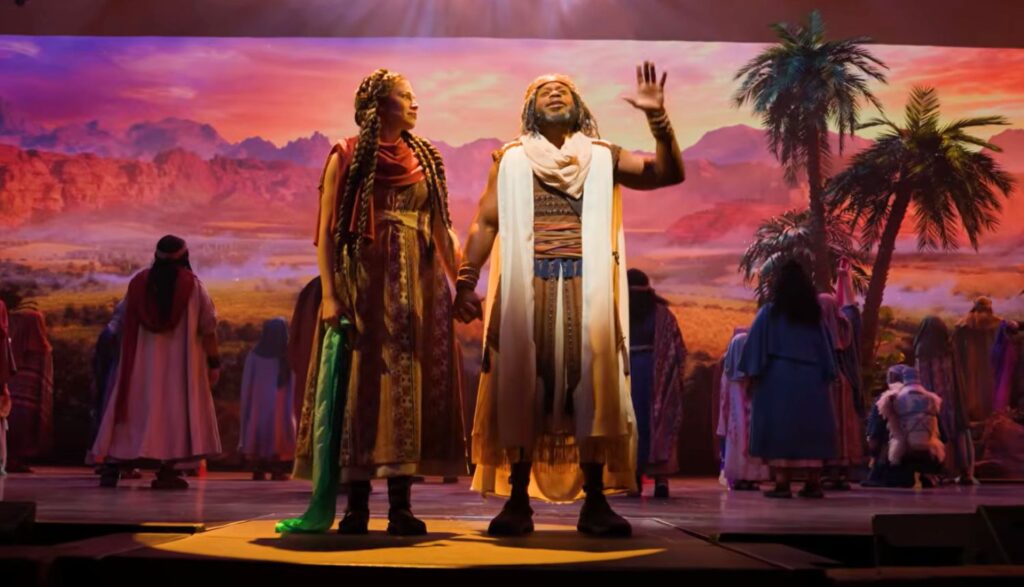
If you like musicals and incredible depictions of biblical stories, then Sight & Sound Presents: JOSHUA Live! just might be the film for you. This filmed musical production covers events in Joshua’s life from the parting of the Red Sea to the fall of Jericho’s walls. And it’s fairly navigable for most families.
“Be strong and courageous.”
Hearing these words from his mentor, Moses, Joshua is filled with both hope and trepidation. By the power of their God—the one true God—Moses parted the Red Sea and led their people, the Hebrews, out of Egyptian slavery and into the wilderness.
But now it’s Joshua’s turn to lead, and this is the Promised Land. The fulfillment of a 400-year-old promise. A land filled with honey and milk and, they’re told, giants.
Joshua is filled with doubt—not about God’s goodness, mind you, but about whether or not he’s the right man to lead the next generation of Hebrews into this centuries-old covenant with the Lord.
Joshua has a decision to make. It’s not easy, but as far as he’s concerned, it’s the only one that makes sense: “As for me and my house, we will serve the Lord.”
There are many, many positive elements in JOSHUA Live, but most will fall under our Spiritual Elements category.
Joshua leads by example, always praising the Lord’s goodness and thanking God for His provision. He teaches his family to do the same.
When the Hebrews are repeatedly attacked by foreign armies, their faith wavers. Many want to collect the weapons and chariots of their enemies, but the Lord instructs them to burn them instead. At times, even Joshua doubts these commands, but he is faithful. He tells his men: “Some will trust in the weapons of war, but I will trust in the name of the Lord.”
The Hebrews celebrate that they are no longer slaves. When the Hebrews are low on water, Joshua shares his water with a young child. He and his wife then ration their remaining water to ensure there’s enough for their daughters.
Sight & Sound Theaters’ JOSHUA Live covers events from the book of Exodus, starting with the parting of the Red Sea, through the book of Joshua, ending with the fall of Jericho.
The story is largely accurate to biblical accounts, sometimes pulling information from other parts of the Bible to work in here. For instance, when Joshua sends spies into Jericho, he warns them not to enter into any covenant with the Canaanites. As such, Joshua and the spies become worried when the spies agree to spare Rahab the prostitute and her family in exchange for her help in escaping the city safely. The tidbit about the covenant actually comes from the book of Exodus, not Joshua (the book in which we read about the spies being sent): God warns the Hebrews not to show the people of the Promised Land any mercy. But it stands to reason that God’s command would still apply here.
Joshua comes to understand that the true Promised Land isn’t a place: It’s being in communion with the Lord. Moses understands this too. However, in a moment of weakness, he disobeys a command from the Lord, striking a stone with his staff instead of speaking to it: The stone gushes with fresh water. Moses understands his mistake—that he had grown bitter toward his fellow Hebrews, who are constantly complaining—and the consequence is that he will never enter the Promised Land. However, he is at peace with this since he knows that he will still be with the Lord.
When the Hebrews reach Mt. Sinai, the Lord’s presence descends on the mountain in a pillar of fire. Moses receives the Ten Commandments there. However, he smashes the tablets upon his descent after learning that his people created a golden calf to worship. He orders the calf be destroyed and begs for God’s forgiveness. God grants that forgiveness, giving Moses a new set of tablets. (Moses is glowing when he returns to his people.) However, the wickedness of the Hebrews has grown too great, and God’s very presence—His very goodness—will destroy them if He passes among them. So He gives Moses instructions to build the Tabernacle and the Ark of the Covenant, a way for His presence to travel among the Hebrews without harming them.
Many people living in the Promised Land worship the false gods Molech and Baal. The followers of Molech have even constructed a giant statue of their bull-headed god on Mt. Moriah, the same mountain where God spared Isaac by providing a ram for sacrifice. (Later in the show, we see the ruins of this same statue after the Hebrews have defeated the Canaanites.)
Rahab becomes disenchanted with her gods because she doesn’t understand why a god would demand blood sacrifice (it’s implied that her family has been forced to sacrifice her younger brothers and sisters). She admires the God of the Hebrews. She sees that He is loving and merciful. She has heard of His many great works. And she makes the decision to follow Yahweh, whom she knows is the one true God.
When Joshua approaches Jericho, he obeys God’s commands to march around the city for seven days. On the seventh day, the Hebrews march seven times, then blow their trumpets and shout. God sends the walls of the city crumbling to the ground, but the house where Rahab lives is spared.
The Hebrews worship the Lord in song and dance. By the power of God, Moses performs many miracles. An angel appears to Joshua to give him instructions from the Lord.
We are reminded that one day, Jesus will return.
Jericho is filled with prostitutes. Nothing explicit is ever seen: The women wear clothing that covers them entirely, so there’s no cleavage to speak of. At most, a spaghetti strap might expose a shoulder. Rather, it’s more of the idea of what’s happening here. The women hang red cords outside their doors to indicate that they are available. Men who wish to hire their services take those cords down and go inside. The song lyrics in this scene talk about worshipping “desire.” A couple of men may put their arms around the prostitutes.
Rahab herself is a prostitute, and we learn her father is the one who sells her body to other men.
Joshua and other Hebrew men embrace their wives on a few occasions or hold their hands.
A few battle scenes are depicted. These aren’t bloody, and much of what we see is simply stage fighting (since JOSHUA Live is a filmed stage production). However, video screens in the background show some chariots (and their drivers) flying through the air.
We’re told that Joshua and the Hebrews achieve complete victory wherever they go, leaving none alive—and considering that they conquer 60 cities on their way through the Promised Land, that’s a very high death toll. When Moses parts the Red Sea, the Hebrews pass through unscathed. But when the Egyptians give pursuit, God sends the waves crashing down over them. We see the silhouettes of their bodies and chariots floating in the water.
Soldiers and Hebrews alike carry swords and shields. Nobody is killed when the walls of Jericho fall, but the implication is that the Hebrew army could easily march in to slaughter its people.
Molech and Baal, we learn, demand blood sacrifice. As such, the Canaanites have made a practice of sacrificing their own children to the false gods—as well as anyone who might disobey the orders of their priests. We see the beginning of one such ritual, overseen by a priest and two priestesses. Elsewhere, a man is condemned to death by sacrifice.
The Hebrews threaten to stone two men, but they’re stopped. A Hebrew man chases a thief with a knife, but again, he’s stopped before he can bring harm to the thief. We hear references to the “whips” and “bruises” of the Hebrews’ slave past. The Hebrews encounter many things in the desert that threaten their lives, such as sandstorms and a lack of water.
Jericho’s priests of Molech order all the people to gather in the center of the city. They send soldiers to ensure nobody stays behind, with orders to execute anyone they find as a traitor.
None.
In one scene, Rahab’s father drunkenly passes out.
The Hebrews are a finicky bunch, celebrating the Lord’s goodness one moment and complaining that He has led them to the wilderness to die the next. More than once, they entertain the idea of returning to Egypt. Joshua and Moses never give heed to these concerns. They constantly remind their people that the Lord is watching out for them. However, because of the Hebrews’ constant doubt and disobedience, God does punish the people, telling them they’ll have to wander an additional 40 years in the desert—and thus ensuring that the naysayers and instigators will die before they reach the Promised Land.
Someone says that because the Hebrews are God’s children, they must “prolong our misery as long as possible.”
A woman spits in a man’s face. When a woman steals a loaf of bread from a market stall, the stall’s owner has guards apprehend her. The guards offer back the stolen bread, but he discards it, stating he doesn’t want it anymore; he just didn’t want her to have it either.
A man prostitutes his own daughter and then uses the money she earned to buy himself booze instead of paying their family’s rent. As a result, the landlord tries to evict them.
Sight & Sound Theaters has done it again.
For the past 50 years, the ministry has endeavored to deliver the stories of the Bible to the big stage. The results speak for themselves: Monumental set designs, music that draws you in to every emotion and incredible vocal and acting talent bring the Gospel to life, attracting nearly 2 million people to Sight & Sound stages every year.
JOSHUA Live! follows that legacy. Four years in the making, the masterful theater production (now showing in movie theaters across the U.S.) tells us the story of Joshua and Jericho. But Josh didn’t just show up at Jericho and start marching: There was a journey to get there.
Joshua is told to be strong and courageous. He’s reminded that while some may rely on the weapons of war, the Hebrews should trust in the name of the Lord. And ultimately, Joshua spends 40 years outside the Promised Land only to realize that the true Promised Land isn’t a place at all: Communion with the Lord is where all promises will be fulfilled.
“As for me and my house, we will serve the Lord,” Joshua declares. And it’s a reminder to all of us that putting our faith in the things of this earth will never prosper. Rather, we should serve God faithfully because He is slow to anger, rich in love and forever faithful.
Now, because this is a very accurate recounting of biblical events, parents with little ones should note that there are allusions to prostitution and some stage-fight battles that take place. It’s hinted that the Canaanites sacrificed their own children to false gods. But nothing explicit or lewd is ever seen. Blood doesn’t spill. So while things might get intense, it’s still fairly navigable for almost all families.

Emily studied film and writing when she was in college. And when she isn’t being way too competitive while playing board games, she enjoys food, sleep, and geeking out with her husband indulging in their “nerdoms,” which is the collective fan cultures of everything they love, such as Star Wars, Star Trek, Stargate and Lord of the Rings.