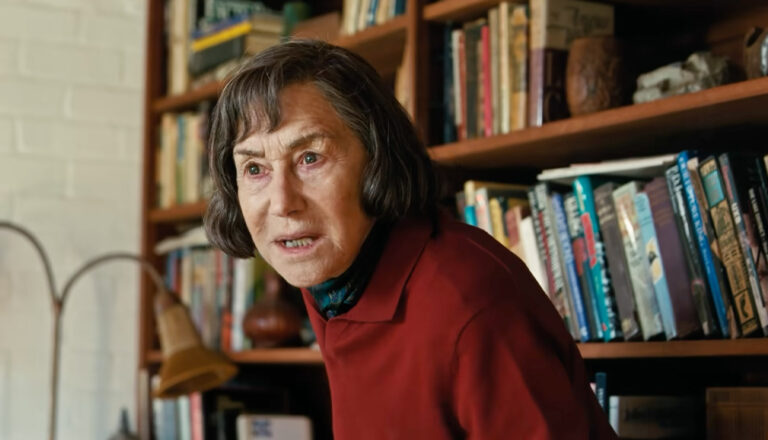


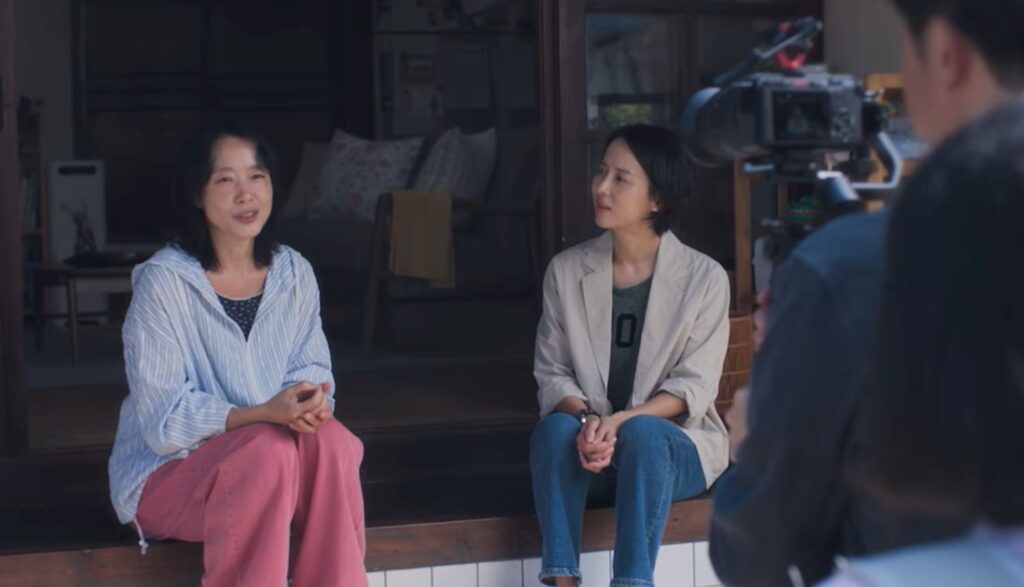
A blue-collar Korean family becomes the subject of a wealthy documentarian’s film. In the process, they grow close with the filmmaker and her husband, and covetous desires emerge. Possible Love is well crafted and is earning critical acclaim, but this nearly three-hour film contains a host of problematic content (nudity, a sexual scene, foul language and lots of drinking).
Mi-ok and Ho-seok, with their young son Cheol, are a working-class family still reeling in the wake of a failed labor strike. The loss of Ho-seok’s job was hard enough, but the lingering psychological effects have put a continual strain on the family.
In the wake of a man’s suicide—a former coworker of Ho-seok who also lost his job—Mi-ok meets Ye-ji, a documentary filmmaker.
Mi-ok and Ye-ji come from different worlds: Ye-ji is wealthy. Well-traveled. Whereas Mi-ok’s marriage is difficult and emotionally distant, Ye-ji and her husband, Sang-woo, have an easy relationship, like friends. Despite their differences, Mi-ok and Ye-ji hit it off. What’s more, Ye-ji tells Mi-ok that she wants her family to be the subject of a new documentary, one examining the plight of factory workers in South Korea.
Mi-ok is happy to tell her story–and to make such a sophisticated friend. Her husband, however, is not-so forthcoming. Ho-seok isn’t much of a conversationalist as it is, but he does his best to seem like a man who has made an unbreakable vow of silence when the camera rolls.
That’s unfortunate for Ye-ji, who believes Ho-seok would be the key to deliver a dynamite documentary.
So she sticks around, keeps talking to Mi-ok and even brings Sang-woo along, hoping Ho-seok will eventually open up. But as these two disparate couples spend more time together, and the layers of discretion are peeled away, a whole host of covetous desires emerge.
Ye-ji is a gentle, attentive friend to Mi-ok at a time when Mi-ok really needs it. Now, one could fairly call Ye-ji’s motivations into question, since she is also using Mi-ok for her documentary, but Ye-ji seems to be sincere in her friendship.
Fired factory workers and their families band together to peacefully protest the company’s cutthroat corporate measures. A woman says she appreciated the unity and equality she felt with her family and others during the strike.
A man puts himself into harm’s way to save a friend who is being brutally attacked. Someone comes to acknowledge that he (and his family) would benefit from his going to therapy to process his difficult experiences.
The film opens with a reference to Exodus 20:17 (“thou shalt not covet”).
A woman juxtaposes a brief period of great happiness with a subsequent, and much longer, season of suffering. She speculates that the pain she currently feels is the price for that former happiness—which feels akin to a dualist worldview.
Mi-ok says that her family once “bowed” to pictures of deceased family members to seek blessings. She mentions that, as a young woman, she felt was “fated” to be with Ho-seok.
Possible Love focuses on the growing relationship between its two couples and, eventually, the intimacy that develops between the pairs who are not husband and wife.
For Ye-ji and Ho-seok, the intimacy they come to share is of the emotional variety. Ye-ji wants the former factory worker to be the featured subject in her documentary and, ultimately, she does get him to express his pent-up emotions in heartrending detail. And while Mi-ok encouraged Ho-seok to do the interview with Ye-ji, Ho-seok’s outpouring of pain and fear to Ye-ji is something he had withheld from his own wife, to the detriment of their marriage.
Mi-ok and Sang-woo share a simmering sexual tension. Each is intrigued by the other, but for most of the film’s runtime this doesn’t go beyond some lingering looks and a few low-key flirtations. Eventually, though, this tension boils over. Mi-ok removes her clothing in front of Sang-woo (and the camera) and goes skinny dipping; breast and rear nudity is plainly seen. It doesn’t take long for Sang-woo to ditch his duds and join her in the water (he seems to have no qualms about cheating on his wife), and his bare backside is visible. Despite this sensual sequence, Mi-ok rebuffs Sang-woo’s further advances, which frustrates him and leads to an encounter I’ll talk more about in the Violent Content section.
After his interlude with Mi-ok, Sang-woo has aggressive sex with Ye-ji. While their bodies are covered in shadow, sexual movements and sounds are still present. Afterward, Ye-ji remarks that their relations “felt different,” which could imply that Sang-woo’s sexual frustrations with Mi-ok factored into the couple’s physical intimacy.
Mi-ok and Sang-woo sing karaoke while Ye-ji and Ho-seok dance. All parties appear drunk, so the scene definitely comes across as a bit uninhibited, though nothing else happens.
Ye-ji shares that Sang-woo was popular with girls in high school and that he liked “bimbos.” Sang-woo tells a few people that, as a child, he would swim naked on a private beach.
Both couples had non-arranged “love marriages.” Mi-ok seems to imply that she and her husband didn’t “date” growing up so much as “meet up,” potentially implying a physical relationship. Someone mentions divorce. Specific mention is made that a couple’s adult daughter is not married.
A teen boy works out without his shirt and shows off his bare torso to a few teen girls. The same boy later gives one of the girls an apple as a romantic gesture.
A woman’s clothing shows off a bit of her midriff in certain situations.
Following their naked swim, Mi-ok rebuffs Sang-woo’s advances. But he still seems adamant about consummating their flirtations and tries to grab Mi-ok several time while she ducks away. The scene does not result in any sexual violence, but it’s pretty uncomfortable nonetheless.
Striking workers are attacked and viciously beaten by police. People are kicked, hit with riot batons and tackled. One worker has his head slammed by a police shield. Victims of the attack lie bloodied and unmoving as a result of the violence. We learn that one man was beaten so severely that he had to be put on a respirator and was unable to walk for a time.
We’re told that someone killed himself. A man shares that he has suicidal thoughts. Someone says that, if he attended therapy, he might “flip out and kill everyone around.”
Someone has a panic attack while recounting a traumatic event. Two people have a brief fight. A woman slaps a child on the shoulder. Someone cuts her finger on a sewing machine.
Ho-seok was known for getting into fights in his youth.
The f-word is used 11 times, spoken in Korean and subtitled in English. Similarly, the s-word is heard five times. God’s name is misused three times. “B–ch” is used five times. Additional profanity includes “d–n,” “h—,” “a–” and “a–hole,” “b–tard” and “p-ss.” Uses of “jeez” and “crap” are present as well.
Characters drink soju, beer and wine frequently throughout the film. Ho-seok’s desire to drink causes Mi-ok some embarrassment, though we learn that he drinks in part to manage the physical pain he still has from prior injuries. While he was still employed at his factory job, Ho-seok built a patio so he and his coworkers could drink socially after work. Several characters appear drunk throughout the film. After failing to get someone to drive his family home, a man seems to be prepared to drive under the influence of alcohol.
People regularly smoke cigarettes.
I touched on the friendship between Mi-ok and Ye-ji in the Positive Elements section. But while Ye-ji seems genuine in her care for Mi-ok, that care is often superseded by the desire to get compelling footage for her documentary. Ye-ji often has her camera on hand to capture the lives of Mi-ok and Ho-seok, and she callously intrudes during one particularly private moment of anguish.
Mi-ok encourages her husband to consider therapy, but Ho-seok is resistant, finding the thought of reliving his experiences too painful.
Mourners bow twice to a picture of a deceased man as a sign of respectful condolence. (This is a common Korean funerary practice and does not carry the implication of worship.)
Two drunken men urinate all over a bathroom before finishing their business in a bathtub.
We learn that Ho-seok’s parents passed away early in the couple’s marriage. Ho-seok and his fellow fired factory employees refer to themselves as “the dead,” and those who retained their jobs as “the living.”
“Thou shalt not covet.”
That reference to one of the Ten Commandments kicks off Possible Love, and we see the different faces of covetousness throughout the film. Mi-ok covets Ye-ji’s wealth. Ye-ji covets Ho-seok’s story. Sang-woo covets Mi-ok. And Ho-seok covets his former coworkers who were never laid off.
Possible Love, which comes from famed Korean director Lee Chang-dong and produced and distributed by Netflix, is already racking up critical acclaim: The film currently holds a 100% fresh rating on Rotten Tomatoes and is shaping up to be an awards-season contender. The performances are strong, the story is heartfelt and the direction is confident.
The film, frankly, takes on a lot: classism, Korean work culture, marital fidelity, labor strife, government interventionism and more besides. But it’s also a nearly three-hour domestic drama that, let’s just say, is not afraid to take its time.
Possible Love can feel equal parts poignant and ponderous.
And while it is an undoubtedly well-made film, viewers will have to contend with its content stumbles as much as its pacing. Nudity, an explicit (if obscured) sex scene, moments of sensuality, lots of drinking and smoking, a smattering of harsh language and a few intensely violent sequences feature here.
Possible Love has a lot to say, but how it says those things matters, too.

Bret loves a good story—be it a movie, show, or video game—and enjoys geeking out about things like plot and story structure. He has a blast reading and writing fiction and has penned several short stories and screenplays. He and his wife love to kayak the many beautiful Colorado lakes with their dog.