


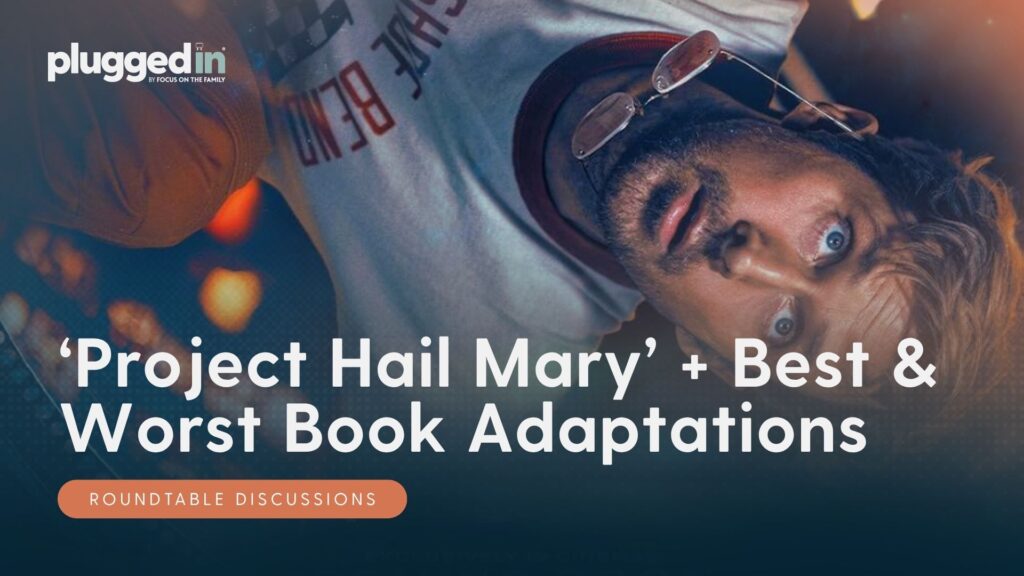
Project Hail Mary was a book before it was a movie—but barely. Author Andy Weir sold the film rights to the novel before it was even published. Even so, the book’s readers will notice plenty of departures in the new film. And plenty of ‘em will likely say, “Eh, the book was better.”
But is it?
Well, I’m not sure if we’ll get a definitive answer during this roundtable. But that won’t stop us from trying. In this video, I discuss Project Hail Mary with Bob Hoose (who reviewed the book) and Kennedy Unthank (who reviewed the movie). We also talk about the ticklish task of bringing beloved books to the big screen. And we offer our thoughts on the best movie adaptations—and perhaps some of the worst.
Oh, and we just may follow a controversial rabbit trail or two as well. You won’t want to miss that. So sit down in your favorite wingback chair, set a fire in the fireplace and pick up your nearest screen to check out our conversation. It’ll be a virtual page-turner.

2 Responses
I think that whether or not the movie is better than the book depends a lot on whether or not you read the book before you watch the movie. For example, I read the Chronicles of Narnia after watching the movies, and I specifically remember a part in the Dawn Treader book where I was like, “That didn’t happen!” (Although I do like both the books and the movies.)
I also tend to be a “the movie is better than the book” person. I can think of a lot of movies (pretty much any Disney movie, actually) where I loved or liked the movie and thought the book was only ok or hated it.
This is a fascinating conversation. The Princess Bride is sort of unusual as the movie and book were written by the same person. I personally liked the movie better because at the time I read the book I was not used to satire.
I think in many cases the book versus the movie debates can be subjective. What is the audience wanting from the story? Does narration or a character’s internal monologue play a significant role in the book? How do you translate it to a visual format? Did the book describe many action scenes that are difficult to imagine? Are the character descriptions so vague so that readers can see themselves in the book characters, but might have difficulty seeing themselves in a specific actor or actress?
Movies often have to significantly shorten the work for time and favorite scenes are altered or excluded. Sometimes the entire theme of the book is rejected. For example, Disney’s Peter Pan obscures the underlying references to child mortality and how Peter is kidnapping reckless children who fall out of strollers and sick children to keep them from growing up because if time doesn’t pass for them, then maybe they will live longer. There are still references, like Captain Hook being scared of clocks/time/the alligator, but it is not the same story.
Characters are often changed such as High King Peter in Disney’s Prince Caspian. In order to make the movie more emotional, Peter is changed to be antagonistic to Caspian and he discounts the opinions of Narnians who advise him against directly storming Miraz’s castle. In the book, although Peter is only about 12 or 13, he is more open to advice and also has knowledge from living many years in Narnia before being de-aged when they went back to England. The movie is a good action movie, but Peter is changed so that he feels unfamiliar and immature to book fans.