TV Series Review
The Jewish people boasted a dramatic history long before David wrote his first Psalm or slayed his first giant. And David’s father, Jesse—like fathers and grandfathers throughout the land of Israel at that time—wants to make sure that future generations know about its forefathers, and the God who guided them.
And so, just as the shepherd David gets home from a hard day of shepherding, he finds his father telling a group of children about Moses—a seminal figure in their people’s history. And Jesse begins the tale in the wilderness, with a burning bush.
Chief of Staff
Moses was already an old man by then, and he kept quiet about much of his past. In this telling, even his wife, Zipporah, has no idea that Moses didn’t just live in Egypt: He ruled there.
But one morning, Moses staggers back home to Zipporah with a fantastic story. He realizes that he can’t keep quiet anymore—not after hearing God speak to him.
“You heard the voice of God?” Zipporah asks.
“Not with these ears,” Moses says. “With my mind, with my body, with my whole soul. As if He knew all of me in a single breath. And for a moment, I knew all of Him that a man can bear to know.”
That Voice gave Moses an impossible command: Return to the land of his birth, a land he fled from for fear of his life. Speak to Egypt’s all-powerful Pharaoh. Free the Hebrews living there.
As Jesse tells his young, enraptured audience, “[Moses] did what every man must do when God calls him to do an impossible thing: He had to decide who to fear and who to serve.”
Parting the Technological Waters
The Old Stories: Moses is meant to be a companion piece to the Wonder Project’s hit show House of David—a relatively short miniseries meant to give viewers additional context for David’s core drama.
Like House of David, Moses embraces some creative license in bringing the patriarch’s story to the screen. During the opening episode, for instance, when Moses begs God to send someone else, God makes no mention of Aaron: He just tells Moses that He’s with him, and to take his staff and do what God asked. “For with it, you will do wonders,” God says. And, of course, the Bible never suggests that Moses kept Zipporah in the dark for 40 years regarding his royal background.
But those omissions and surmises are executed to serve this spiritual and biblical story, and to underline God’s goodness, grace and sovereignty.
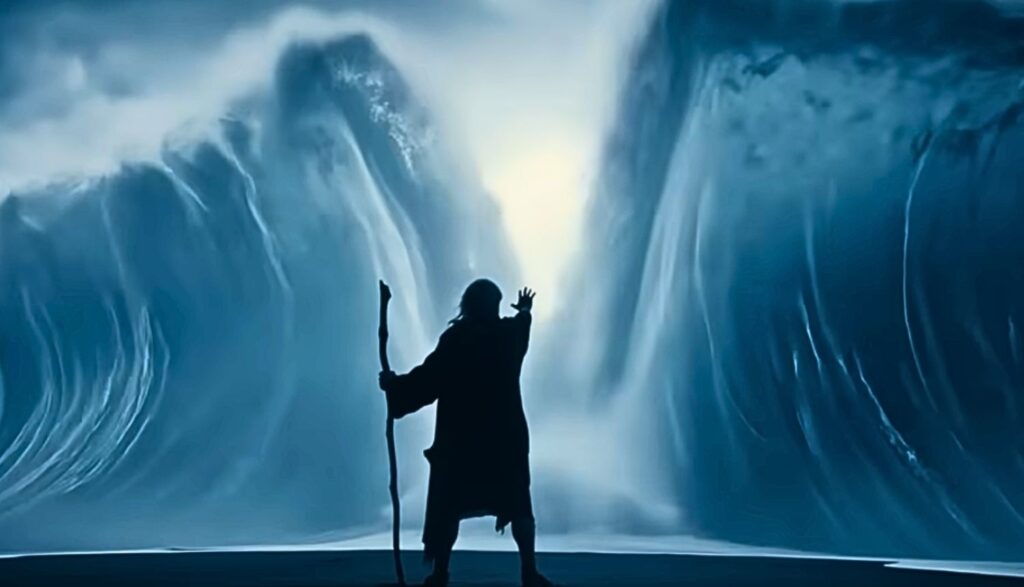
And while this short series on Moses plays second fiddle to David in the Wonder Project hierarchy, that comes with a mighty big asterisk: The titular character is played by Oscar winner Ben Kingsley, who brings to the role all the power and poignancy you’d expect. Using artificial intelligence to regress Kingsley’s age in certain scenes, we see the thespian both as a flinty Egyptian prince and an old, sometimes terrified shepherd—and in both guises, Kingsley is utterly believable.
Another interesting note: Creator and director Jon Erwin used AI extensively throughout the production, according to the Los Angeles Times—not just to de-age Kingsley but in almost every aspect of the show. “A production that traditionally would’ve taken months to shoot and require multiple locations was filmed entirely in one week with a crew of just 100 people—who never left Los Angeles,” the Times says.
According to the Times, in fact, Erwin is leading the charge to incorporate AI in film production: Christian filmmakers rarely get the budget that some secular filmmakers do, and it can be a cost-effective way to make a production look top-notch while allowing for much quicker turnaround times to get products on screen. And he believes that AI might actually create jobs.
“I think the greater threat of job loss in our industry is actually just how expensive things have gotten and how long they take to make,” Erwin told the Times. “If you can make things quicker, and you can make things at a price point that studios will say ‘yes,’ you can employ more people in aggregate and create jobs.”
Regardless, The Old Stories: Moses looks and feels like a strong, biblically based story in an era full of them—one that stands out for both its casting and technological creativity. And if Erwin is right, this may be just the beginning.
(Editor’s Note: Plugged In is rarely able to watch every episode of a given series for review. As such, there’s always a chance that you might see a problem that we didn’t. If you notice content that you feel should be included in our review, send us an email at letters@pluggedin.com, or contact us via Facebook or Instagram, and be sure to let us know the episode number, title and season so that we can check it out.)