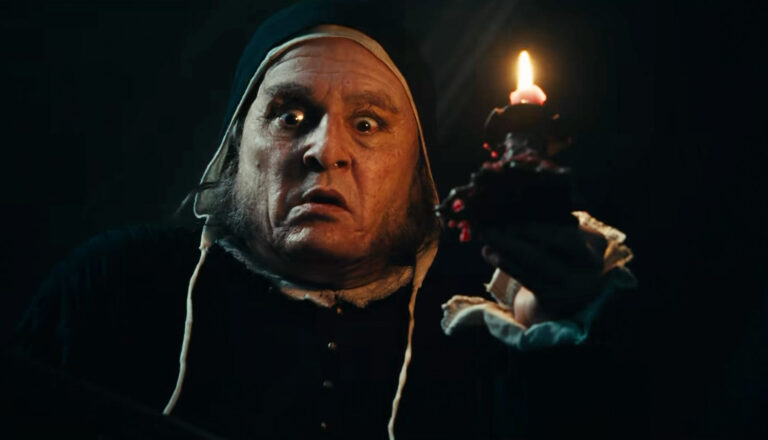

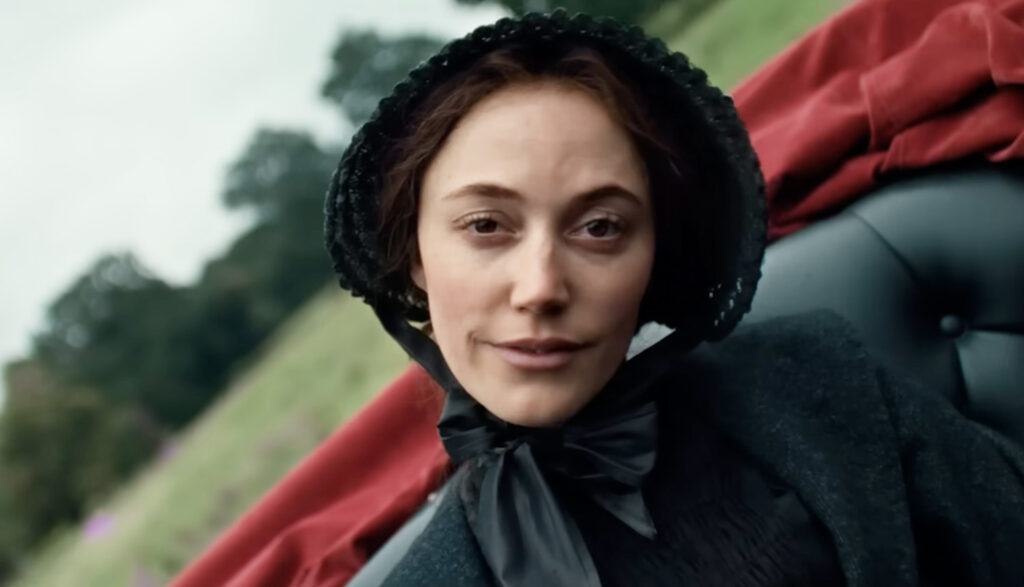
Even while milking its clever setting for everything it’s worth, this slasher flick can’t help but spin its wheels to reach its relatively short runtime. Lead actress Maika Monroe is phenomenally deranged as governess Winnifred Notty. But while the film may not be quite as graphic as viewers may be expecting, plenty of axes are swung, muskets are shot, and the blood pools up quickly. Worse are the actions we don’t see—including the murder of an infant. Add in some uncomfortable sexuality, and this film will have families blacklisting Winnifred from all the good nanny lists.
“I am the sanest person I’ve ever met.”
While this insistence of her own sanity is … well, optimistic, it is doubtful anyone else who has spent an extended period with Winnifred Notty would come to the conclusion that she’s sane at all.
But this time will be different. Winnifred is traveling to the large estate inhabited by the wealthy Pounds family to become governess to their two children, Andrew and Drusilla.
Winnifred’s track record as a governess is spotty at best, and some folks are starting to catch on to the uncommonly high number of children that go missing under her purview.
But this time will be different. This time, they will love Winnifred. They will accept her as their own, and she will become a part of the family.
This time, no kids will go missing.
Winnifred indeed starts her new position repeating the mantra, “I will be worthy of this family.” (And it seems she really means it, even if the notion doesn’t last long.)
Another servant of the Pounds family, Miss Lamb, is a kind and trusting friend for the majority of the film—perhaps the only person in the film who shows Winnifred any amount of warmth.
Winnifred has a bloodlust that apparently cannot be satiated. She claims on multiple occasions that her behavior is the result of a darkness, even a demon, inside of her—one that she’s named “Fred.”
Winnifred’s “condition” forces her to act creepily throughout the entire film, making unsettling faces and scurrying around at night like a rat. She reports that her “soul is wrapped in darkness” and describes this oppressive force in a friendly, familiar manner.
Winnifred mentions that her adoptive father was a clergyman. Andrew and Drusilla ask their teacher about God’s appointment for their lives and if it’s possible to step outside of that fate. This leads into a discussion about evil, and whether or not you can touch it—or, in Winnifred’s case, feel it bouncing around inside of you.
Winnifred falsely reports to a fellow worker that she sustained injuries due to a dark force stalking the manor’s grounds—a supposed “ghoul.” Believing her, this woman asks about any ghoul sightings or activity throughout the film. A character comments that there is “an evil in this world that we can’t fathom.”
Winnifred stares at a painting of a boar as its eyes glow bright yellow. She also sees strange symbols in a fire and consistently hears the chanting and whispers of ghostly apparitions. On at least two occasions, we see such specters—including that of a young woman and infant whom Winnifred killed. We glimpse a bright energy within her, the supposed demon. A woman opens her mouth unnaturally wide to release white smoke in a disturbing scene.
In a very uncomfortable scene, a much older married man tells a woman that her head is a temple—and that it would go against God’s appointment to not succumb to the lustful side of her brain. A woman’s delusions cause her to see a celestial galaxy on the ceiling of a house.
Children pray in a condescending way, both for their parents to be less insufferable and for a “subservient” future wife. A woman wears a cross necklace.
In an extremely uncomfortable scene, an older married man tells a much younger woman that his study on the science of brains has told him her “organ of obedience” is large, and her “organ of lust” has been long underserved. He starts to kiss the woman—until she reveals to him that they may be related.
A woman sexually licks the neck of another woman, who is disgusted by the act. After blackmailing a female character, a man suggests that if a woman can’t pay him the fee he requests, then she may be able to pay him with sexual acts instead. A man cuts the wrapping off of a female skeleton’s pelvic area, as another comments that the ease at which he did such an act implies he had done so to other women before. A young girl draws lewd pictures of the same man having intercourse with the skeleton. A character mentions seeing her female friend standing naked outside at night.
A woman states that her mom was instructed to drown her as a baby in a baptismal fount. She mentions a few other instances of how her parents attempted to murder her in her infancy. One of Winnifred’s past assignments took place in a town known for “babies found murdered,” and the film hints that Winnifred likely had something to do with this tragedy. While not showing the act itself, the film makes it clear that Winnifred takes the life of an infant during her stay at the Pounds’ manor.
Winnifred keeps some remnants of those she dispatches, including a hand, a few rogue fingers and an ear—the last of which she eats. During past assignments, we are told other kids under her care drowned or went missing altogether. People are brutally hit in the chest and skull with an axe, skewered by a bayonet, shot and stabbed dozens of times—all with bloody results.
A woman puts a dying deer out of its misery with a rock, bloodily bashing in its head. Afterwards, she tells the children who witnessed the ordeal that “all living creatures are in tremendous pain.” To a young boy’s horror, Winnifred claims that “sometimes people say silly things,” such as “Oh please, not my daughter’s fingers!” A severed hand is seen burning in a fireplace. A character remarks that their mother was softened by syphilis before it took her life.
Women discuss belladonna drops, which came from the deadly nightshade plant and were used in the Victorian era to make women’s eyes wider to fit the beauty standards of the time—typically at the cost of one’s sight. Winnifred dips her hands into a bowl of beet juice, letting the red liquid drip down her hands and licking it. During some of her nighttime outings, she creepily stalks members of the Pounds family, sometimes lying in their beds with them.
A character displays a supposed mummy to a room of onlookers, mentioning that it was unearthed by “80 sickly Arab children” whom he forced to find the treasure. The “mummy” is seen and looks to simply be a skeleton with a wig on.
In order to teach his daughter a lesson, a man forces her to hold a book out as he aims a musket at the book, shooting it out of her hand. A woman breaks a ceramic cup in her hand and uses a shard of the glass to slit another character’s throat. A character holds a razor blade over a sleeping child, who wakes up and is understandably frightened. A woman is painfully thrown into a wall, hitting her head hard. A character is presumably hung, although the act takes place off-screen.
We are told a long-deceased man was “friendly” with children, a line with disturbing implications.
A single use of “d–n,” as well as a couple misuses of God’s name, are the only profane words. There is some harsh name-calling, such as “whore.” Winnifred insults the intelligence of the children under her care multiple times, calling them “idiots.”
Adults drink socially at a party, and two adult women pass a bottle of liquor to each other.
Both Mr. and Mrs. Pounds repeatedly make misogynistic comments. For instance, they say how their son will be more important socially and economically than their daughter. A character says they read in a paper that “over-education can spoil a woman’s fertility.” A woman asks another if she’s been swallowing leeches again. Mrs. Pounds is quite cruel to one of the maids, cutting the woman’s hair against her will after finding a hair in some food she prepared.
Two characters discuss the nature of “women’s bodily functions.” A woman vomits. Someone comments on a man who soiled himself after being murdered. A character steals a family heirloom from the Pounds, swallowing it. Mrs. Pound forces a woman in her employment to sleep in a kennel.
Descriptions of the conditions Winnifred has endured in the past are certainly less than ideal: She says they were “smelly” and “rat-infested.”
“I acknowledge that I may have made certain inadvisable choices in the past.”
Winnifred, dear, that is the understatement of the century.
While lead actress Maika Monroe has broken into the mainstream once or twice with recent films, such as Reminders of Him and Longlegs, the majority of her work can be found in smaller indie horror flicks, including this one. Overall, that seems to be where she shines. Monroe does her best to walk the tonal tightrope that this film demands of her in her portrayal of Winnifred, navigating horror and dark comedy with a surprising amount of gracefulness. That being said, the film surrounding her doesn’t quite deserve her efforts, and nothing else about Victorian Psycho is graceful in the slightest.
Based on a novel that is just over 200 pages long, Victorian Psycho spins its wheels for too much of its runtime, all to reach the bloody conclusion that viewers foresaw from the start. This is the kind of film where, if you’ve seen the trailer, you know exactly what to expect—other than a few disturbing wrinkles.
Mr. Pounds’ underlying, perverted treatment of Winnifred boils over in a scene that is exceedingly uncomfortable to watch. And the film doesn’t follow the unspoken rule of most horror movies—that while adult humans are fodder to be gorily dispatched, don’t harm kids or animals. While not explicitly showing the acts, the film confirms the death of a young boy and an infant—along with at least a handful of other children from Winnifred’s past.
Horror fans clamor for gory carnage. I don’t envy the job of a filmmaker in this genre—attempting to show viewers something original and new without crossing the line. While certainly not the first film to do so, Victorian Psycho unfortunately does cross that line. I can only hope other filmmakers don’t view films like these as an indication that the line of what audiences will accept has moved even further.

Jonah Parker’s first interaction with Plugged In came when he was just five years old, after his parents read a review for The Chronicles of Narnia: Prince Caspian and deemed the content too intense for him. What started out as a contentious relationship between Jonah and a staff of reviewers who knew not of his existence would later turn into an appreciation for the site’s ability to present media content in a way that was accurate and fair. Jonah enjoys analyzing how our entertainment echoes the creativity of our Creator while finding glimpses of Biblical truths within every genre. He believes that Robert Pattinson’s Batmobile is the perfect mix of cool and practical.