
A corporate conglomerate is aiming to make billions by coaxing owners off their data center-worthy property. But when they turn to forcefully muscling the locals to sell, a former Green Beret steps in to fight back. There is high-tech weaponry and destructive explosions aplenty in Ghost Soldier. And lots of people die.
At first glance, Henry “Fitz” Fitzgerald appears to be a guy who’s getting away from the hustle and bustle of regular life in the bucolic peace of Wyoming.
It’s not that this former soldier is a recluse—Fitz is friendly to the local farmers and anyone he meets in the nearby town—but you’ll never see him out on a date or stopping in at the local pub. Fitz is content simply being alone: hunting, fishing, swimming in the local river and walking through the rolling hills and woods.
However, the people from the Brownstone corporation aren’t interested in Fitz’s lifestyle: They just want his land—his and everyone else’s who lives along the nearby rural Wyoming river.
Brownstone is in the process of building a new artificial intelligence data center. And the international corporation is offering a reasonable price for the land. Of course, the local government has also declared the land to be under the jurisdiction of public domain. So, if the owners won’t sell, their land will be taken anyway and picked up for pennies on the dollar.
But Brownstone doesn’t want to wait through months of court cases to eventually clear out all the owners along the river. They want the land now. If the farmers along that many miles of riverbank aren’t willing to take the cash and scoot, then Brownstone just happens to have connections to a tier-one army of individuals who will help the recalcitrant owners, uh, see the wisdom in leaving.
Fitz, however, isn’t really concerned about the Brownstone operatives. The land he’s living on doesn’t belong to him anyway. You see, Fitz is secretly squirreled away out here in nowhere Wyoming as a weapons tester for the U.S. government. In fact, there’s a string of underground labs and vaults on the property that he uses for that very purpose. So the Brownstone pressure rolls right off Fitz’s back.
But when those operatives start waving around guns, pistol-whipping holdouts and burning down a local family’s barn … well, Fitz takes notice. I mean, he’s a guy who keeps to himself, but he’s also a guy who sees the right and wrong of things very clearly.
That ton of experimental, cutting-edge weapons at his disposal could come in handy, too. And he knows how to use every one of them. You know, just to make sure right prevails.
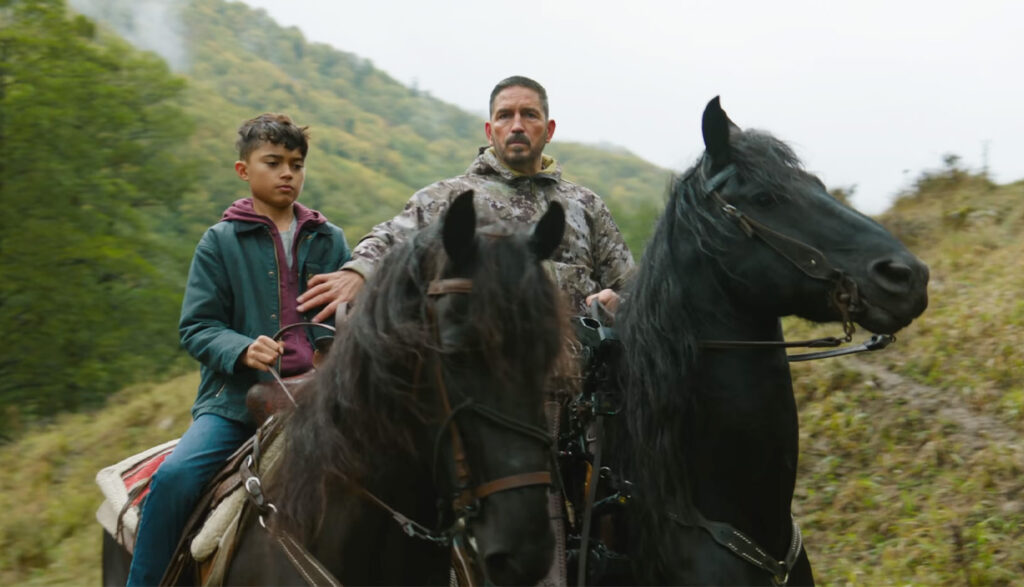
Fitz tends to keep to himself but quickly comes to the aid of others when people are in danger. After protecting a young boy named Jack from a pair of armed hunters, Fitz takes the boy under his wing. He encourages Jack to keep the memory of his deceased father alive: “Just keep thinking and talking about him,” he tells the boy. He also takes Jack hunting, stepping in to teach the teen things that his father no longer can.
Eventually Fitz steps up to protect Jack’s whole family, putting his own life in danger to save them.
Heidi, the town’s sheriff, also takes a self-sacrificial stance in the course of things. Even after being fired by a corrupt mayor, she steps up to protect the public from heavily armed Brownstone thugs.
Jack’s grandfather prays before a family meal, thanking God for the food and friends. Fitz wears a St. Michael medal, explaining that “soldiers like me believe he’ll protect us in battle.” Fitz later grabs Jack to hide him from armed attackers and prays aloud for St. Michael’s protection. Jack mentions that he wishes his father would have had a St. Michael medal to protect him in battle. And Fitz later gives the boy his medallion as a token of protection.
Fitz painfully presses a violent killer to give him information. When the man spills what Fitz is seeking, Fitz lets him go. “Thank, God,” the thug sighs out. But Fitz then tells him, “You can thank God all you want, but He ain’t the guy you’re going to meet,” before shooting him.
None.
Early on in the film, there are hints of the coming danger and peril that we eventually see. We see young Jack shooting at a rattlesnake with a pellet gun, for instance. He then learns to shoot a .22 caliber rifle from Fitz. We also see a local farmer with a bruised face and black eye, which gives the impression that he and his wife were just manhandled and pistol-whipped by armed men.
However, once Fitz begins unpacking his weapons, there’s no foreshadowed violence from there out.
Brownstone sends in a large number of former soldiers to clear the land. Then an international money man hires a group of Bolivian mercenaries to join them. The men are very heavy-handed while seeking information and putting down any resistance. The thick-accented mercenaries grab an elderly shop owner and use their knives to stab and torture the man to death. (The man’s agony is evident, though the bloodiness is relatively toned down.)
A man gets stabbed in the side and kicked into a rushing river. Other men are impaled by a super-sharp, carbon steel blade. Fitz fights mano a mano with a thug. They slam each other into walls and tables until Fitz pins the man down and twists his arm back in a painful hold. Fitz fights another assailant in a knife fight, the two slashing at each other’s arms and legs.
We see men shot with steel-tipped arrows, hit with scoped-rifle headshots and riddled with automatic fire. Guided projectiles get shot into the sky and then return to earth to rip into pre-selected human targets. A man gets blasted by a specialized weapon that leaves a gaping 5-inch hole in his torso. Massive explosions destroy a large water pump station, flooding tunnels and hallways with thousands of gallons of water. Rocket-propelled weapons rain down on a large building, obliterating it.
Fitz grabs and binds a female executive from Brownstone and threatens to force-feed her a toxic and deadly nerve agent, describing its horrible, debilitating effects. “It’s cyanide on steroids,” he growls at her. The woman panics and tells him what he wants to know. Then he reveals that the liquid substance is actually Gatorade.
There’s a single s-word in the dialogue and one or two uses each of the words “h—,” “d–n” and “b–tard.” Jesus’s name is misused once, and God’s name is combined with “d–n” once as well.
Several different people drink beer in the course of the movie. Fitz injects himself with medication and chomps down on several painkillers after getting injured.
Brownstone’s corporate officers (and their international backers) are all painted as corrupt, money-hungry individuals who would openly risk the lives of innocents for the sake of immediate profit. Fitz proclaims his belief that there are two systems of law in our country: one for the rich who don’t care about it; one for the poor who can’t afford it.
Ghost Soldier is a lean actioner that features a rather formulaic throughline that we’ve seen oft repeated: The quiet loner stands up against powerful baddies and fights for the little guy with heroic skills.
In this case, the baddies work for a ruthless, international corporate conglomerate. And the loner good guy is a former Green Beret who happens to also be a secret weapons-tester for the U.S. government. Thus, there’s a huge, tucked-away vault of cutting-edge weaponry that our hero knows exactly how to use.
Aren’t there laws against savagely wiping out an army of corporately hired killers? Yeah. But who cares? As long as corrupt politicians and greedy money mongers are hoisted on a suitable petard. In a way, then, this movie’s plotline has become one of our new cultural fairy tales that Hollywood is willing to replicate regularly.
That’s not to say that this movie can’t be enjoyed. Jim Caviezel slips easily into the leading role with softspoken charisma. And the weaponry-laden, 90-minute runtime clips along briskly.
Just go in, fair reader, realizing that this matinee actioner is little more than a time killer—a distraction filled with big, deadly ‘splosions and little else.

After spending more than two decades touring, directing, writing and producing for Christian theater and radio (most recently for Adventures in Odyssey, which he still contributes to), Bob joined the Plugged In staff to help us focus more heavily on video games. He is also one of our primary movie reviewers.