Despite surviving two previous movies, Maya is still trying to escape the small town of Venus, Oregon, in The Strangers: Chapter 3. She—and the viewer—will be faced with plenty of murder, blood and profanity. And the film even manages to get in a bit of blasphemy, too.
Maya’s stay in Venus, Oregon, hasn’t been exactly restful.
Oh, plenty of folks have sought to give her a bit of eternal peace, if you catch my drift. She’s been stabbed, attacked by a wild boar, involved in a handful of vehicular mishaps. She watched her boyfriend die, stabbed someone with a pair of scissors and burned ever-so-many calories in her panicked romps through the forest.
Long weekend? Yeah, you could say that.
Still, she’s alive, and that’s something. Few people who visit Venus ever leave. Sure, visitors who’re old or relatively unattractive are fairly safe. But if you’re a model-worthy 20-something? Oh, yeah. Be sure to take out a hefty insurance policy and pack a few weapons.
Maya has survived her ordeal thus far, though (as chronicled in The Strangers: Chapter 1 and Chapter 2), and she’s ready to bring her Venus vacation to a sad but welcome end.
Alas, she’s having a hard time leaving.
First, Maya—free from murderous assailants for once—makes a curious pit stop in a deserted church before leaving town. Naturally, one of her would-be killers stops by to make small talk. (He reassures Maya that he’s not wearing his mask, so she has nothing to worry about. And if you can’t trust a serial killer to keep his word, who can you trust?)
Then she runs into the town’s creepy sheriff and steals his SUV.
And then, as she’s driving down the road to safety, Maya starts shuffling through papers and whatnot in the SUV (looking, perhaps, for a stick of gum, since it’s been a while since she brushed her teeth), she careens off the road and smashes into a tree.
Note: When fleeing homicidal maniacs in stolen vehicles, always keep your eyes on the road.
Well. Scarecrow—mask back on—must’ve had an idea she’d crash in that exact spot, as he’s right there to drag Maya away. Looks like Venus’ most stubbornly lively visitor isn’t free to leave just yet.
Who says that small towns are boring?

Maya’s sister must’ve watched The Strangers: Chapter 1 and Chapter 2. Why? Because she, her beau and their intimidating (but obviously doomed) bodyguard come to Venus to search for Maya. And that’s very nice of them.
Statistically, Oregon is one of the most secular states in the nation. And if most of the state’s churches look like the one in which Maya and her would-be killer chat, I can see why: The church features a massive crucifix festooned with what looks to be a papier-mache-sculpted Christ—and realistic blood is painted on (or perhaps seeps out of) the wound in Jesus’ side.
Maya and her homicidal assailant talk a bit about spiritual matters while sitting in the pews. Maya asks if he came in to pray. “Do you really think He’d listen to me?” the killer replies, and he asks Maya if she prayed for her now-dead beau.
And then, he asks Maya, “Why do you think God let Cain kill Abel?” Maya doesn’t know. The killer admits that he doesn’t, either, but he suggests, “Maybe He just wanted to watch.”
A man listens to a preacher on the radio talk about sin and hell. Maya stumbles on a candle-covered shrine of sorts, where at least one murderer keeps pictures of their victims. Carved into a wall, we see an assortment of grim phrases, including “Justice=Death=Redemption.”
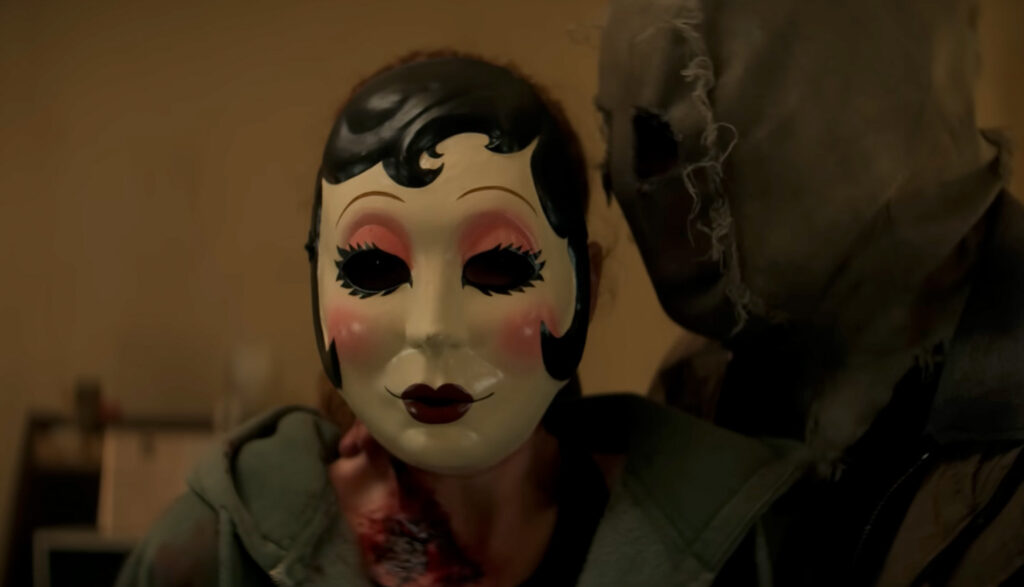
The killers in The Strangers franchise are known by what their masks look like. And it seems that Scarecrow and fellow murderer Pin-Up Girl (whose mask looks like the face of a coquettish 1920s Vaudeville dancer) had some sort of relationship before Maya killed Pin-Up Girl in Chapter 2. In flashback, we see the couple “kiss” while wearing the masks, and Scarecrow strokes both the original Pin-Up Girl’s masked and unmasked face fondly.
With the original Pin-Up girl gone, it seems as though Scarecrow is looking for a replacement—and he’s eyeing Maya as that replacement. He forces Maya to wear the mask at some junctures as he tries to draw her into his world of murder. The film seems to suggest that Scarecrow and the original Pin-Up Girl derive a certain level of sexual satisfaction from the act of killing, and such scenes can feel—for the killers—somewhat erotic. Scarecrow and Maya share a moment spiked with a curiously sensual, almost romantic tension; the two touch hands and hug.
A couple giggles and wrestles a bit—an act of foreplay, it seems—before they’re interrupted. A guy tries to sweet-talk a girl he meets in a convenience store. (Though we can’t be sure, the girl sure looks like she could be underage.) The man’s girlfriend is furious, telling him that he promised not to make passes at other women.
A woman sits in a bathrobe, laughing at what she’s seeing on her phone. We hear mention of two women who were in a same-sex relationship.
At least five people are killed—or nearly killed—after getting stabbed in the gut. In one instance, we see the blade protrude from the character’s back. In others, the knife slides in and the victims slowly bleed out. Scarecrow’s axe terminates a handful of other victims. Most of the axe blows take place off camera, but we do see a couple of instances where the blade lands in someone’s chest. Occasionally, the axe is left in the body.
Someone is stabbed in the forehead with what looks like an electric surgical saw. (The murder takes place in a morgue, and the tool/weapon continues to run after it gets stuck in the man’s noggin.) Two people are shot (and killed)—one by a handgun, the other via a shotgun.
Two corpses are run through a wood chipper. In one case, we watch as the body heads through the machine, blood spraying out the other end. In the other, the machine is examined after the body’s been eviscerated: Blood and gore cover the blades and rest at the bottom of the machine. Another murder victim lays on a hotel bed, shirtless and covered in blood. (Blood covers much of the rest of the hotel room—and the killer—as well.)
Someone is thwacked in the bridge of the nose with an axe handle. Maya crashes an SUV into a tree. A trailer home is knocked over by a careening truck. We learn someone committed his first murder when he was just a kid.
The f-word is used half a dozen times. We also hear “h—” and “d–k,” along with one misuse of God’s name.
For some reason, the church in which Maya and Scarecrow talk is stocked with whiskey. The killer pours out two shots, and he invites Maya to drink one. She does so, downing the alcohol in one gulp. Someone else drinks a beer.
In flashback, we see Scarecrow as a child: We’re introduced to him after he’s convicted of his first murder. The judge decides to let the kid go free as long as his father keeps a close eye on him. If the kid kills again, the judge warns, he’ll have no choice but to send the boy to jail until he’s at least 18. Naturally, the boy does kill again—and his only slightly disappointed father decides to help him cover up the deed. “No more townsfolk, you understand?” he scolds the boy.
When Maya’s sister comes looking for her in Venus, most of the townsfolk are incredibly unhelpful.
I suspect director Renny Harlin picked up the rights to The Strangers franchise in some sort of supermarket copyright bargain bin. It’s hard to explain his dedication to this franchise otherwise.
All the movies in this latest trilogy have been awful, and that’s not just Plugged In saying so. The Strangers: Chapter 1, from 2024, scored a 21% “freshness” rating on Rotten Tomatoes, and that’s the trilogy’s high-water mark: It’s gone downhill from there. Harlin has said he hopes to stitch all three of his Strangers movies into one long four-and-a-half-hour film. And yet, the supposed “final” chapter ends with yet another quasi-cliffhanger.
Perhaps national governments could use the film as some sort of nonlethal form of information gathering. “No!” the would-be informant would scream, “Not The Strangers supercut! I’ll tell you everything you want to know!”
The Strangers: Chapter 3 is a study in vapid violence—a movie so pointless and void of reason that, if I see a worse movie in 2026, it’ll be a bad movie year indeed. Chapter 3 manages to be both brutal and boring, a picture of human depravity that tries to make killing look fun—and fails miserably at it.
But these films, as pointless as they might be, do make money—which presumably is why Harlin keeps making more. And for some, The Strangers franchise is apparently family viewing. I saw a family of five in the movie showing I attended—including a boy about 7 years old, cuddled in a blanket he brought from home, just in case he wanted to take a nap.
I sympathize. The Strangers: Chapter 3 is a movie you’d like to shut your eyes to.
Paul Asay has been part of the Plugged In staff since 2007, watching and reviewing roughly 15 quintillion movies and television shows. He’s written for a number of other publications, too, including Time, The Washington Post and Christianity Today. The author of several books, Paul loves to find spirituality in unexpected places, including popular entertainment, and he loves all things superhero. His vices include James Bond films, Mountain Dew and terrible B-grade movies. He’s married, has two children and a neurotic dog, runs marathons on occasion and hopes to someday own his own tuxedo. Feel free to follow him on Twitter @AsayPaul.