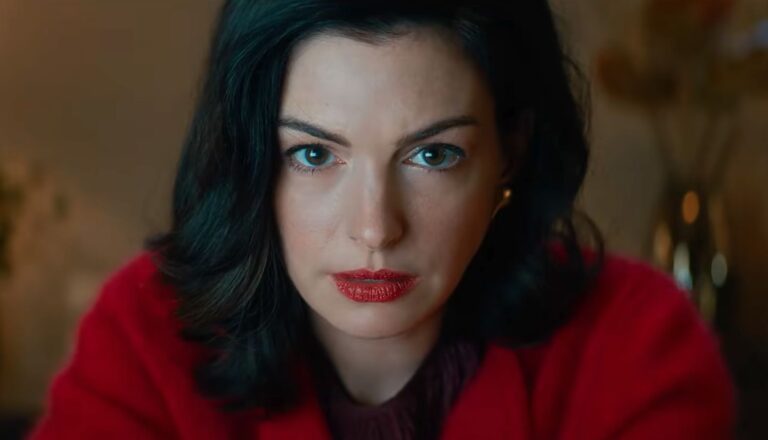



A married couple in crisis shares an evening with their apartment neighbors. Little do they know, their guests have an indecent proposal in mind. The Invite is a lecherous story that tsk-tsks monogamous marriage in favor of sexual deviancy. Despite its artistic merits, the film’s sensuality, explicit sexual dialogue and harsh, vulgar language make it a tough one to stomach.
Joe and Angela’s marriage is on the rocks. Resentment reigns. Pettiness and petulance permeate every interaction. You’d find less spite in a house shared by a mongoose and a cobra.
The fun, loving relationship that Joe and Angela once shared is now little more than a desiccated husk, shambling along for the sake of their tween daughter.
Their latest argument centers around the impending arrival of the neighbors who live in the apartment above them. Angela invited them over; she thinks they’re classy, and she’s desperate to interact with someone besides her mopey, caustic husband. Joe is displeased; he dislikes the neighbors and wishes his high-strung, controlling wife would let him have some peace.
All the same, the neighbors arrive: Hawk and Piña, a picture-perfect couple. Angela can barely contain her excitement. Joe can barely contain his annoyance.
The awkward acquaintanceship proceeds. But little do Joe and Angela realize where the evening is headed—and the indecent proposal Hawk and Piña have planned.
Joe and Angela love their daughter (who is spoken of but not present in the film), and it seems that they each have a good relationship with her, if not with one another. Angela tells Piña that there’s “nothing in the world better than being a mom.” She immediately walks the statement back, seemingly out of politeness (as Piña doesn’t have children).
Hawk is a practitioner of “Rolfing,” a pseudoscientific form of alternative medicine that incorporates elements of vitalism. (Though those elements are not explored here.)
[This section contains spoilers.]
Hawk and Piña may be, in Angela’s eyes, the picture-perfect couple. But by some measures, they’re not a “couple” at all. We never learn whether they’re married or not, and it’s revealed that Hawk and Piña have sex with many different people and participate in group sex. The titular “invite” of the film is the couple’s offer that Joe and Angela join them in their polyamorous lifestyle. Through a combination of marital frustration, vindictiveness and lust, Joe and Angela agree. (Circumstances prevent them from consummating this arrangement, but it’s not for lack of trying.)
We see a woman and a man about to perform a sexual act. Two women kiss. Men and women are seen in their underwear at various points in the film. Piña wears clothing that accentuates her cleavage.
The topic of sex in The Invite’s conversations is near constant. At Joe and Angela’s prompting, Hawk and Piña describe the details of their orgies, mentioning several sex acts in explicit detail. (Joe chimes in with crude commentary.) Hawk and Piña say that they will “switch roles” during sex. Piña admits to being “bi-curious” and gets pleasure from sexual interactions with women.
What’s more, The Invite seems to view Hawk and Piña’s sexual deviance as a sort of relational heroism, an enlightened solution to repressive monogamy. Someone regrets having suppressed the sexual desires of his late wife and, as a result, now seeks to live a “less inhibited” life.
Joe learns that Angela regularly exhibits her naked body for Hawk (viewed through their apartment windows). As a counterbalance to this revelation, Joe is called out for having frequently ogled Piña’s cleavage.
We are told that the sounds from Hawk and Piña’s “sex parties” can be heard in Joe and Angela’s apartment—and have been heard by their tween daughter. More than once, Joe and Angela discuss the intensity of Piña’s sexual climaxes.
Piña is a therapist and “sexologist,” and Hawk was her patient before Piña began a relationship with him. She makes the argument that Joe and Angela should separate for the “benefit” of their daughter, implying that their separation will make them all happier.
Angela says that she and Joe used to have sex regularly but now lack any physical intimacy. A character makes a few crude references to masturbation. Someone mentions (and later distributes) condoms. Suggestive comments are heard.
The final scene of the film hints at the possibility of marital reconciliation.
Someone tumbles into a bookshelf and injures his back. A video shows a man tripping and falling to the ground.
The f-word is used more than 110 times. There are 11 uses of the s-word. God’s name is misused more than 20 times, while Jesus’ name is abused once. We hear one use of the c-word. A crude term is used for breasts. Vulgar slang is used to describe a sexual function.
Joe talks about smoking marijuana. Later, he shares a marijuana cigarette with Angela and Piña. Piña vapes. Characters consume a variety of alcoholic beverages, including beer, wine and tequila.
Angela takes a Xanax to reduce her anxiety. (She drinks alcohol shortly afterward, which is strongly discouraged by medical professionals.) Hawk jokes about heroin addiction.
As mentioned, Joe and Angela bicker and fight constantly throughout the film. Joe makes an insensitive comment about age affecting a woman’s ability to become pregnant. Hawk snoops around his neighbor’s medicine cabinet.
A woman discuss perimenopause and relates the process to a man’s testicles. A man urinates while sharing the bathroom with his wife. We learn that a man’s first wife died from cancer. Someone jokes about suicide.
“One should always be in love. That is the reason one should never marry.”
That pithy quote from Oscar Wilde kicks off the proceedings for The Invite and succinctly summarizes the film’s dim view of marriage. Joe and Angela used to be happy, the film tells us, but then their love was choked on the vine by marital commitment and—gasp—the expectation of fidelity.
In contrast, Hawk and Piña (whose marital status is unclear) live a life unfettered by inhibition. Although the couple’s, uh, life choices are used to shock the viewer, the film ultimately holds them in esteem. Whatever they’re doing, we’re told, it’s working. Don’t be so narrow-minded.
The Invite paints committed monogamous matrimony as a repressive restriction that turns two lovers into embittered and embattled adversaries. That’s a far cry from what we see in the actual research, which “finds that marriage is an unparalleled factor in happiness.”
Doubtless, there are unhappy marriages like the one depicted here between Joe and Angela. But it’s irresponsible to so broadly contrast a miserable stand-in for matrimony against the “freedom” and “excitement” of sexual deviancy. That is a selfish pursuit, not the sacred, other-focused covenant between a man and a woman that echoes Christ’s union with His Church.
The Invite is clever and often funny. Director (and lead actress) Olivia Wilde weds confident direction, sharp dialogue and strong performances into an affecting film. But one wishes she would put her talents to better use than serving lechery like this.
Squirm-inducing sensuality, explicit sexual dialogue and vulgar language is what you can expect in The Invite. I’d suggest you decline an invite to view this debaucherous tale.

Bret loves a good story—be it a movie, show, or video game—and enjoys geeking out about things like plot and story structure. He has a blast reading and writing fiction and has penned several short stories and screenplays. He and his wife love to kayak the many beautiful Colorado lakes with their dog.