


A “Man from the Future” invades a Los Angeles diner and asks for volunteers to stop an impending AI apocalypse. But for families, this movie comes with some apocalyptic-level content, including blood, flying limbs and more than 100 f-words.
Don’t you hate it when you’re out having a bite to eat with your significant other—your phone, I mean—and someone tells you your relationship is a sham?
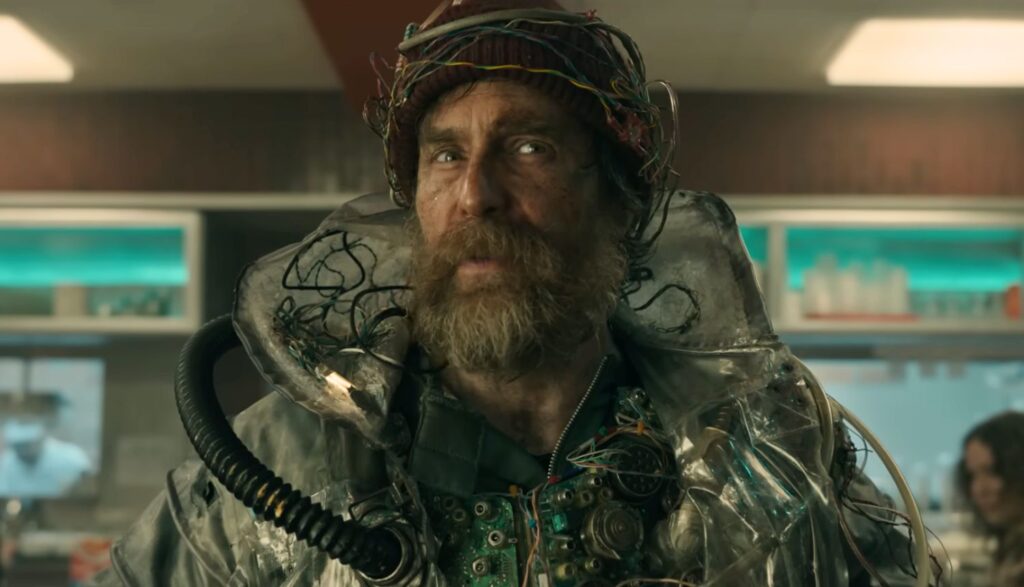
If so, you know just how the folks at Norm’s Diner in Los Angeles feel when—at exactly 10:10 p.m. one evening—a “Man from the Future” walks in and starts screaming.
“This is all a giant mistake!” he yells, yanking phones out of people’s hands and tossing them into glasses. “Social media has robbed you of your dignity and turned you into little children!”
Yeah, yeah, diners think to themselves, fishing their phones out of glasses to finish up the videos they were just watching. Whatever. Hey, this is L.A.: Men in plastic overcoats are bound to walk into diners and start screaming on occasion.
But this particular man then screams that he has a bomb. And the collective mood of the diners changes considerably.
“I’m looking for recruits!” the Man from the Future hollers. For what? To take on the scourge of artificial intelligence, that’s what. Not the infantile AI with which we’re all familiar, but the singularity-smashing, life-crashing AI that’s an hour away from being created just a few blocks down. The Man from the Future believes that here, in Norm’s Diner, he can find a team capable of taking on the AI’s creator and steer the world-splitting neural network in a more benevolent direction. He’s positive of it.
Sure, the previous 116 times he’s called for recruits from the diner—the same time, the same day, time loop after time loop—things haven’t worked out so hot. But the 117th time’s the charm, right?
This time, maybe they’ll hit on just the right combination of diner/warriors to face the perils that await—be they police or rabid dogs or zombies. Or perhaps rabid, zombie, police dogs. The Man from the Future does not know.
A few volunteer, but the Man from the Future rejects most out of hand. He’s worked with them before: The old, boring man who always dies within the first 10 minutes. Joe, the well-meaning dude with the bad knee. “You are the least useful person I’ve ever met,” the Man from the Future tells him.
But Susan? She’s a new volunteer. She’ll do. The Man from the Future will have to, um, “voluntell” the rest: a quiet couple (Mark and Janet) sitting in a booth; Jillian, the woman eating pie at the counter. The big guy might come in handy. How ‘bout the assistant Boy Scout master, eating with part of his troop?
The Man from the Future really, really doesn’t want to recruit the woman in the back, sitting all by herself—the woman in the princess outfit. She creeps him out, he tells her. But … well, this time, he’ll take her along. Just this once. What could it hurt, right? It’s only the future of the human race hanging in the balance.
And with that—and with the police cars peeling into the diner parking lot—the Man from the Future and his reluctant band of warriors prepare for their departure.
“Hey, it’s going to be OK!” he tells them. “Or it’s not. I don’t know.” But if it’s not, they’ll all be there to try again come attempt 118.
[Warning: The following sections contain spoilers.]
We can all agree that saving the world is, on balance, a good thing. The fact that the Man from the Future (he’s not really into introducing himself) has tried to save the world more than 100 times already speaks to both his desire to save the world and his stubborn gumption.
Those who join him—those who survive long enough, that is—come to embrace their own parts in this quixotic quest. Many show that they’re willing to sacrifice themselves for the greater good.
And, of course, Plugged In would agree with the Man from the Future that technology can indeed be a danger—not just to our future selves but to our present ones, too.
A supernatural force appears to be in operation in Good Luck, Have Fun, Don’t Die. For instance, let’s take the makeup of the team. When Ingrid—the woman in the princess outfit—offers to go along, the Man from the Future is absolutely, positively set against it. But then a bottle of hot sauce mysteriously falls to the floor and starts spinning. When it stops, the neck points at Ingrid, which the Man from the Future takes as a sign.
It’s not the only Deus ex machina moment we see. A mysterious power seems to put a stopped car in gear, too, and the car winds up saving the team to fight for—well, another few minutes or so.
But the film presents technology itself as its own theologically themed threat.
The Man from the Future tells his recruits that the AI creator is a 9-year-old boy who’s “building god in his bedroom. Our mission is to make sure that the god he builds is a god that likes people.”
It’s not the last time we see the film play with the intersection of the technical and the spiritual.
Take Susan, the first volunteer: We learn that she recently lost her son, Darren, in a school shooting. She’s inconsolable until a handful of other moms point her to a shadowy business that creates clones of children. (Physically, they’re always a perfect match. “When it comes to personality, we do our best,” the salesman says. “The brain is a tricky thing.”)
Susan does decide to clone Darren, with dispiriting results. She talks with parents who’ve cloned their own kids several times, and one couple said that this time, they decided to “just have fun,” making their latest clone ridiculously tall and a follower of Islam. (The cloned girl apparently asks sometimes, “Are we Muslim?” To which the mother responds, “No, honey. Only you.”)
Susan eventually discovers something that would seem to be her son’s body-less personality, which feels far more like Darren to her. But all of these interactions beg questions about the nature of life and the existence of the soul.
When we dig into Ingrid’s story, we learn that her beau—someone who initially rejected phones completely—gets sucked into a virtual world that he prefers to the real one.
“What if someone made a better reality than ours?” he asks.
That’s ultimately the Faustian question at the root of Good Luck, Have Fun, Don’t Die. Technology promises paradises of our own making, where we can walk through a dying world, slowly starving, and be perfectly happy. “All I want is to make [people] happy,” our heroes are told at the end. “And I’m very, very good at it.” So Satan says as he presents sin to us all, right? This will make you happy. Really.
But then one of our heroes calls out this artificial being on his promises. “You’re not a god,” she says. “You’re not inevitable. You’re just us. A twisted, warped reflection of us.” And that, too, is profoundly theological. According to Augustine, Satan can never create anything good—just twist God’s creations to fit his own purposes. And that, the movie suggests, is what this sentient AI is doing here.
A mural depicts the classic illustration of evolution—depicting a monkey morphing, picture by picture, into a man—only in this example, the last picture shows a man slumped over, wearing a set of virtual reality goggles. Someone levitates. Phones are used to hypnotize people.
Ingrid and her boyfriend have sex on a spring-coil bed. We “see” this interlude from the inside of the mattress itself, watching the springs move and hearing them squeak as the two people have sex above. Later, the camera does show the couple in bed together, both apparently topless but covered by a sheet.
The Man from the Future greets one of the diners as a quasi-lover, knowing their shared time-loop past. “You are my greatest soldier,” he tells the woman. “The sexual tension between us is like a summer storm.” Because she betrays the man every single time he selects her, he won’t take her along this time. But that doesn’t stop him from kissing her fondly.
Mark and Janet kiss and cuddle in the back of a station wagon, fully clothed.
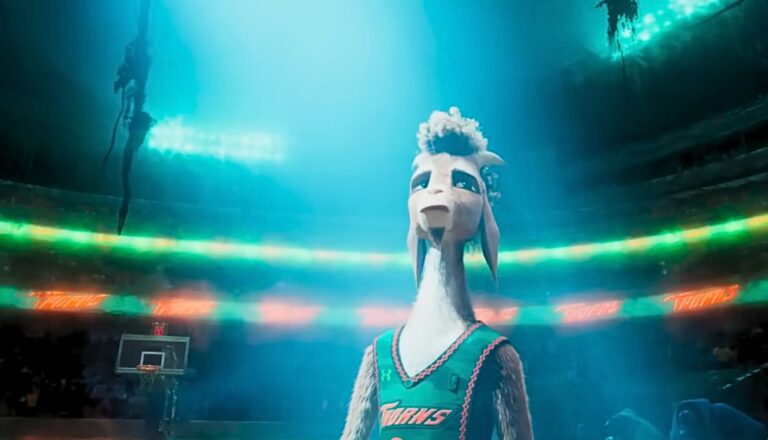
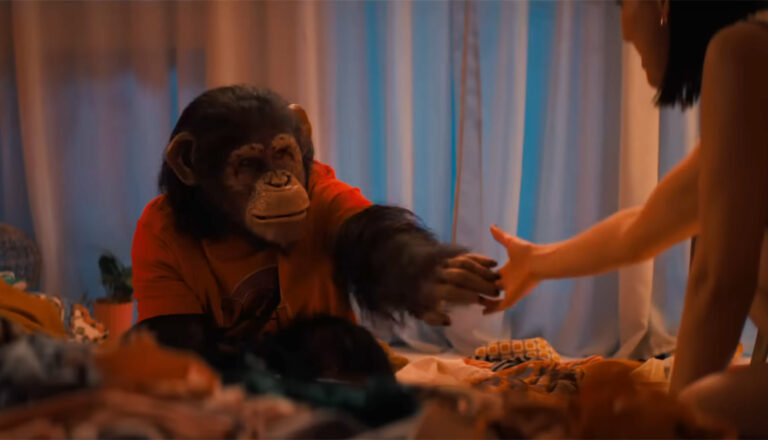
We see the screens of several phones. One user swipes through pictures of shirtless, muscled men before she finds one that she likes. Another phone showss a blubbery, goat-headed monstrosity dancing in a thong. Another bit of AI slop showcases an extremely muscled giant with a tree where its head should be. (Its privates are covered by the position of the thing’s body.) In still another, a racoon-headed man appears to be having cartoonish sex with someone. (Again, nothing critical is seen, but we do see movements. A comment posted underneath the video reads that he wishes he could bleach his eyes after watching.)
A monster’s privates are exposed to the camera as it, um, urinates glitter. Mark, who works as a substitute teacher, comes into his class and sees that someone has drawn an obscene picture on the board.
The Man from the Future tells diners that he has strapped a bomb to his body—and the contraption certainly looks the part. (He later confesses that it’s not a bomb at all.) He also tells them that he’s “held some of you in my arms and watched the very life flicker from your eyes.”
As they plot their escape from the diner (which, you’ll remember, is surrounded by the police), the Man from the Future tells his cohorts that the escape usually ends badly—terminated by a hail of bullets or vicious police dogs or bombards of tear gas followed by brutal baton beatings. (Each scenario is accompanied by visual flashbacks.)
School shootings are even more fraught in this imagined future: Susan rushes to her son’s school and sees dead students getting wheeled out of the school building, their bodies covered. She discovers that her son is under one and weeps. Other mothers seem far less put out by these untimely deaths: After one woman’s son gets shot by his best friend, she laments that she “had to go halfway across town in rush hour traffic” to reach the school.
We later learn that these moms have been through the horrors of a school shooting several times before—and they’ve cloned their kids each time. Susan later goes to a support group filled with parents of now-cloned kids. One parent says that he doesn’t worry so much about his newly cloned child: “Just have fun with it,” he says. “They’re just going to shoot each other anyway.” Another couple says they didn’t mind their child dying that much. “He was completely unhinged before,” the dad says, adding quickly that his kid wasn’t the shooter. “There’s a different group for that,” the mother adds hastily.
A couple of people get shot several times (each) and die, one off-screen and one on. A monster bites and swallows several people, sometimes shaking the bodies until limbs fly off. A dismembered leg lands at someone’s feet. Freshly severed fingers continue to wriggle on a floor. Someone’s stabbed in the temple with a meat thermometer. Cars crash into people, sometimes splattering blood everywhere. A character gets gunned down with a shotgun.
Teenagers hypnotized by their phones attack the Man from the Future’s posse: The heroes take shelter in a home, but hands bash through doors and walls (think classic zombie-movie tropes), forcing them to flee to the rooftop. There, they thwack at teens climbing to get them, with some attackers falling to the yard below.
A missile barrels into a concrete bunker, presumably killing the person inside. Someone gets stabbed in the chest by a tiny robot. Semi-sentient cables wrap around people and pin them to walls. A boy gets punched in the face, knocking him out. A car nearly falls on Ingrid; the Man from the Future saves her just in time.
Ingrid is allergic to both cell phones and Wi-Fi, and she gets nosebleeds whenever she’s in close proximity to either. A couple of people wield cartoonish-looking guns that temporarily disable phones. A homeless man attacks people with a large knife. (He claims that Krampus—Santa Claus’ evil counterpart—took his daughter.) We see some dead rats.
More than 100 f-words (some of which are paired with the word “mother”) and about 30 s-words. We also hear, as you might expect, some other profanities: “A–,” “b–ch,” “d–n” and “h—.”
Ingrid’s boyfriend smokes something—possibly a cigarette, possibly marijuana. We see a bong resting on a table in their shared apartment. Both drink wine during dinner. There’s a reference to “methed-up lunatics with axes.”
Someone lights a cigar. When recruiting volunteers, the Man from the Future greets some frat members and promises that beers will be on him (should they survive).
High school students treat teachers incredibly disrespectfully. “You’re a sad old lady,” one student tells her teacher. “You’re like a hundred years old. You’re like a witch. You’re like my mom’s age. You’re like a dead person.” When Mark tries to step in and protect the teacher (who is, by the way, 35), the student says, “What did you say, Grandpa Dinosaur?”
If it wasn’t for all the body limbs and curses flying around, Good Luck, Have Fun, Don’t Die just might be a movie that a sentient version of Plugged In itself might write.
“Progress is only progress if it makes things better!” the Man from the Future tells the diners. And certainly, technology can be a catalyst for better lives. We can do everything from level picture frames to search for our keys to identify weird plants with our phones. Artificial intelligence can make many tasks easier, too.
But undeniably, technology has made some elements of our lives worse, as well. All you need to do is check out Plugged In’s Parents’ Guide to Technology for evidence of that.
So yes, the alarms sounded by Good Luck, Have Fun, Don’t Die resonate deeply in the Plugged In soul.
But Plugged In must sound the alarm over the movie itself, too.
This zany, over-the-top, satirical look at what the future might hold contains an exorbitant quantity of problematic content, from severed limbs to punched children to more than 100 f-bombs. If the movie was a sponge and content issues were water, the film would be dripping them all over the kitchen floor.
As the movie warns us against being absorbed with screens, this screen-based diversion might be the perfect example to ignore. For many, and certainly for families, a more fitting title might be Good Luck, Have Fun, Don’t Watch.

Paul Asay has been part of the Plugged In staff since 2007, watching and reviewing roughly 15 quintillion movies and television shows. He’s written for a number of other publications, too, including Time, The Washington Post and Christianity Today. The author of several books, Paul loves to find spirituality in unexpected places, including popular entertainment, and he loves all things superhero. His vices include James Bond films, Mountain Dew and terrible B-grade movies. He’s married, has two children and a neurotic dog, runs marathons on occasion and hopes to someday own his own tuxedo. Feel free to follow him on Twitter @AsayPaul.