


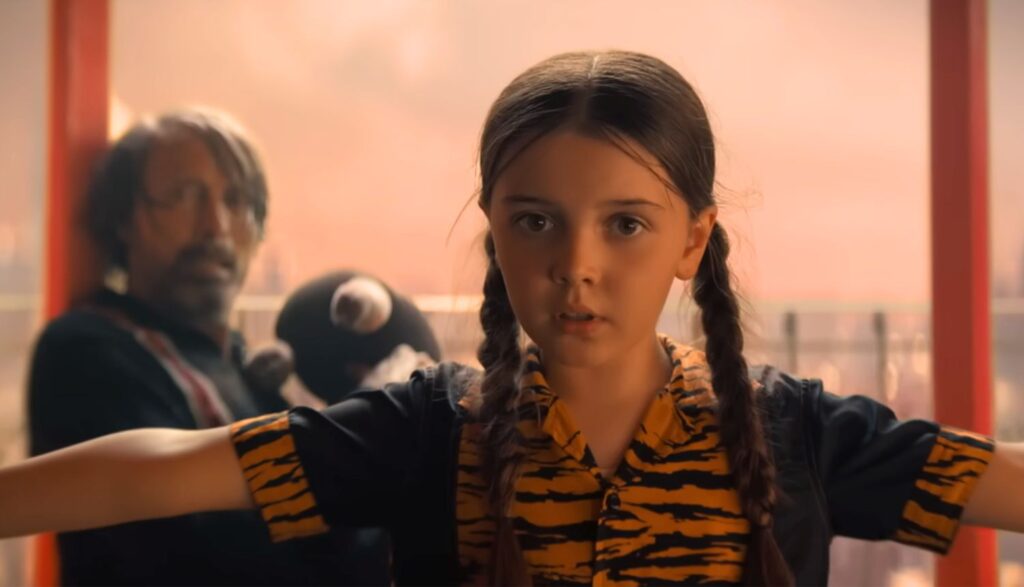

An orphaned girl hires her hitman next-door neighbor to kill the monster under her bed. This R-rated action/horror movie mashup has lots of violence but surprisingly little gore. However, there are still many gruesome moments, even if they’re just offscreen. And some language and a strange portrayal of Christian worship come up, too.
“There’s a monster under my bed.”
Plenty of parents will be familiar with that particular claim. It’s a common refrain among young, overactive imaginations discomforted by the dark.
But in Aurora’s case, it’s true. There really is a monster under her bed.
Maybe.
Oh, Aurora is certainly convinced. And it’s not like she doesn’t have anything to back up her claim.
She warned her parents over and over. Don’t touch the floor, she’d tell them, the monster will get you. They didn’t listen. They never did. Then, one night, the monster got them—Aurora heard it all while hiding under her blanket.
Now, she’s all alone. And she’s sure the monster will come for her next.
She only has one hope: her neighbor, Resident 5B, who lives in the apartment across the hall. He kills monsters for a living. Aurora’s seen it with her own eyes.
Maybe.
A child’s imaginings don’t always line up with reality. While 5B does kill “monsters” for a living, they’re more of the human variety than anything that might be lurking below a child’s bed. But the girl’s parents are missing—perhaps 5B’s own flesh-and-blood entanglements put them in the crosshairs?
If that’s the case, Aurora could still be in danger. 5B decides to keep an eye on her. To protect her from the monsters, real or imagined.
Resident 5B becomes Aurora’s protector in the wake of her parents’ disappearance, and while he takes on this role initially out of guilt, he comes to truly care for the young girl. He puts himself at great risk to preserve her life when he could easily leave her to fend for herself.
Aurora repeatedly tries to warn people about the monster under her bed—even those who mean to harm her. Aurora’s parents seem kind and try to comfort her when she’s afraid.
Aurora says she made a wish on a shooting star—which seems to have come true. She argues that her wishes have power. She also believes that the monster under her bed knows she’s “wicked”—and that’s why it attacked her parents.
One bizarre scene takes place during what looks like a Catholic Mass. A priest and several nuns dance to a pop version of the Lord’s Prayer while offertory plates are distributed to the congregation. (Some might argue that this scene is simply a stylized representation of a church service in a very stylized film, but it left me feeling sour. It seemed to portray Christian worship as nothing more than glorified entertainment to make money.)
Someone references the idea of “delayed personhood” and a version of ensoulment. 5B makes an adjustment to the phrase, “Rob Peter to pay Paul.” A crucifix is seen.
[Spoiler Warning] Aurora’s monster is real. It manifests as a giant, furry, toothy creature. Several characters are devoured in this monster’s gaping jaws. Many of these deaths are not shown, but we hear screams and disgusting munching sounds. In instances where the monster devours someone on-camera, the demises are mostly bloodless but no less disturbing.
5B and his handler, Laverne, seem to share a romantic connection. (He touches and kisses her hand.) A woman wears a revealing dress.
5B is a professional hitman, and we see his work on several occasions. People are clubbed, stabbed and shot. The violence is visceral but not especially bloody—a quick spray is the most that we see. That isn’t to say there aren’t some gruesome moments in Dust Bunny; it’s just that, rather than shown, many occur just off-screen.
Perhaps the most disturbing scene is when 5B must dispose of a body. He describes the process—to Aurora, no less—likening it to the work of a butcher. While Aurora (and mercifully, the viewer, too) is spared from any visuals, we do hear some of the gory, squelching work take place. Afterwards, 5B recruits Aurora to help him “wrap up the pieces.”
Assassins come to Aurora’s apartment to kill her. One killer shoots the bed where the girl would be sleeping. (Fortunately, she is hiding elsewhere.) 5B brawls with another assassin, and they choke each other to the point of unconsciousness.
One henchman gets an electric toothbrush lodged in his eye; he is shot and killed shortly after.
Aurora hires 5B to kill her monster because it seems like he’s “killed a lot of things.” She confesses that she wished a monster would come eat her parents because they weren’t “very nice” to her. Laverne references a nature program where a baby animal died after its parents were killed.
We hear one s-word. Jesus’ name is abused once; God’s name is misused seven times (mostly heard in one tense scene). Someone says “a–hole.” There is one aborted use of the f-word.
5B meets Laverne in what appears to be an underground bar. A character uses an emetic to induce vomiting. Someone who has been wounded pops a pill into his mouth.
Aurora sneaks out of her room at night to follow 5B. When she sees his proficiency for physical violence, she steals money from a church offering plate to hire him to kill her monster. Laverne encourages 5B to abandon Aurora. “Grown-ups pretend not to be afraid,” Aurora says to 5B, “but they are, all the time.”
We see a taxidermized chicken lamp—with its egg-like lightbulb fastened squarely to the bird’s behind.
Dust Bunny is a stylish, if simple, variation of the “lone wolf and cub” storyline, with a mercenary taking a precocious child under his (bloody) wing. We’ve seen plenty of versions of this story, from Léon: The Professional to The Mandalorian.
But Dust Bunny hopes to differentiate itself by infusing its story with a horror/mystery element. Is Aurora’s monster real or imagined? What’s worse, the monsters in your head (and under your bed) or those that live just down the block? And what happens when those monsters collide?
However, the resulting product is a mess, both confused and confusing. The film prioritizes style over substance and doesn’t have much to say beyond the need to “live with your monsters.” That may have been a fruitful theme if Dust Bunny had put some effort into reckoning with “monsters,” like violence and regret, alongside its more tangible terrors. Unfortunately, this urban fairytale doesn’t have much depth under its flashy cover.
As far as content concerns go, there’s plenty of violence to be found here. And while there’s not as much blood as one might expect from an R-rated action/horror film, that doesn’t mean Dust Bunny is a worry-free flick. If anything, it shows that the grisly and the grim are not limited only to what our eyes can see.
Language, while limited, still rears its ugly head. And a bizarre depiction of Christian worship could turn away some viewers.
Dust Bunny may try to label itself as “family horror” (as The Hollywood Reporter put it), but this is not a film for families—or those looking for a coherent story.
Bret loves a good story—be it a movie, show, or video game—and enjoys geeking out about things like plot and story structure. He has a blast reading and writing fiction and has penned several short stories and screenplays. He and his wife love to kayak the many beautiful Colorado lakes with their dog.