


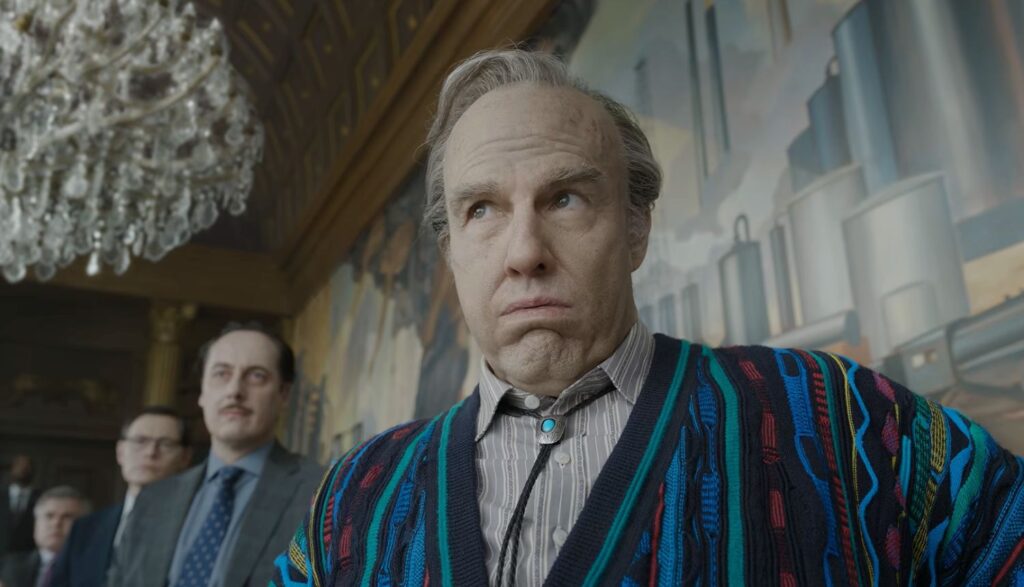
An oil tycoon’s greed kicks off an environmental disaster that he tries to spin to his own advantage. Digger is a satirical film that takes aim at the grotesqueries of powerful people—both in business and government—and imagines the harm they might cause. Unfortunately, this absurdist flick includes religious mockery, violence (including suicide) and loads of harsh language.
Digger Rockwell might be the most powerful man in the world.
The fast-talking oil tycoon has an obscene amount of wealth and influence. He’s got the president of the United States on speed dial, for crying out loud. Yep, Digger Rockwell just might be the most powerful man in the world.
Too bad he might have destroyed it.
The world, that is. Not his riches or clout. He’s still got those. But Digger may have caused a teeny, tiny global disaster. His aggressive pursuit of crude oil has led to an explosion at his Greenland rig.
The lives lost there are tragic, of course, but think of the financial impact!
The fallout doesn’t stop with a few less dollars in Digger’s deep pockets, though. The explosion causes a massive ice shelf to detach from Greenland, and, thanks to a combination of ocean currents and weather events, the titanic iceberg is making a beeline for the European coast.
If the ice hits Europe as predicted, it will result in a massive loss of life. And an even bigger profit loss.
Still, Digger will warn those in danger, right? Well, hold your horses. If he does, he’ll also have to accept the blame for his recklessness. Wouldn’t it be better to wait and see what happens? After all, the ice shelf could miss Europe, and this whole situation might just melt away.
And even if not, Digger could use the time to figure out how to dig himself out of this mess—and spin it to his advantage.
While they may not have much success, a few people try to stand up against Digger’s destructive behavior. A mother and father fret over the whereabouts of their adult daughter; it’s clear that they love each other. Someone shows a great deal of care for a dying pet.
Digger is a brash satire and frequently sets its sights on a specific strain of nationalistic, politically-enmeshed Christianity.
A sycophantic pastor serves as part of the president’s inner circle. In one scene, he prays over the president and his advisors, invoking the Holy Spirit and speaking in tongues: This benediction follows a decidedly un-Christian discussion more concerned with the loss of profits than human life.
Fostered by this pastor character, the president comes to envision himself as something of a Christ-like figure, taking the sins of the world upon himself. This “revelation” leads the president toward some dangerous decisions. When someone tries to challenge the president by quoting Scripture, the president grabs a Bible and tosses it aside, saying the book was “written by Hebrews, not Americans.”
To a similar (if less demented) degree, Digger justifies his actions through God—basically, in Digger’s mind, or at least how he presents it to those around him, whatever heinous action he chooses to take must simply be God’s will. Digger says he believes in a higher power and quotes Hebrews 11:1 to dismiss the suffering he has caused.
A man prays that God would miraculously restore a group’s food supplies, which he refers to as their “loaves and fishes.” It initially seems like this miracle takes place, and the man begins blessing those around him as if he were a holy man. Ultimately, it’s revealed that this “miracle” is just a hallucination tied to the man’s unstable mental state.
The film contains several mocking depictions of prayer. Someone rips a cross necklace from a man’s neck and chastises him for his lack of faith. We are told that a man cannot be consecrated following his death if he is cremated. Someone accuses an entire country of being full of “sinners.” (While this is technically true from a theological perspective, in this instance it’s being used in a pointed, derogatory manner.)
Digger says that some people think of him as “Satan himself.” A man tells Digger to “burn in h—.” Digger calls oil a “gift from God.” We hear phrases like “God bless you,” “God willing,” “by God” and “godspeed.” We hear a story about a Japanese man who “prays over” the fish he raises.
There is a brief reference to Darwinian evolution.
Digger strips down to his underwear and the tops of his buttocks are seen. We hear crude comments involving both male and female anatomy, and Digger makes a few references to the size of his genitals. Another vulgar comment mentions a sex toy.
During one scene, the process of drilling for oil is described in what could be seen as violent, sexual terms. Someone purposely mispronounces a man’s name, “Ganesh,” to sound like “gay niece.”
A husband and wife share a peck on the lips. Another husband and wife verbally express their love for one another.
Digger’s disaster kicks off with a methane explosion at his Greenland drilling facility—an explosion, we’re told, that killed everyone at the facility. In response, Digger tells a story about when his grandfather first dug for oil and the sacrifices it entailed; his point being that the loss of human life is simply the “cost of doing business.”
Digger’s recklessness eventually leads to an even bigger disaster that results in a massive number of casualties. We don’t see the full extent of the calamity—some news footage shows people being swept away by a flood at a distance and corpses covered with sheets, including a child—but it’s no less grim. In one scene, the president and his advisors watch the onset of the disaster on TV, and by their reactions, what they see is pretty horrible. (Viewers are spared from seeing what they see, however.)
An assembly descends into chaos. People brawl, a man is tackled, and someone else is hit in the head by a thrown shoe, which draws some blood. Outside of the assembly, riots take place while a city burns.
A man takes his own life. A dead body is preserved in a beverage refrigerator.
Someone says that Digger would “roast … children alive” if he thought he could profit off it. The same man wonders if Digger will kill him for his candor; Digger half-jokes that he has people who would do that for him.
The president unironically says he should have someone killed. His paranoia leads him to consider launching a nuclear attack on another country. Bombs are dropped from planes and explode.
An environmental advisor says that a loose ice shelf contains nuclear waste and viral organisms that will create their own disasters as the ice melts. Animals killed by the environmental impact of the oil drilling process are briefly seen.
A cat suffers from feline leukemia and looks to be in rough shape. We hear it “tore into” someone’s finger, resulting in a lot of blood. We don’t see the incident, just the man’s stitched wound. A woman suggests that someone “burn the cat.”
A man burns himself and hits his head. A painting depicts a lion killing a gazelle.
The f-word is used nearly 110 times. There are more than 20 uses of the s-word. The c-word is heard once. God’s name is misused 11 times, often paired with “d–n.” Jesus’ name is abused 10 times.
Other foul language includes “d–n,” “h—,” “a–” and “a–hole,” “d–k” and “d–khead,” “t-ts,” “p-ss” and the British profanity “bloody.” The rude phrase “suck it” is seen in written form.
Someone uses a racial slur for Asians. A man calls a group of Indigenous people “Eskimos.”
People drink throughout the film, and one man becomes very drunk. Someone is given liquor to down some medication with. There are mentions of whiskey and vodka. We hear an offhand comment about heroin addiction. Someone starts to light up a cigarette before being interrupted. Another man vapes.
Prescription bottles are glimpsed on a bedside table. A man believes an animal died from mercury poisoning.
A man says he has been diagnosed with rectal cancer. The film makes several subsequent jokes about this at his expense, including the fact that using the bathroom is now extremely painful for the man.
Someone uses a doctor’s family history—specifically, that his grandparents came from humble origins in India—as a way to demean and discredit him.
Digger has no qualms about lying or spinning stories to try to absolve himself from blame or turn things to his advantage. He expresses a preference to work with people who he can manipulate and are “afraid to disappoint him.” We see Digger bully a few of his employees to get his way. He also bribes and manipulates governments, news outlets and social media networks to distract from his dangerous (and perhaps criminal) actions.
We hear about an “AI firewall” which can scrub social media of certain terms that might incriminate Digger or the U.S. government in the oil disaster.
Someone vomits. A man urinates just out of the camera’s view.
A veterinarian checks a cat’s temperature via rectal thermometer. We are told that a sick animal vomited and urinated uncontrollably. A child says an animal “smells like a heinie.”
In Digger, Tom Cruise and director Alejandro González Iñárritu team up for an absurdist examination of the grotesqueries of power and those who wield it. To put it simply, Digger is a lot.
The film leans hard into satire, skewering everything from corporate megalomaniacs and unchecked consumerism to religious nationalists and American exceptionalism. It’s brash, loud and frequently cacophonic—its chaos both orbiting and personified by Cruise’s flamboyant starring performance.
There is a certain leeway given to satirical works: They’re meant to play on the edges, to show us the extremes of cultural trends or ideologies, to shock us into an awareness of current issues perceived by the work’s creator. And, without spoiling anything here, Iñárritu uses some clever tricks to increase the length of his satirical leash here.
Digger succeeds in some ways. It certainly makes its subjects despicable in their disregard for human life and outright antagonism toward the natural world. The production design is eye-catching and the cinematography is clever. As chaotic as Digger is, the talents of its filmmakers are certainly on display.
But this messy film is also quite foul. We see terrible people making decisions for terrible reasons that result in terrible consequences. Harsh and vulgar language is a constant throughout the film’s runtime. What we see of Christianity is presented here as an empty, servile, jingoistic façade to justify vile behavior. Alcohol abuse and crude humor are frequent companions as well.
Satire may exist in the extremes, but there’s a way to do it without these kinds of problematic excesses.
To quote an old adage: “If you find yourself in a hole, the first thing to do is stop digging.” Well, Digger drops its viewers into a content hole of its own making and throws away the shovel.

Bret loves a good story—be it a movie, show, or video game—and enjoys geeking out about things like plot and story structure. He has a blast reading and writing fiction and has penned several short stories and screenplays. He and his wife love to kayak the many beautiful Colorado lakes with their dog.