


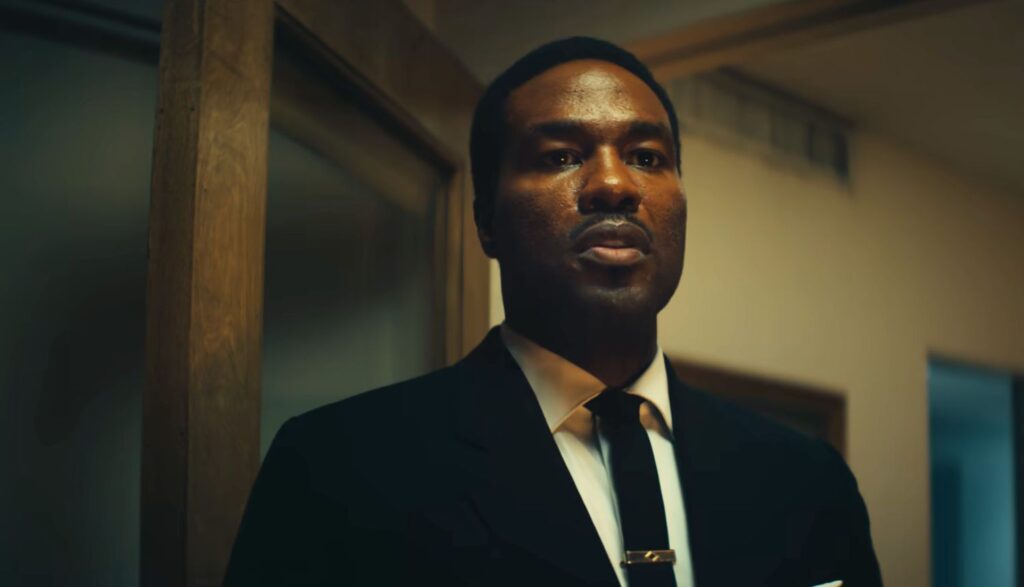
An African American FBI agent pairs up with a mob hitman in 1966 Mississippi amidst racial suppression and violence. They aim for justice—but may settle for retribution, instead. This period piece is well-acted and depicts the evils of racism. But bloody violence, including torture, abounds, along with harsh language and some sensual moments.
Special Agent Wayne Strider is coming home.
That home is Mississippi, 1966. As a newly minted agent of the Federal Bureau of Investigation, he hopes to do some good for his community. They say you can’t go home again, but for Wayne, home remains all too familiar.
Wayne, you see, is African American.
While the Civil Rights Movement has taken root and borne fruit elsewhere, the seeds of equality have struggled in the parched Deep South. And what gains have been made haven’t come without cost.
Racial violence is rampant. White supremacists use threats and violence to suppress their Black neighbors. And when anyone does “get out of line” … well, that often leads to the types of tragic cases that Wayne became an FBI agent to solve.
But the good ol’ boys in Mississippi don’t much care for government agents, much less a Black one. Even the people Wayne hopes to protect aren’t talking: They live in fear of retribution. Justice is stifled at every turn.
So, the FBI turns to injustice.
Gregory Scarpa is a mafia hitman who works for the Colombo crime family in New York City. He also happens to be an FBI informant. Evidently, as the mobster tells Wayne, this isn’t his first time to the South. The FBI had leveraged Gregory’s unique interrogation skills to find the bodies of civil rights workers Chaney, Goodman and Schwerner two years earlier.
Wayne is assigned as Gregory’s handler for this most recent trip—and it doesn’t take long for Gregory to start drawing blood.
Wayne is far from comfortable with this arrangement, but he wants justice. But racism and violence are embedded in Mississippi like fat ticks.
Is Wayne willing to fight back, by any means necessary?
Wayne believes in the law and seeks justice within its confines, even in the face of significant resistance. He is shocked by Gregory’s lawlessness (and the FBI’s sanction of it) and attempts to rein in the mobster’s brutality.
Allison, Wayne’s wife, provides him with unwavering support. She willingly joins her husband in his return to Mississippi and stands firm in the face of the subsequent danger they face. Allison also gets involved in helping the local African American community in Mississippi. For his part, Wayne works to prepare his wife for the danger they’ll face.
A man bravely defends his family and sacrifices himself to ensure their safety. Someone says, “When a man has enough, he has an obligation to give back.”
When Wayne expresses his distaste for Gregory’s violent (and very illegal) methods, Gregory replies that “turning the other cheek” hasn’t been doing much good for African Americans living in Mississippi.
A white supremacist leader twists Christian history to justify the evil ideology and deeds of the Ku Klux Klan (KKK). He claims that white (non-Jewish, non-Catholic) Americans are “God’s chosen people” who tamed a “savage nation.” References are made to the “blood of martyrs” and the medieval Crusades. The man also speaks of the cross as the sign of Christianity—this is juxtaposed with a scene of a cross set aflame as a KKK rallying symbol. Another burning cross is glimpsed later in the film. A picture of Jesus hangs on the wall of a racist man’s house.
In the wake of a tragedy, Wayne and Allison pray together. Allison prays for the salvation of a man who has recently died and quotes Psalm 23:4.
Someone jokingly compares Wayne to the prodigal son. Someone claims to be a “man of God.” A man says he is “blessed.” A woman mentions an “evil eye.”
Wayne and Allison kiss a few times. In one scene, they smooch passionately before getting interrupted. When Wayne teaches Allison how to handle a gun, he positions her legs to be in a more stable stance, which she takes flirtatiously.
Gregory kisses his wife. However, we later see him with a different woman in a hotel room. His mistress wears revealing lingerie. They kiss and she climbs on top of Gregory while Wayne is still in the room. The mobster jokes that Wayne might like to stay and watch them have sex.
A husband and wife talk about “making babies.” Gregory tells a lecherous (and fictional) story to someone to lower their guard.
A woman wears a dress that shows some cleavage. She is seen later in a modest nightgown. Gregory often wears a sleeveless undershirt that shows off his physique.
By Any Means contains a bevy of violence in its 107-minute runtime. Much of this violence is racially motivated, with white supremacists attacking—and in some instances, murdering—Black men and women. Hooded men shoot guns and firebomb houses.
A family’s home is burned down, and someone dies in the inferno. An elderly woman is killed in retribution for speaking to the authorities. (We don’t see her death, but we do see her lifeless body afterward.) Others are threatened with guns and/or beaten.
Most of the rest of the violence comes from Gregory’s savage interrogation tactics. He is quite comfortable with torture, and some of it shows up on screen. The mobster beats people within an inch of their lives, and we are shown the bloodied, swollen results. He slices up one man with a knife and shoots a few others. He breaks a man’s knees with a baseball bat and burns someone else with a cigarette. In one scene, Gregory has one of his torture victims remove the underwear from another man: It seems Gregory plans to make the man watch as he mutilates the other man’s genitals. (Nothing critical is seen and, mercifully, that element of torture doesn’t happen.)
Wayne doles out (and receives) some punishment as well. A group of men beat and choke Wayne, which is only broken up when Gregory hits some of the assailants with a car. Wayne and Gregory get into a scrape, punching and kicking each other.
A man’s head is slammed into a glass case. Cars swerve dangerously on a busy road during a chase, and one of the vehicles crashes.
Someone shoots and kills a man’s dog. (Though it’s hard to feel bad for the grieving owner since he himself had participated in the killing of a human being.) It’s insinuated that a man will be sexually assaulted in prison. We hear about lynching. Old news footage shows a police dog attacking an African American protestor. A man is forced to testify under the threat of death.
We hear a story about a police officer who broke a child’s jaw and arm.
More than 100 f-words are used, including several instances preceded by “mother.” The s-word is used 13 times. God’s name is misused six times, often paired with “d–n.” Jesus’ name is abused five times.
The n-word is heard eight times. Other racial slurs, including “kike,” “wop” and “cracker” are used. The terms “colored” and “Negro” come up frequently.
Additional profanity includes “d–n,” “a–” and “a–hole,” “h—,” “b–ch” and “son of a b–ch,” “b–tard,” “p—y,” “d–k” and “pr–k.” Someone uses the term “h—bent.”
Men and women smoke cigarettes. Someone pours himself a drink. A liquor bottle is glimpsed in the background of one scene.
Wayne shares that, as a kid, he burned a police officer’s car as revenge for the officer’s vicious beating of Wayne’s friend. Wayne wasn’t caught, which he still feels guilt over, and this drives him to make sure others don’t “get away” with their crimes.
Gregory frequently calls Wayne “Jackie Robinson” because Wayne is the first Black FBI agent he has seen. (Wayne points out that he is far from the first Black federal agent.) We’re told that African American voters in Mississippi are forced to pay a “poll tax,” which was a means of suppressing their right to vote. Gregory refers to African Americans as “you people” and makes a degrading comment about “shining shoes.”
Wayne and Gregory discuss the methods of Martin Luther King, Jr. versus Malcolm X.
When Gregory learns his son received a black eye from a classmate, he tells the boy to get retribution—and to make it much worse than a black eye.
Local law enforcement turns a blind eye to racial violence. Someone accepts a bribe.
By Any Means tells what you might call an “adjacent to a true story” tale. Gregory Scarpa was a real mafia hitman who served as an informant for the FBI for several years. Scarpa was alleged to have assisted the Bureau in digging up information on the Chaney, Goodman and Schwerner murders—and later, the Vernon Dahmer murder with (as the film’s end credits tell us) an unnamed Black federal agent serving as his handler.
The film treats those claims as fact to deliver a story about racial violence, suppression and (eventually) retribution in 1960s Mississippi. By Any Means depicts an ugly time in American history and the ugly means that were used to get convictions for race-driven crimes.
By Any Means boasts solid performances while providing an unflinching depiction of the evils of bigotry and racism. But this is not a movie where evil is overcome with good. Despite Wayne’s hope to see justice done within the law, By Any Means tells us that the methods of Gregory Scarpa (you know, the murderous hitman) simply work better. If you can’t beat ‘em, beat ‘em, this period piece seems to say: The ends justify the means.
It’s a message that can be dangerously satisfying—to repay evil with evil. But it runs contrary to a Christian ethos. As the Apostle Paul wrote in Romans 12:
“Beloved, never avenge yourselves, but leave it to the wrath of God, for it is written, ‘Vengeance is mine, I will repay, says the Lord.’ To the contrary, ‘if your enemy is hungry, feed him; if he is thirsty, give him something to drink; for by so doing you will heap burning coals on his head.’ Do not be overcome by evil, but overcome evil with good.”
Given the film’s ultimate message, not to mention loads of bloody violence (including torture), harsh language and some sensuality, discerning families will likely want to avoid this pic, well, by any means.

Bret loves a good story—be it a movie, show, or video game—and enjoys geeking out about things like plot and story structure. He has a blast reading and writing fiction and has penned several short stories and screenplays. He and his wife love to kayak the many beautiful Colorado lakes with their dog.