

Note: This article was originally published on May 14, 2026. With the official announcement that Meryl Streep is indeed voicing Aslan in Greta Gerwig’s adaptation of C.S. Lewis’The Lion, The Witch, and the Wardrobe, we wanted to once again share our thoughts and offer a Christian perspective on the matter.
Narnia is my second home.
I grew up on C.S. Lewis’ classic children’s books, The Chronicles of Narnia. Sometimes, on lazy summer days, I’d reread one in an afternoon. The Last Battle was the first book that made me cry. The Silver Chair was the first book that made me think about faith and doubt. The Magician’s Nephew was, perhaps, the first book that made me want to be a writer.
I thought that Disney’s three films based on The Chronicles of Narnia were fine. But for me, they didn’t quite capture the power, humor and resonance of the books. So when I heard that Greta Gerwig would be bringing Narnia to Netflix, I was thrilled to journey through the wardrobe once again. Gerwig is a talented director who knows something about Christianity. Her Oscar-nominated film, Lady Bird, has some difficult, R-rated content—but it was also a surprisingly sweet and sympathetic depiction of faith, too. (You can read my interview with Gerwig about Lady Bird here.) And she, like me, is a bit of a Narnia geek.
“I’m slightly in the place of terror because I really do have such reverence for Narnia,” she told BBC Radio 4. “I loved Narnia so much as a child, [and] as an adult, C.S. Lewis as a thinker and a writer. I’m intimidated by doing this.”
I sympathize. But now—with Gerwig’s version of The Magician’s Nephew now set for release on Feb. 12, 2027, I’m not so sure what to think. Here’s why.
Puzzle-d
In the movie Project Hail Mary, scientist Ryland Grace tries to communicate with an unusual helpmate, endowing it with a variety of voices. He even tries out Meryl Streep’s voice at one point. “She can do anything,” Grace sighs.
And that’s almost true. Almost.
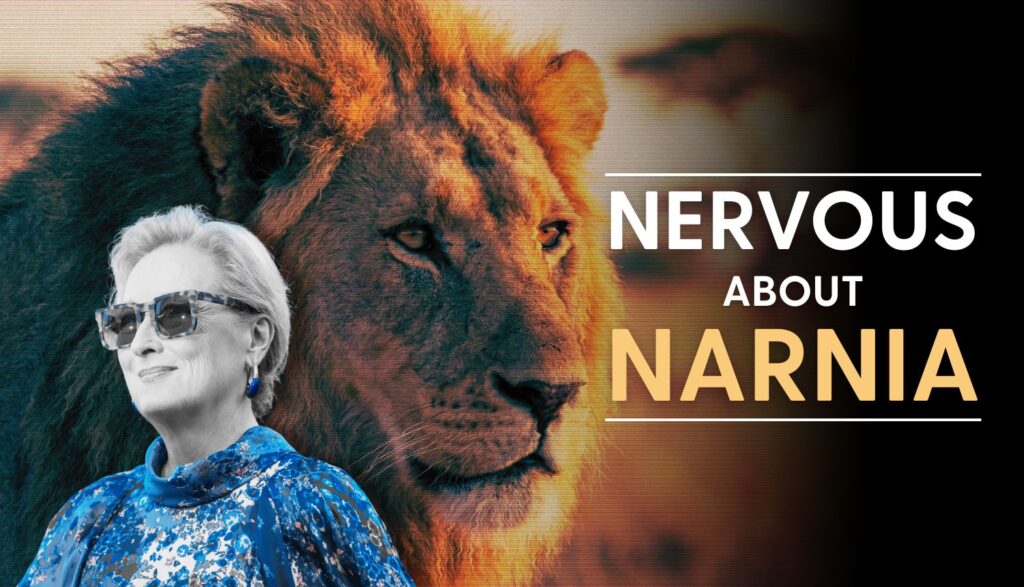
Last April, rumors started swirling that the Oscar-winning actress would be voicing Aslan, Narnia’s great lion, in Gerwig’s adaptations. While those rumors have never been confirmed, a partial cast list for The Magician’s Nephew was revealed earlier this month, and Streep is indeed on the list (along with other A-listers such as Daniel Craig and Carey Mulligan).
Is Streep going to be voicing Aslan? We just don’t know. But if she is, that’s a problem.
As you likely know, C.S. Lewis wasn’t just a children’s author. He’s perhaps best known as one of the 20th century’s greatest Christian apologists, helping many folks reconcile faith with reason. And for Christians, his Narnia books come with an unmistakable Christian heartbeat. You don’t need to be a Christian to enjoy Lewis’ adventure yarns—but it adds additional layers of meaning and resonance.
Aslan, son of the Emperor-Beyond-the-Sea, is Narnia’s avatar of Christ. The great lion says so (in so many words) in The Voyage of the Dawn Treader. “In your world, I have another name,” he tells one of Narnia’s visiting humans. “You should know me by it. This was the very reason why you were brought to Narnia, that by knowing me here for a little, you may know me better there.”
Obviously, switching the gender of Aslan from male to female—even if that female has won three Academy Awards—will be sure to infuriate a great many Christians and limit the movie’s appeal.
But even if you set aside those faith-based concerns, a Streep-as-Aslan casting decision just doesn’t make narrative sense.
Not Safe, But Good
Narnia is, obviously, another world—very different from the one we inhabit. Animals can talk. Horses can fly. Lamp posts grow right out of the ground. (Or, at least, one did.) As such, God’s interactions with such a world would look different from God’s interactions with ours. Thus, Narnia’s savior takes the form of a lion, not a man.
Certainly, many would say this is not theologically correct, at least if we interpret Genesis 1:27 literally. That verse tells us that we people (“male and female,” according to the Bible) were created in God’s own image, and we don’t look a thing like lions. Those big cats are products of the sixth day of creation, not the seventh. But no matter: Most Christians don’t have a problem with Lewis’ characterization of Aslan. Imaginary worlds get a lot of theological leeway.
But when you’re working in someone else’s imaginary world, you should adhere to its own rules. Narnia was created by C.S. Lewis. And Lewis wrote Aslan in as, not just a lion, but a male lion.
I think that Lewis wrote Aslan as such because of his mane. That mane serves as both a crown and halo for Lewis, a symbol of authority, a golden reflection of the sun. Characters lucky enough to sink their faces into that mane feel comfort, power and peace. And if they’re lucky enough to ride on Aslan’s back, they hold onto that mane for dear life.
And that mane takes on special significance when we hit the most famous Narnia book of all: The Lion, The Witch and the Wardrobe. It becomes not just a symbolic crown, but—like Christ’s own crown of thorns—a symbol of sacrifice.
When Aslan chooses to lay down his life for a traitor (Edmund Pevensie), the lion’s mortal enemy, the White Witch, shaves off Aslan’s mane. It’s an act intended to mock and humiliate the lion, a vindictive exclamation point for the Witch’s supposed victory. And it’s telling that when Aslan rises from the dead (as he does), the mane has grown back. The lion’s majesty and power have been restored.
That mane is a key element in Aslan’s character, both literary and theological. Turn Aslan into a female lion, and the mane is stripped away. And with it goes so much of the story’s power and pop. What the White Witch failed to do, Netflix might try to do again—without any real vindictiveness, but without real purpose or reason.
Again, setting aside the theology for a moment, Aslan without a mane ceases to be the Aslan that Narnia fans know and love. And a Narnia without Aslan—without that Aslan—ceases to be Narnia at all.
Greta Gerwig is, as I said, a very talented director. She appreciates the chronicles, she understands the stakes, and I’m sure these thoughts are not alien to her. But I hope, for the success of her project, that the Streep-as-Aslan rumors are untrue. Narnia deserves its ultimate savior and symbol, golden mane and all.
For more on Narnia, check out Plugged In’s Rewind on The Chronicles of Narnia: The Lion, the Witch and the Wardrobe.

19 Responses
“Obviously, switching the gender of Aslan from male to female—even if that female has won three Academy Awards—will be sure to infuriate a great many Christians and limit the movie’s appeal.”
I don’t remember a big upset when the devil was portrayed as androgynous in “The Passion of the Christ” (at least not from the Christian right—I do remember the film being characterized as some variant of homophobic because of that, cf. criticisms of “300”) and was played by a woman, Rosalinda Celentano.
Also, if I may make a minor correction:
“Her Oscar-winning film, Lady Bird”
I love love loved Lady Bird, but it didn’t win any of the Oscars it got nominated for.
Erik, you’re right–thought Laurie Metcalf snagged one, but we’ll get that corrected.
The Percy Jackson series: “Hey let’s stir up some controversy by casting Athena as black.”
The Narnia series: “Hold my beer.”
Asking a woman to play the part of a man (or vice versa) is a bad idea regardless of what script you’re using.
Having a woman play Aslan is a hate crime against Christianity
I always thought the best books were the ones that did not get made into films. The Horse and His Boy, The Magician’s Nephew, and The Last Battle were all incredible. Even with all of their greatness, I would much rather they just had no films forever than have them made into bad films. Aslan should not be female. Period.
Also, why is Gerwig making The Magician’s Nephew first? I don’t care as much as some people do as to what order the books are read in, but you absolutely cannot read The Magician’s Nephew before The Lion, the Witch, and the Wardrobe!
To me it makes sense because chronological order has The Magician’s Nephew as the first book. It’s kind of like ordering all the Star Wars movies in the order that makes sense when you look at origins. Now, I do also agree that LWW is definitely one that should be produced first even if it feels confusing.
I’m a teacher, and this year I decided to revisit The Chronicles of Narnia by reading the entire series with my students. They loved the stories, but the further we got in the series the more disturbed I became. I guess when I read them as a kid I didn’t think much of the tie to Christianity. I just enjoyed good adventure stories.
However, now that I’m much older, I am actually put off by the series. It feels like indoctrination to me, so we have had several discussions about author’s purpose and Lewis’s faith. But it’s not just the pushy religious rhetoric that bugs me. The series is riddled with misogyny and, in two of the novels, racism. The Calormenes are frequently criticized for the way they smell (of onions and garlic), and their culture. Plus, their brown skin is mentioned several times in a negative light, including the word “darkie” used as a slur. Simply put, I am no longer comfortable reading those books to kids, and I won’t be watching the films. So they can make Aslan whatever they want as far as I’m concerned.
The racism critique I agree with to some extent; the same concern could be raised for the LOTR. A lot of content that nobody thought twice about back then, has not aged well.
However, calling the Narnia series “indoctrination” strikes me as irrationally paranoid. I honestly don’t see the difference in mentality between that comment, and conservative parents not letting their kids read Harry Potter because they’re afraid it’ll turn them into witches. I guess when you’re adverse to a certain worldview, you’ll see it lurking in every imaginable corner.
Mike, I understand why you would not be comfortable reading the books in class, but I do want to mention that it is a group of dwarfs that has turned evil and is shooting all the talking horses who is calling the Calormenes “darkies,” not the Narnians loyal to Aslan. Lewis later shows these dwarfs blind to reality and suffering in the afterlife because of their actions.
C. S. Lewis does criticize the Calormenes for forced marriage of child brides, human sacrifice on the altar of their multi-armed bird-god Tash, and their allowance of slavery with his writings in The Last Battle and The Horse and His Boy books. They are also described as using scimitars, having darker skin color, riding in litters, building spires, living on the edge of the desert, wearing curved toed shoes, and two of the girls use veils as a disguise. Although the Calormenes do not exactly fit any religion of our world and we meet Calormenes who are good guys, these descriptions are not politically correct by today’s standards.
However, I do want to emphasize that in comparison to other books of the time, Lewis was ahead in many ways. Shasta later marries Aravis (an interracial marriage) and they become King and Queen and the Calormenes we meet are as involved in the story as other characters and they aren’t all the same.
Lewis is criticized for writing two antagonists, Jadis and the Lady of the Green Kirtle, as being women, however the male characters: Rabadash, Miraz, Shift, and Rishda were the main villains of other books. When it comes to ancillary characters, Lewis does gravitate to having most of the talking beasts, dwarfs, and fauns we meet being male, but among main human characters, half are girls: Polly, Jill, Aravis, Susan, and Lucy, and they all have different personalities and the novels usually meet the Bechdel test’s standard of having at least 2 named female characters have a conversation with each other about something other than a man. (Which is a standard that 43% of movies fail.) And although Susan is generally reserved, the other girls do take initiative and do brave things.
Susan is criticized for abandoning Narnia for parties, lipsticks, and nylons by Polly. Some people take this to be a criticism for women’s fashions. My mom explained to me as a child, that in the 1950s, lipsticks and nylons were still thought of as improper in the U.K. by the older generation, even though it was not that way in America. Apparently Ruth Graham, Billy Graham’s wife, was criticized for wearing lipstick in England back then. Aravis’ friend, Lasaraleen, is also criticized for caring too much about fancy clothes, but it is implied that it is because fashion is all she cares about, and Lewis also criticizes English clothes many times for being uncomfortable for both girls and boys. In fact, Digory’s Uncle Andrew is truly mocked in The Magician’s Nephew for his trying to look “respectable” without being respectable.
I realize that this is insufficient for today’s standards, but I do believe Lewis was more progressive than many writers of the 1940s-1960s, and even many movies I’ve seen from the 1980s and 1990s. Obviously, Christian writers should be held to a higher standard than secular ones, and children do not have the context when reading if they read Narnia by themselves, but I think Lewis did not intend to make a racist or misogynist series.
They’re also changing the timeline, setting Magician’s Nephew in the 1960s, which basically upends the entire rest of the series.
But I gave up expecting Hollywood to respect the source material for ANY IP a long, long time ago. So this doesn’t even really surprise me anymore. This is why I stick to anime these days. (Incidentally… there’s a fantastic manga adaptation of The Magician’s Nephew. I read it last year. Gorgeously illustrated and the text comes right out of Lewis’s novel.)
(Those big cats are products of the sixth day of creation, not the seventh.). Slight error, lions and humans were both made on the sixth day of creation, nothing was made on the seventh, thus it became the day of rest.
She would make an excellent Jadis. I’ve got hopes!
At this point Meryl Streep is only a circulated rumor. There has been other named attached to the film since, including Cirian Hinds. He potentially might be Aslan, time will tell.
So blasphemous and demonic, but not as bad as Cynthia Erivo in JCSS
When Barbie was coming out, Greta Gerwig, who is also directing this, said that the film was a “reverse of the Creation myth, because Barbie (woman) was created before Ken (Man).” It’s clear this woman has zero respect for God. Not sure why CS Lewis’ estate allowed Satanic Netflix to make this when they could have sold it to Angel Studios.
People were already going to be mad when they announced Greta was directing, and as someone who really doesn’t like the Narnia books, I am interested to see her adaptation I think the noise online is usually from a small, very loud, few but it’s still gonna be loud.
Much like whatever the heck was going on when The Rings of Power was premiering, I’m guessing the lead up to this thing to be toxic and ridiculous when at the end of the day it will cost you $0 to not watch it or interact with it. Speak with your wallet and if there really is enough out there it’ll fail.
But also, this is all rumors. I need to see footage before I judge and so does everyone else.
As a Narnia fan, I have avoided discussing this subject with people who are not very familiar with Narnia, because I do not want to undermine Gerwig’s movie; it may be just a rumor, and she may not have a choice in the matter.
These are my reasons that Aslan should be a male lion:
1. If a story is well-written, changing the gender of the main character will change how the character reacts and also how he or she is treated.
2. There has not been a movie adaptation of The Magician’s Nephew before and I hope to see one that is fairly faithful to the messages of the book.
3. C.S. Lewis was more experienced with father figures; he deeply loved his mom when he was a child, but she died of cancer. He took in children to his home in Oxford during the Blitz to protect them from the bombing of London, so his personal experience relating to children was as a paternal figure.
4. Aslan sacrifices himself for Edmund’s betrayal and is humiliated by Jadis’ followers. There is a movement in society to blame all society’s problems on women. But historically, our Western culture valued the strong sacrificing themselves for the weak, to protect them, instead of tearing them down. Of course, many women, children, and men with physical disabilities have sacrificed themselves to help and save others, but Aslan is setting an example for the Pevensie children in addition to saving Edmund. As kings and queens, they will then have great power and they also put themselves at risk. Susan was planning on marrying a man two countries away which would have created an alliance with Calormen. Peter almost died fighting Miraz to keep the Old Narnians from having to fight. Lucy and Edmund fought to defend their neighbor: Archenland. A female Aslan would also have great power as the representative of God in Narnia, but audiences would be more likely to think of Jadis as an analog to her, like a Yin-yang situation or the belief that the Devil is equal in power to God. As for me, I am a Christian woman, so because C.S. Lewis is so clear that Aslan represents Jesus Christ in Narnia, it doesn’t feel okay to change him.
5. Digory’s father is absent for work, and Digory is left with his mom who’s very ill, Aunt Letty, and Uncle Andrew. Uncle Andrew is a terrible father figure to Digory and Aslan is a positive one.
Benefits of Aslan being portrayed as female:
1. Aslan creates Narnia and brings life into it. Women are usually given the ability to bring children into the world, so this would relate to the aspect of creation in the first book.
2. Meryl Streep is a good actress.
3. Critics will praise and complain about the movie for being revolutionary and progressive, which will bring press to the franchise and get more people to hear about it.
4. The Guardian wrote an article about how Narnia is misogynistic. I don’t believe it is fair to the series and it leaves out crucial plot points, but if Aslan is portrayed as female, maybe it would get in their good graces. Or maybe not, what with the sacrifice issue.
To clarify, I do not want Aslan’s gender to be changed and don’t think I’d watch the movie if they did, but these points are probably things we should be discussing.
The whole project is obviously intended as a slap in the face to Christians. The best case scenario at this point is that families won’t tune in and it will fail miserably. For once we should refrain from giving money to people who hate us. Only then will beloved franchises return to normal.