



Backrooms was the talk of the box office this past weekend. The R-rated horror movie earned $81.4 million (just a bit lower than Monday’s estimates) and, in so doing, may mark a shift in how Hollywood does its business.
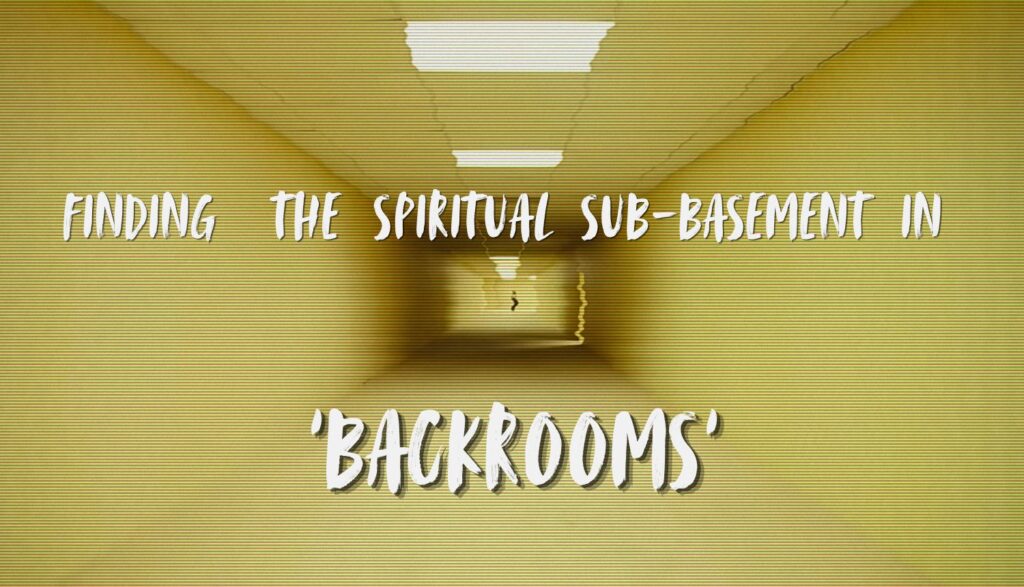
You can read about Backrooms’ interesting backstory in my review. But in short, the movie’s fright factor is based on a popular and growing internet theme predicated on liminal spaces. Those spaces are huge, uncanny and empty—or, at least, they would seem so at first.
But just why do these spaces look so creepy? What’s so horrifying about a bunch of rooms with yellow wallpaper?
I think the answer is more spiritual than you might think. So let’s dive—carefully—into Backrooms’ own backrooms and see just what might be lurking in its corners.
[Note: We will be getting into spoilers below.]
Things That Go Bump
What scares us? We may think of sharks or monsters or that thing under the bed. But what really frightens us are the unknowns of it all. Sure, spiders creep a lot of people out, but the spider you see on the table is far less freaky than the one you imagine crawling on your neck. The monster under the bed probably wouldn’t be so monstrous if he came out and introduced himself: It’s the fact that he lurks in the dark—unseen but fiercely imagined—that triggers the calls for “Mom!”
You need a little eeriness to make something scary. Otherwise, every trip to the mailbox (filled with its unknown bits of junk mail) would terrify us. And Backrooms gives us a sense of disquieting familiarity.
Backrooms’ yellowed walls and fluorescent lights don’t look that dissimilar from spaces we might see every week. And that’s the point: It’s familiar, but not. It gives us an uncanny mirror into the spaces we inhabit every day—but one twisted and contorted. Clark, one of the film’s characters, tells us that the backrooms seem like the work of an architect who’s been told what a room or a hallway or a furniture store might look like but has never seen one for himself.
But Backrooms’ real horror comes not from what we see, but from what we don’t. Those yellow walls are pocked with openings. Its floors marked with pits. Rooms open into more shadowy rooms that could hide anything. Doors may open either to safety or death.
Backrooms brings the time-honored haunted house into the 21st century and gives it a sci-fi spin. But even as the movie’s rooms sprawl out to infinity, the movie comes with an inward component as well. This isn’t just a supernatural realm, but a psychological one. And perhaps the most terrifying element that visitors must face is themselves.
The Only Thing We Have to Fear …
Clark, one of two primary characters we meet in Backrooms, is a furniture salesman who’s been kicked out of his house by his wife. Clark’s tendency to spend long hours at work and drink heavily once he leaves were the catalysts for the split, he admits—but Clark argues to his psychologist, Dr. Mary Kline, that his wife is unreasonable. He works so hard for her, after all. He deserves a drink or three.
But Clark also makes an interesting admission. “Maybe I deserve to be alone,” he tells Mary. He’s made mistakes. He let his work get in the way and his anger get the best of him. Maybe he deserves what he gets.
So when Clark stumbles into the backrooms from a secret door in his furniture store, it seems to be a place at least partly of his own making. The first room features a pile of furniture in the middle of it. Other areas are filled with chairs or couches or even wooden ships’ wheels embedded into the walls. One room contains a beachy wall mural—one identical to that in his store’s own showroom.
And Clark is alone. All alone with … himself.
Without spoiling too much of the film, Clark is indeed his own worst nemesis here. (And he’s not too nice to anyone else who stumbles into the backrooms, either.) But even with that danger, Clark comes to appreciate, and even embrace, the backrooms. They’re horrific, yes, but he belongs there. Maybe he deserves to be alone.
In Dante Alighieri’s book Inferno, the 14th-century Italian author created nine circles of hell and populated it with all of his, and history’s, enemies. In Backrooms, Clark creates his own land of torment. And he populates it with himself.
A Peak Beneath the Wallpaper
Backrooms takes place in the early 1990s, a time devoid of smartphones and the internet. But it is a product of the 2020s and speaks to the horrors of our own time. Yes, we’re still terrified of the unknown. But the unknown’s most terrifying aspect isn’t something we find outside ourselves, like spiders or sharks, but inside.
We don’t like silence, so we fill our own liminal spaces with noise. Whenever we may be at risk for a moment of contemplation or (shivers) boredom, we pull out our phones and check social media or play a time-wasting game.
We seem terrified to confront ourselves in these empty spaces. So we fill those spaces with whatever is in our hands. Thank goodness the phone in our hands is filled with endless distractions—distractions enough, in fact, to fill even the most cavernous of our own psychic backrooms.
We fill the silent spaces because we fear them. We fear them because we fear what we might encounter there.
That is why we might get goose pimples when we see a picture of a yellowed hobby store in need of renovation. We see the emptiness. We feel its silence. It is a place void of distraction, one where we must confront the hidden parts of ourselves. The elements of our personalities that we keep hidden and locked away. The pieces that even we long to forget and unknow. We must grapple with our own fallenness. And that is a terrifying thing. We fear the unknown, yes. But when it comes to our shadowed selves, the worst parts of us, we’re even more scared of other people knowing us.
Maybe we deserve to be alone.
But even in such liminal spaces, either physical or psychological, God is there. Maybe God is especially there. Even if we fear to see the ugliness in ourselves, God sees and loves us anyway.
O Lord, you have searched me and known me!
You know when I sit down and when I rise up;
you discern my thoughts from afar.
You search out my path and my lying down
and are acquainted with all my ways.
Even before a word is on my tongue,
behold, O Lord, you know it altogether.
You hem me in, behind and before,
and lay your hand upon me.
Psalm 139:1-5
The psalm goes on to ask, “where shall I go from your Spirit? … If I ascend to heaven, you are there! If I make my bed in Sheol, you are there!”
Even in the backrooms of our souls, God is there. Thank goodness.
One of the things about our noisy, screen-filled, always-on culture is that it’s so hard to hear God speak to us. Until we see our secret selves can we truly grasp the grace and love of God. We do deserve to be alone—separated and broken from our Divine Creator because of our own sins. But through His mercy, we can be with Him. We can call ourselves His children. If we simply reach out.
Yes, reaching out can itself be terrifying. The God we reach for is beyond our comprehension. And there’s always a chance that, in listening to His call, He might call us somewhere uncomfortable. Frightening. Unknown. God has a way of opening up doors we never imagined would be there, and it can be terrifying to walk through them.
And yet, when we hear the call of a still, small voice through that door, we know—we know—that whatever lies on the other side is where we ought to be.

3 Responses
I find liminal spaces appealing, because I think it’s appealing to the human fear of the unknown. I haven’t watched the movie as I don’t watch R rated movies. However I have lurked through the liminal space subreddit, and I think the pictures are very intriguing. They make us wonder “Why is nobody in these places that are supposed to be packed”
I think the reason Gen Z is digging this, as a member of Gen Z myself, I think it’d because the future seems uncertain.
I really like the approach you took in finding God in this movie! I won’t end up watching it, but I’ve been interested in its story since I watched the trailer and an old youtube backrooms video. Your perspective really opened my eyes!
The producers of “Backrooms” must have done SOMETHING right to warrant such a deep, extensive spiritual analysis.