
A gay, drug-selling party planner learns that he has a 10-year-old son he never knew about. And when the boy moves in with him, the experience changes his life. Club Kid might be about an unconventional family, but the sexual content, drug use and language make this an extraordinarily poor movie for families.
Sex. Drugs. Clubs. Music.
That’s been Peter’s life for … oh, let’s just say, for a long time now. He can’t remember what happened last night, much less what happened a decade ago. The nights blur together anyway.
Like vampires, Peter and his friends have always come alive at night. At the sun’s farewell, the party begins—across apartments and nightclubs and bars, through the glowing, pulsing city: New York on fire with blues and reds, reedy light and inky shadow.
You feel the city in those hours—the grinding, thumping beat on the dance floor pushing against your feet, your chest, your head. Bodies press and move like birds, like snakes, like fish.
And then the sun arrives again, spoiling another grand party. Peter may spend a few hours under the covers with a male partner, or two, or three. Or perhaps he’ll just sleep, readying himself for another night.
So it is. So it was. So … will it always be?
Peter may wonder how long this partying life can last. It used to be fun. But is it anymore? The drugs have begun to eat at his mind, rat-like and rabid. He’s a young man, but he feels so old.
These all-night parties have always been his parties, a money-making enterprise filled with his guests, his friends, his music. His friend, Sophie, used to run the business side of things. Peter’s job was to bring in his connections and be the life of the party.
But now, it feels as though the life is ebbing out of him. His pretty skin is slipping, revealing a not-so-pretty human underneath. The business is slipping, too. He’s selling drugs on the side now, hoping to pay the bills.
Sophie doesn’t want him as a business partner anymore. She’s kicking him out of his business. And he’s barely coherent enough to protest.
And then, one hazy, blurry morning, Edison, an old acquaintance, begs to be let up. And she comes with a surprise.
A kid.
Arlo’s 10 years old. Edison tells Peter that Arlo is Peter’s son.
No, Peter protests. It can’t be. He’s never even had sex with a woma—no, wait.
One night, in the midst of the drugs and music and skin and flesh—a night that blends in with all the others—he remembers. Barely.
Edison tells Peter that Arlo’s mother is dead. Peter is the kid’s only family. Peter protests: Maybe he is Arlo’s father … but he can’t be a father. Not when he’s so messed up, so like a child himself.
Edison understands, but she has things to do. Just watch Arlo for a couple of hours, she tells him. Edison will come back and they can figure everything out.
Then she’s gone. And despite her promises, she’s not coming back.
Peter has no job, no money. His mental health hangs by a thread. He’s as irresponsible as they come—and now, he’s responsible for a child.
Club Kid has plenty of problems, and we’ll get into all those. But underneath them all, this movie tells us something that Plugged In would say as well: Fatherhood is impossibly hard, incredibly important and unbelievably beautiful.
When Arlo first shows up, Peter is an unmitigated mess. His best friends would say so. He would admit as much. And when Edison doesn’t come back (surprise, surprise), Peter’s forced to engage in a rare night of sobriety to care for the boy.
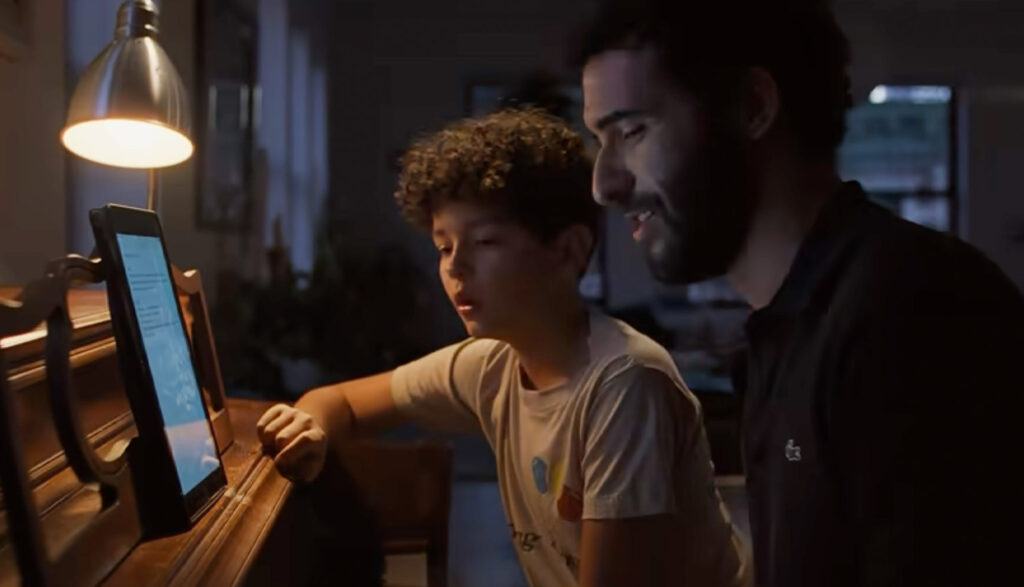
As time goes on, the two begin to bond—over music, over food, over shared traumas. Peter’s night of sobriety stretches into two. Then more. And while he does slip at least once, spending a night drunk and high, he discovers he kinda hates it now. He writes a memo to himself to quit drugs forever, at least partly for Arlo’s sake. And he seems to stick with it.
Certainly, Peter’s far from an ideal parent. But he cares for Arlo, and he even begins to put a few very basic (and very imperfect) rules in place to safeguard the kid’s physical and emotional well-being. When he realizes that Arlo needs to work through some mental health issues, he arranges meetings with a counselor for the boy. He comes to love Arlo. And Arlo, in turn, loves him.
[Spoiler warning] But as much as they both might like to hang out together—imperfect father with imperfect son—Peter’s own history ultimately makes that impossible. Authorities ultimately step in and send Arlo back to his native England, to be cared for by a loving, willing and responsible foster mother. While the movie mourns this separation, it grudgingly acknowledges that it may be for the best. Because sometimes love and good intentions simply aren’t enough to raise a child.
When the movie ends, we have a feeling that Arlo is being well cared for, even if he misses his dad (who is invited to come and visit). And Peter’s in a better place, too. He tells a friend that he’s staying mostly sober, only accepting the occasional drink (he works at a bar). He turned his back on his clubbing past, and he seems happier for it.
None.
Peter’s world before Arlo belongs almost entirely to a string of LGBT-centric parties and clubs. The majority of Peter’s friends are in the trans community, and pretty much all would identify as gay or lesbian.
We see plenty of sexual and sensual activities in those parties and clubs. The first one we access features a woman who appears to have three exposed breasts, and most of the club’s revelers are either shirtless or very scantily attired. Some rear ends are almost entirely exposed (covered only with thong-like garments), and dancers of both sexes and all divergent sexual leanings kiss each other and writhe on the dance floor.
Peter meets Arlo’s mother during one such party: She comes on to Peter, complimenting him on his hairy body and whatnot. Peter seems entirely disinterested. But later, as he’s making out with a man in a darkened room (we see them kiss and indistinct bits of flesh), she joins them, kissing and pressing against Peter. The scene gets hazier and impressionistic, perhaps mirroring the participants’ drugged states of mind, so we don’t see any critical body parts.
When Arlo comes into the picture, he meets many of Peter’s friends—again, most of whom would fall under the queer banner. He asks several if they’re “trans” upon first meeting them (though Peter cautions that that’s a faux pas), and one, Saffron, becomes a sort of mentor for Arlo. The boy learns how to DJ from Saffron, and the two eventually convince Peter to let Arlo DJ at least a portion of one of Peter’s lurid parties. (Peter may be mostly sober, but he relaunches his sex-and-drug-drenched party-planning business to pay the bills.)
Peter acquiesces, but only for the 10 p.m. frame of the party—before things get too crazy. Even so, we see plenty of dancers (most of them LGBT or dressed in drag) sultrily twist on the dance floor. The second party Arlo DJs for, however, takes place at 1 a.m.—when Peter and Saffron both admit the crowd gets wilder, drunker, higher and more erratic. Though the initial dancing doesn’t look much different to us moviegoers, Peter notices a difference and decides he’s made a mistake: He pulls Arlo away from the stage, and together, the two make their way through the dancers—some of whom leer at and touch Arlo. When Peter loses Arlo for a few minutes in the party’s chaos, he’s clearly panicked, not sure what some of his “guests” might do to his boy.
At the beginning of the movie, Peter rooms with and sometimes has sex with a guy named Nicky, who describes himself as an “aspiring queer philosopher from Azerbaijan.” In one scene, we see him get out of Peter’s bed and put on a shirt. When Peter kicks Nicky out, Nicky moves downstairs with a much older woman. The two apparently hit it off and get married, with Nicky shouting excitedly that he’s now “straight.”
Peter falls into a longer-term relationship with a guy named Oscar, who serves as Arlo’s counselor at first. Peter and Oscar resist their mutual attraction (as it’d be inappropriate, Oscar knows, given his work with Arlo), but when they hug, Peter says that he can feel Oscar’s arousal underneath his pants. Soon they dive into a full-blown, apparently monogamous, relationship: We see them cuddle and kiss, sometimes passionately, and the two fall onto a couch while groping each other.
Peter and others kiss people of the same sex. They engage in some incredibly lewd and vulgar conversations. References are made to various body parts. Peter tells Oscar that his upbringing was fairly typical of gay boys raised in New York. But when Peter says that “typical” upbringing involved having sex at age 15 with 35-year-old men in public restrooms (which Peter initiated), Oscar says that’s not normal at all.
We see someone apparently masturbating. We hear references to sexual parts, acts and positions.
Arlo’s mother killed herself—something that both Edison and Peter initially try to keep from Arlo, but Arlo already knows. (She mentioned the desire to kill herself several times, apparently.) The mother’s boyfriend is in the picture, but he’s apparently physically abusive, making him an unsuitable caretaker for Arlo.
Arlo gets into a fight with another boy at a park. And when he learns that he’s being separated from Peter, he blames Peter—hitting his father’s chest repeatedly in grief. (Peter takes the boy into his arms to calm him.)
Nicky, Peter’s roommate, plays a violent video game online and tells his opponent that he should “kill himself.” (Peter tells him that he can’t have Nicky saying such things to 12-year-olds.)
More than 120 f-words and nearly 20 s-words. We also hear “a–,” “b–ch,” “f-gg-t,” “d–k” and a few other profanities. God’s name is misused a dozen times, once with the word “d–n.” Jesus’ name is abused five times.
At a party, Peter leads revelers in a chant.
“What do we want?” Peter asks.
“Drugs!” the crowd shouts.
“When do we want them?”
“Now!”
Apparently, this wing of New York’s LGBT subculture is also very into illegal substances. As mentioned, Peter sells drugs for a time, and we see him doing business with several partygoers. When one group pays for their illicit wares via Venmo, they include a little snowflake emoji—which later clues some social workers into Peter’s past side hustle.
Peter uses drugs heavily during the first stages of Club Kid. He has so many on hand that he sometimes uses the “wrong” ones (snorting ketamine instead of cocaine, for instance). And he often tries to modulate his personality—make himself more presentable for a business meeting, for instance—through those artificial means: He takes stimulants for focus, depressives to calm down, etc. Those efforts seem to grow less effective over time, and business partner Sophie chides him for his addiction issues.
“You can’t even fill out the form, Peter,” she says, referring to the papers to dissolve their business partnership. “You’re a drug dealer, and you’ve lost the plot.”
But Sophie uses drugs, too—not the rabid party drugs that Peter uses, but she admits to cocaine use, which grows worse over the course of the film. She presents herself as an uber-efficient, somewhat ruthless business person during Club Kid’s opening stages. But by the end, she’s a mess, both physically and emotionally. She swears to Peter that she’ll get help, and we later learn that she’s gotten sober, too.
In some ways, Club Kid could be seen as a cautionary tale about the dangers of drug use—but it only goes halfway. As noted earlier, Peter sobers up, but only to a point: He admits that he still drinks, and he suggests that he may use another substance he considers to be milder than most (likely marijuana). And when Peter runs into Saffron (after entering his state of semi-sobriety), Saffron still seems deeply embedded in that sex-and-drug subculture, even if Saffron now seems bored by it.
We see scads of other characters drink, smoke (cigarettes and other substances) and use drugs. Some give a newcomer advice on how to more safely use drugs—noting that one particular combination is almost instantly lethal. We hear that Peter has a couple of drug-possession misdemeanors on his record, though he tells a court that he performed community service and those misdemeanors were supposed to be expunged.
When Peter thinks he’s just babysitting Arlo for a few hours, he takes the boy out for pizza. Arlo doesn’t want to make a fuss, but he’s allergic to dairy. He rushes into a bathroom to vomit. Peter runs into the restroom, too, and he throws up as well—all over Arlo’s head.
“Sometimes, I eat things that aren’t good for me either,” Peter says, referring, perhaps, to any number of unsavory habits.
Arlo’s home life has clearly not been stable: His drug-addled mother was a mess, we’re told, and she ultimately killed herself. Her boyfriend was abusive. So perhaps it’s not surprising that Arlo has some issues to work through. At times, Arlo struggles to control his emotions and can—very occasionally—lash out violently, and Peter hires a counselor to help Arlo.
Peter admits to Arlo and others that “I don’t really like myself a lot of the time,” but being a father has helped ease some of his insecurities and self-loathing.
When Edison leaves Arlo with Peter, she promises she’ll be back in just a few hours. She has no intention of doing so. As the hour grows late, Peter takes Arlo through New York’s LGBT subculture, stopping off at clubs and parties looking for Edison. (One club tells Peter that he can’t enter with a kid, which feels appropriate.) When Peter finally connects with Edison, he learns that she’s back in London, and she has no intention of returning.
If you’ve been reading along thus far, I don’t think it’s necessary to once again list the film’s problems. Club Kid is explicit, profane and often troubling. It’s hard to think of two more disparate worlds than that in which Peter lives and the one in which I, and likely most of you, inhabit. Much of what we see in Club Kid is antithetical to traditional Christianity. We would have very little in common with most of the folks we meet here. And let’s be honest: We might look at each other with suspicion, anger and even revulsion.
And in spite of that—or perhaps even because of it—the core message of Club Kid is affecting and challenging.
Peter’s lifestyle may be unthinkable for many of us. We may call many of his choices sinful, and rightly so. And yet, Club Kid reminds us that Peter is no caricature—a bundle of issues to be judged and scorned. He’s a father. And even if his fatherhood is as unexpected to him as it is to us, he grows to love his son. And his son comes to love him.
“He’s the first person to look at me and see something good,” Peter says of Arlo, tears dripping from his eyes. It’s a powerful moment, and perhaps it should be especially powerful for any Christians who might stumble into the theater. Because we know—we know—that if Jesus looked at Peter, He’d see something good, too. How many of us, if we saw Peter on the street, could say the same?
But to see something good in a person isn’t the same as excusing or justifying his choices. And it certainly doesn’t mean that that person is fit to raise and rear a child.
Peter talks about how much Arlo has taught him. And that’s fair: We do learn a lot from our children. No one is prepared to be a mother or father out of the gate, and we learn so much along the way. Our kids have a knack for challenging us, and those challenges are opportunities to grow.
But let’s make no mistake: It’s our role to raise them, not their role to raise us. We have the knowledge, the experience and the God-given directive to teach our kids how to navigate this crazy world of ours. We are tasked with helping our children see glimmers of God through our words and actions. We must show them the difference between right and wrong. And Peter—as much as he loves his boy and as much as that relationship helps him grow—isn’t ready to take on the real role of fatherhood. Just because Peter has put his worst choices behind him doesn’t make him fit to raise Arlo. Our responsibilities as parents are greater than that.
Club Kid is a mess. Sometimes a powerful mess, but a mess nonetheless. It takes us into the darkness of Peter’s world and gives us the flickering light of family. But while the light cannot be overcome by the darkness, it’s hardly enough to see or walk by. And in the end, we long for the day to break.

Paul Asay has been part of the Plugged In staff since 2007, watching and reviewing roughly 15 quintillion movies and television shows. He’s written for a number of other publications, too, including Time, The Washington Post and Christianity Today. The author of several books, Paul loves to find spirituality in unexpected places, including popular entertainment, and he loves all things superhero. His vices include James Bond films, Mountain Dew and terrible B-grade movies. He’s married, has two children and a neurotic dog, runs marathons on occasion and hopes to someday own his own tuxedo. Feel free to follow him on Twitter @AsayPaul.