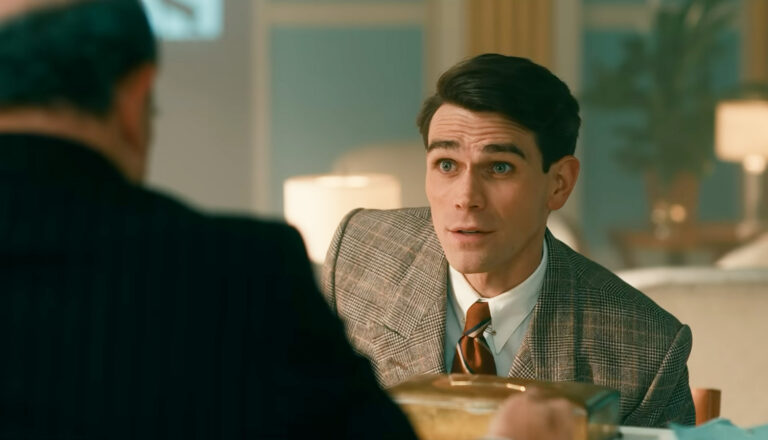

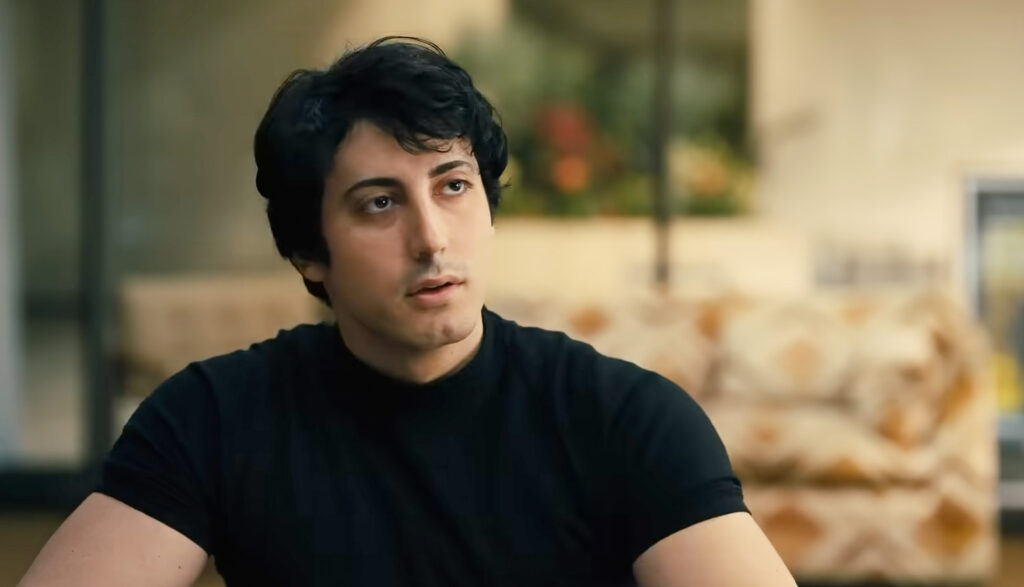
A would-be actor, frustrated by his lack of successful auditions, decides to write his own screenplay in which he can star. That screenplay? A little thing called Rocky. I Play Rocky offers up a quintessentially optimistic message that, with hard work and determination, you can achieve your dreams. But allusions to porn, some violence and plenty of smoking, drinking and cursing make this a film parents should be wary of.
Everyone in Los Angeles is an actor.
Yeah, you’ve heard that old Hollywood cliché, right? And it’s never been more true than it is right now, in the 1970s.
See that waitress in the diner? She’s actually waiting on callbacks. The window washer? He’s got an audition tomorrow. And over there, that guy parking cars? He’s written a screenplay—one in which he hopes to star.
Yeah, like that’s going to happen.
Take a look at that car valet for a minute. See that face? How it’s frozen in a perpetual snarl? I hear that when the guy was born, doctors used a pair of forceps to pull him free: severed a nerve, paralyzed part of his face. You can’t act with a face like that.
Even if his face wasn’t damaged goods, just look at the rest of the guy. Sure, you could cast him as a small-time gangster. Maybe a street cop. But a leading man? No way anyone’s going to give him that kind of responsibility.
Robert Redford? Now, that’s a man who can open a movie. Steve McQueen? Studios will fall all over themselves trying to get him to sign. But this guy? He’s a nobody. Less than a nobody.
It’s a shame, sure. But what’re you gonna do about it? The movie business is a cruel business. It takes brains and good looks and a whole lotta luck to make it. That valet? Doesn’t look like he has any of the above. All the muscles in the world won’t get him a job here. He should head back home. Back to New York. Go into business with his pops doing hair or whatever. Quit while he can.
The screenplay? Oh, I’ve heard it’s about a boxer. Yeah, like Hollywood’s making boxing movies anymore. No money in ‘em. They gave that up long ago.
Think he calls it Rocky.
Yeah, that’s right. Rocky. Like that guy’s life. Like life for 95% of these would-be actors.
He’ll never make it. Not in a million years.
Turns out, “that guy” did make it. His name is Sylvester Stallone. And his real-life rags-to-riches story is just about as improbable as Rocky itself.
I Play Rocky is, in a way, a testament to stubborn self-belief. Sylvester writes Rocky not because he wants to be a screenwriter, but because he wants to be an actor. It’s good to stand up for what you believe in. And Sylvester believes in his dream with such a passion that he turns down life-changing money to make that dream come true.
Now, given Sylvester and wife Sasha’s dire financial straits, one could argue that Sylvester’s insistence on turning down that life-changing money (with a baby on the way, too) is actually selfish and irresponsible—especially since he initially fails to tell his wife about all the cash the studios are trying to throw his way. Sasha is rightfully furious at this secret, but not because of the money. Rather, it’s because they should be making these decisions together. Ironically, when Sylvester asks Sasha what he should do, she demurs, saying that if she made a decision for him that he’d regret, Sylvester would one day blame her—and that’s something she wouldn’t want on her conscience or on their marriage.
Eventually, the Stallones decide to hold out for a starring role for Sylvester, even though it means far less money for them and far more risk for the movie itself: United Artists, Rocky’s eventual distributor, constructs the deal in such a way that, if Rocky’s production falters even a little, the studio can take over the film and re-cast whoever they’d like in the title role. And that means that Sylvester and the rest of the production crew must work incredibly hard to ensure that that doesn’t happen. To this end, the creativity and grit Sylvester and the rest display is remarkable.
Rocky’s producers, Irwin Winkler and Robert Chartoff, initially share the studio’s cynicism. But they come to believe in both the film and its star. And when the film begins to go over its rock-bottom $1 million budget, both mortgage their respective houses to funnel just a little extra cash into the production.
I Play Rocky opens when Sylvester Stallone is still living in New York City, and he lives in or near a building adorned with a neon cross that says “Jesus Saves”—right in front of a movie marquee advertising X-rated fare.
We see one of the opening sequences replicated from the original Rocky movie, wherein boxers fight underneath a huge depiction of a communion-sharing Jesus on the gymnasium wall.
In the movie Rocky, the title character’s opponent is named Apollo Creed—the first name obviously taken from the Greek and Roman god of music, prophecy and the sun.
In New York, Sylvester walks into his low-rent apartment building and past an open door, where it appears a man is washing himself. (He seems to be completely naked, but we don’t see any genitals.)
After Sylvester is kicked out of the apartment and is living on the streets, he decides to audition for a softcore pornographic film (a detail pulled from the life of the real Sylvester Stallone). The movie’s creators have Sylvester strip naked (we see just the side of his hip and buttocks) and hire him on the spot. The director assures him that intercourse is only simulated, but after the film is done, one of the creators tells Sylvester that he could make much, much more if he would be willing to give a “full performance.” (Sylvester takes the money and never returns.)
Sylvester meets Sasha when both are working at a movie theater. They kiss and hug on occasion. When the two are living in California, Sasha—now married to Sylvester—announces that she’s pregnant.
We see boxers and actors shirtless on occasion.
Rocky is a movie about boxing, obviously, and as such, we see a great deal of in-the-ring violence—sometimes fabricated for the camera, sometimes not. Sylvester is put in the ring with a real top-rung boxer auditioning for the role of Apollo Creed, but the movie’s makers quickly pivot, realizing that their suggested co-star just might kill Sylvester. Carl Weathers, the actor who eventually gets the part of Apollo, claims that he’s boxed before. But once he spars with an opponent, it becomes comically clear that he hasn’t: The two eventually grapple with each other like fighting fifth-graders on the playground.
Sylvester’s most serious injuries take place outside the ring, though. During the filming of Rocky’s famous training montage, Sylvester runs as many as 19 miles and injures his leg: The injury is severe enough that doctors recommend he stay off his feet for weeks. (The filming schedule won’t allow it.) Sylvester’s feet are badly bloodied as well. Later, when he punches a slab of beef, he discovers after the first blow that the beef is frozen solid: Sylvester refuses to let that stop the filming, so he does the scene. By the end, his fists are covered in bovine blood, but Sylvester breaks a couple of knuckles, too—another injury that should keep him sidelined.
Sylvester slugs an upright mattress during training, and he punches a door a few times during the filming of Rocky. We see footage of boxing matches—both real and fabricated—and hear that one real-world boxer needed 120 stitches after fighting boxing legend Sonny Liston. The head of a union threatens to harm Rocky’s producers if he finds out that they’re lying to him (and they are). We don’t see much of the actual boxing sequence from Rocky, but we do see the actors bloodied and bruised.
We hear some strong suggestions that Sylvester’s father, Frank, was abusive: Rocky says that, one time, his father hit him so hard that he woke up on the floor 15 minutes later.
We hear two f-words (along with some f-word stand-ins, such as “fricking”) and around 30 s-words. Also on tap: “a–,” “b–ch,” “crap,” “d–n,” “h—,” “d–k” and “t-ts.” Someone calls someone else a “douchebag.”
Sylvester smokes—a habit for which he is chided during the filming. Other characters smoke as well.
People drink wine, martinis and other alcoholic beverages during the film. A critical scene takes place in a bar, where Sylvester watches heavyweight title-holder Muhammad Ali take on 36-year-old journeyman Chuck Wepner. Sylvester drinks a few beers while watching the fight, and the increasingly engaged crowd in the bar is clearly drinking as well. We hear references to whiskey and a fifth of Scotch.
When Sylvester brings Sasha to meet his father, Frank, Sasha is horrified by Frank’s behavior. He belittles Sly with every word, insulting his looks, intelligence and almost every other aspect of his son’s character. Later, Sasha tells Sylvester that the man should’ve never been allowed to raise a child.
Several actors in Rocky lied to get their parts: Carl Weathers claimed he could box, for instance, when he clearly could not. Producer Irwin Winkler grouses that, for his next film, he’s going to force everyone to take a polygraph. Rocky’s producers lie as well—lying to, misleading and evading a union boss in order to make Rocky as cheaply as possible.
Less humorously, we must again note how Sylvester hid the fact that the studio was throwing out huge chunks of cash to get Sly’s script without getting Sly the actor—life-changing money that could’ve helped the Stallones a lot. While the truth comes out, Sylvester’s lies of omission are definitely not admirable. Nor is it particularly laudable how the studio itself treated Stallone both before and after buying the movie and signing him to a contract.
Sylvester cracks eggs into a glass and swallows them raw. When Sylvester is poor, he’s forced to sell his dog—then months later buys the pooch back for a ridiculous amount of money. (While Sly tells the new owner that he can buy 10 dogs for the money he’s getting, it might not matter much to the owner’s children, whom he says have bonded with the dog.)
“I’d rather be an optimist and be wrong than be a pessimist and be right,” Sasha tells Sylvester early in their relationship. And that’s a very nice thought—especially for I Play Rocky.
This movie—as was the case with Rocky itself—is brimming with optimism: The idea that a talented nobody can become a somebody? That’s an idea most of us would love to believe, even if we sometimes doubt it’s true. It’s a quintessentially American message, this idea that, with talent, hard work and determination, we can truly achieve our dreams.
It’s easy for that message to come off as saccharine pap, especially in our cynical age. But I Play Rocky delivers that message with authenticity and grit. And while that’s gratifying, that grit comes with its own set of problems.
While I Play Rocky deviates from history at times, it still pulls from plenty of real-world moments. When Sylvester agrees to be in a softcore porn film, for instance. Or when he takes off his socks and his feet look like bloody, raw slabs of skin. Or when he and others drink and smoke and swear.
Again, for some viewers, some of this content will strengthen the film—make it feel like it comes from the fallen world that can inspire such pessimism. But for families hoping to instill a little optimism in their own kids, I Play Rocky may prove to be a rocky cinematic ride. The content pushes right up to the edge of the film’s PG-13 rating. And you have to wonder, too, whether the story of how a 50-year-old movie was made really has the necessary weight to make it worth the trip.
I Play Rocky, like the movie at its core, is an inspirational crowd pleaser. But it won’t please everyone. And some might feel that it hits below the belt.

Paul Asay has been part of the Plugged In staff since 2007, watching and reviewing roughly 15 quintillion movies and television shows. He’s written for a number of other publications, too, including Time, The Washington Post and Christianity Today. The author of several books, Paul loves to find spirituality in unexpected places, including popular entertainment, and he loves all things superhero. His vices include James Bond films, Mountain Dew and terrible B-grade movies. He’s married, has two children and a neurotic dog, runs marathons on occasion and hopes to someday own his own tuxedo. Feel free to follow him on Twitter @AsayPaul.