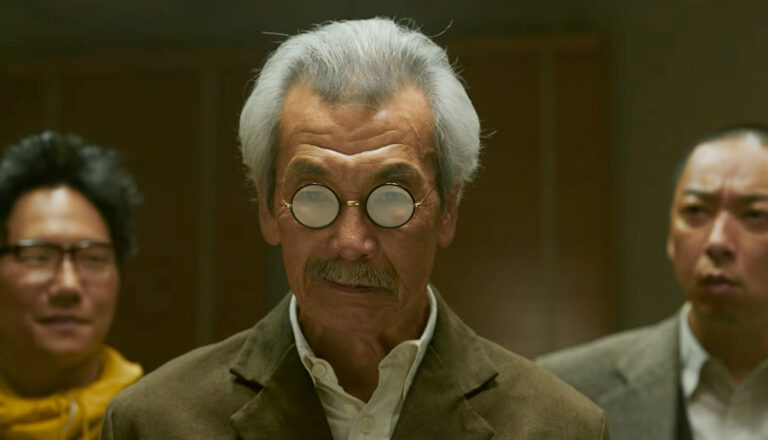

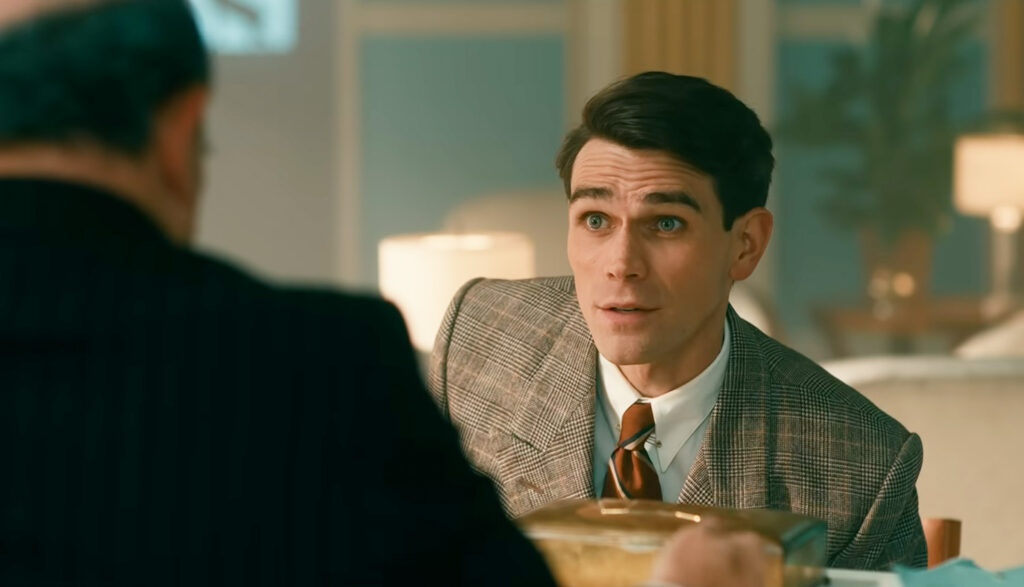
Jimmy recounts the remarkable life of actor Jimmy Stewart, who stepped away from Hollywood fame to serve in World War II. The film contains a fair bit of war violence, though nothing too graphic or bloody. The rest of the film is pretty clean and gives families lots to cheer for in this tale of hope and healing.
Jimmy Stewart is on top of the world. He just won the Oscar for Best Actor at the 1941 Academy Awards. He’s a certified Hollywood A-lister. He’s dating silver-screen queen, Ginger Rogers. When the press asks him how it feels to be a star, he replies with his usual “aw shucks” charm: “It’s the best feeling in the world.”
Then, Jimmy gets a letter that turns his world upside down: He’s been drafted for World War II.
No sweat, says Hollywood mogul Louis B. Mayer (the Mayer in Metro-Goldwyn-Mayer, in case you were wondering). With a snap of his fingers, that pesky draft letter will be history. MGM won’t have their golden boy shipped off to Europe to be shot at by the Nazis.
Jimmy’s not so sure he can stay in Tinseltown while his fellow countrymen are fighting and dying overseas, though. Fine, say the powers that be, but that doesn’t mean you have to see combat.
“America can’t afford to lose Jimmy Stewart,” a military man tells Jimmy matter-of-factly.
But Jimmy won’t be deterred. He won’t spend the war making recruitment videos and holing up out of harm’s way. He’s been called to serve his country and, by golly, he’ll do just that, no matter what anyone may say.
Finally, Jimmy gets his wish. He’ll fly bombing missions for the newly minted U.S. Army Air Forces.
And so begins an indelible chapter in the challenging, captivating, rueful and (dare I say) wonderful life of Jimmy Stewart.
Jimmy accepts the call to serve his country in the war effort, despite ample opportunities to avoid his obligation. Upon reaching the front, he serves with bravery and compassion. He cares deeply about the men under his command, encouraging them and regularly flying missions alongside them. He feels the weight of every soldier lost and takes great care in writing condolence letters to their families. Jimmy comforts a dying soldier.
Just as Jimmy exhibits bravery in the face of danger, so too do his fellow soldiers. At one point, Jimmy and his crew accompany a squadron that has veered off course into enemy territory to support them.
While in Europe, Jimmy meets Lady Julia, an English noblewoman who uses her position to support various charitable causes. She provides care for children orphaned by the war and organizes a Christmas party for the U.S. soldiers stationed far from home. She is patient with Jimmy as he struggles with the symptoms of post-traumatic stress disorder.
After World War II concludes, Jimmy returns to Hollywood, but it seems they have little use for him. The only thing he is initially offered is a film based on his own exploits during the war, but Jimmy declines. He tells a Hollywood executive that he wants to “bring hope” in his subsequent films.
Director Frank Capra is a staunch supporter of Jimmy, frequently providing counsel and encouragement. When Jimmy can’t get an acting gig following the war, it’s Frank who gives him a “hopeful” leading role—that of George Bailey in It’s a Wonderful Life.
Jimmy’s family, particularly his father, provides him with loving support after he returns home from the war.
Jimmy’s father, Alexander, gifts him with a pocket-sized copy of the book of Psalms to carry with him through the war. Alexander, a veteran of the First World War, tells Jimmy that the Psalms helped him through his own difficult times. In Europe, Jimmy takes comfort from the book and, at one point, reads aloud from Psalm 91.
Jimmy prays a few times throughout the film. While he admits that he is not “much of a praying man,” he asks God to help his fellow soldiers who lost their lives during a combat mission.
Julia and Jimmy have a chance encounter at a church. After speaking for a bit, Julia says that she will pray for him and that she writes down all the names of people she thinks needs prayer. An orphaned boy asks Jimmy and Julia to pray that he would find a new family. Jimmy tells him that he thinks God will listen to the boy’s prayer.
When Jimmy expresses guilt over the thought of dodging his draft letter, Mayer tells him to “talk to a priest,” to which Jimmy replies, “I’m a Presbyterian.” Frank, a Catholic, crosses himself and speaks the Trinitarian formula in Latin before telling Jimmy to “be at peace.”
While filming an emotional scene in It’s a Wonderful Life, Jimmy has a vision of his fallen comrades present with him—and his subsequent lines become a very real and heartfelt prayer.
Frank details plot elements of It’s a Wonderful Life to Jimmy, mentioning that an angel is featured. “Gabriel?” Jimmy asks. Frank replies, “No. Clarence!” Frank tells Jimmy that while he hasn’t been to Mass in a long time, they shouldn’t argue with the will of “the Big Guy” (God).
An Oscar trophy is referred to as a “little gold idol.” A Hollywood executive raises movie stars to a near mythological level, calling them “gods” and saying, “a god may drink champagne or nectar, but never beer.” (The latter is a slight paraphrase of a quote attributed to influential MGM assistant Ida Koverman.)
The phrases “thank God” and “God bless” are used a few times.
Prior to his military service, Jimmy is in a relationship with Ginger Rogers. The pair share a kiss. Before he leaves for Europe, he proposes a rushed marriage to Ginger, who declines—thus ending their relationship. Several famous actresses bid Jimmy farewell as he leaves for the war; his face and handkerchief are covered in bright lipstick from their (offscreen) kisses.
Jimmy and Julia engage in a romantic relationship while Jimmy serves overseas. They kiss and flirt. Julia confesses her love for Jimmy, and Jimmy refers to himself as her “lover” in one scene—which could imply a further physical element to their relationship—but their interactions onscreen are kept fairly chaste.
Eventually, Jimmy meets his future wife, Gloria. The end credits let us know that Jimmy married Gloria and adopted her two young boys, and that they later had twin daughters.
During a scene for a movie, Jimmy draws in an actress for a passionate embrace, and he kisses her neck.
Female performers are seen wearing tutus which show most of their legs. We see a photo of a woman that shows a bit of her cleavage.
Post-war footage shows returning American sailors and soldiers kissing their sweethearts. In a Tonight Show clip played during the end credits, the real Jimmy Stewart makes a humorous, but suggestive, comment about “making” his twins with his wife.
While nothing ever gets too graphic, there is a fair bit of war violence in Jimmy. Jimmy and his crew run several bombing missions over Nazi-controlled territory, and their planes come under near constant fire. Planes are hit with shrapnel. Some aircraft explode or crash in a blaze. Soldiers cry out in fear. In the wake of a crash, a soldier dies onscreen, his face bloodied. Other dead bodies are pulled from planes and hauled away on medical stretchers.
One plane in Jimmy’s squadron crashes into the ocean, and Jimmy makes the decision to leave the men behind and continue with their mission. We learn that those men were unable to be rescued in time and died at sea.
Bomber planes drop explosives from above. A soldier is hit in the arm by shrapnel. Planes dogfight in the sky. A boy says his parents were killed during the Blitz. Additional footage from World War II shows flaming planes, crashes and an injured (and possibly dead) soldier.
A man stands at the edge of a perilous cliff. It’s unclear if he intends to jump, but a passerby says that it would be “a long drop.”
Frank mentions that the character of George Bailey “wants to kill himself” at one point in It’s a Wonderful Life. When Jimmy is filming that movie, it’s clear that his PTSD and wartime experiences are affecting him: He goes too far with an outburst in one scene and upsets a child costar.
Jimmy’s father references the “horrors of war.”
One aborted use of “son of a b–ch.” “H—” is nearly used but muffled before it can be heard. Otherwise, the profanity here is pretty mild, including “darn,” “heck,” “butt,” “fink” and “crumbum.”
A few people let loose a few colorful exclamations, including “Holy Toledo” and “Saint Francis on a surfboard.”
Some of Jimmy’s soldiers steal a keg and bring it to their barracks. People hold glasses of champagne. A few people smoke cigarettes.
A famous scene from It’s a Wonderful Life takes place in front of a bar.
Jimmy feels that, as an officer, he used his acting gifts to lie and convince soldiers to go to their deaths. He struggles with PTSD from his experiences in the war, which sometimes leads to angry outbursts and unkind remarks.
While relating to his soldiers, Jimmy says that he might have vomited during one of their missions had he not had an empty stomach.
Frank makes promotional films to aid army morale and explain to soldiers the reason for fighting. One of these films includes footage of the Nazi flag.
Jimmy Stewart once said, “I’d like people to remember me as someone who was good at his job and seemed to mean what he said.”
KJ Apa transforms himself to embody the gangly charisma of the famed Hollywood actor and war veteran. Director Aaron Burns—producer of several films, including the Kendrick Brothers productions Overcomer and The Forge—puts the spotlight on the remarkable life of Jimmy Stewart.
(If you’d like to hear more from Aaron about Jimmy and the moviemaking process, he was kind enough to sit down with me for an interview: https://www.youtube.com/watch?v=hvpcW2an9Ec.)
The result is a heartfelt portrayal of a turbulent and impactful time in Stewart’s life—quite literally the story of a man who had everything giving it all up to serve his country.
“Like people fantasizing about being a racing driver, they imagine excitement and glory without appreciating the fear, death or injury.”
That’s another quote from Stewart and, gratefully, Jimmy doesn’t fall into that trap. Much of the film unflinchingly depicts Stewart’s military service and his resulting struggle with PTSD. (Stewart flew 20 combat missions during World War II.) While it makes for more challenging viewing, by all accounts it holds true to Jimmy Stewart’s real-life experiences. These elements could give pause to families with younger, sensitive viewers, though the film handles these difficult subjects as tastefully as possible.
Beyond that, Jimmy is a faith-tinged tale with few other content concerns and plenty to cheer for. Through the difficulties, Jimmy Stewart’s life is presented here as one of courage, healing and hope.
Jimmy Stewart also said that he wanted to be remembered as someone “who worked hard, loved his family, country and God.”
Jimmy is a biopic that remembers the man as just that.

Bret loves a good story—be it a movie, show, or video game—and enjoys geeking out about things like plot and story structure. He has a blast reading and writing fiction and has penned several short stories and screenplays. He and his wife love to kayak the many beautiful Colorado lakes with their dog.