


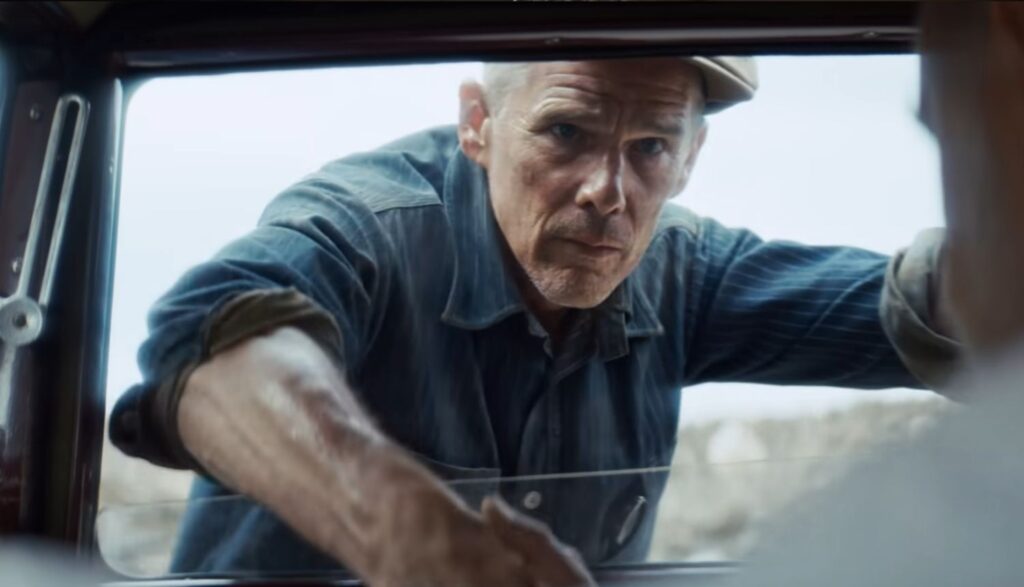
Desperate to return to his young daughter, a war veteran takes on a grueling criminal job in the 1930s in The Weight. The acting is solid and the story is good, but a little too much blood and way too much profanity betrays the heart of what this period piece could have been.
Samuel Murphy has not lived an easy life. But he’s always made do.
In fact, the process of battling through the pain and scars of war, of working hard for every tiny thing he’s ever gotten has been perfect training for where Murphy is now. The national Depression of 1933 has been hard. But Murphy is harder.
The thing is, Murphy needs to be hard and strong and secure. For he has a young daughter named Penny to take care of. He’d give or lose anything for her. Penny is the one small thing worth everything.
Murphy hasn’t ever been a particularly cheery man. But for Penny, he’ll always stay positive. He’ll always seem hopeful. No matter how thin his wallet gets or how long he has to work to scrape by, he’ll do it to make sure Penny is safe and feels loved.
That’s why what happened next was so unfortunate.
While looking for a new apartment, Murphy and Penny were approached by three men. They were intimidating. They were large. They had a certain squinting disdain in their eyes.
And when Murphy started throwing punches to protect Penny, those men also proved that they were … cops. You might think that a misunderstanding like that would be easy to work out. Murphy was only trying to protect his daughter.
Nope.
So now, here Murphy is in a labor camp. He’s part of a work crew, building roads for the government. He keeps his head down and his mouth shut, and he works as hard as any two men. But Murphy has a whole year ahead of him. That’s how easy the judge took it on a man who accidentally punched a cop.
However, the crew boss, Clancy, has had his eye on Murphy. He’s seen this man work over the last few weeks. He’s talked to him. He’s come to trust him. And when Murphy gets Clancy’s Ford Model 18 roadster up and running properly again (just because Clancy casually asked), a decision is made.
Clancy approaches Murphy with a very special project. It’ll be extracurricular and off the books. It’ll take about a week and require Murphy to choose three other trustworthy men from the crew. But if they do this special job for Clancy, he’ll sign their dismissal papers and wipe away the rest of their sentences. They’ll be free men after one short job.
That sounds incredibly sweet to Murphy’s ears because in about a month, the church school that has been looking after Penny will be legally obligated to make the girl a ward of the state. She’ll be dragged away from her desperate and incarcerated dad, maybe forever.
Of course, this “special” job will be illegal. Murphy isn’t so naïve as to think otherwise. But he’s been through a war. He knows his way around things legal and illegal. He’s a hard man who’s got a daughter waiting for him.
And Murphy will make do.
It’s very obvious that Murphy loves Penny and would do anything for her. In fact, after he’s initially arrested, his greatest pain doesn’t come from being pummeled by policemen or being thrown in a cell, but by way of the fear he sees in his little girl’s eyes. “Don’t be scared,” Murphy pleads. He then promises to come back to her as soon as he can.
Murphy also does his best to form a grudging bond with the other inmates and a Native American woman, Anna, who joins their crew. Despite their own prejudices and distrust, they all fight for one another against deadly forces. In fact, Anna saves Murphy’s life once and helps him keep a finger that might have otherwise been cut off. In return, Murphy holds off an attacker who intends to rape and kill Anna.
Murphy takes Penny to church. We see and hear the congregation praying the Lord’s prayer. And while Murphy is not a guy who appears to believe in such things, it’s obvious that he thinks it’s an important experience for Penny. Penny, however, asks, “Why’s it gotta be so boring?” “Pastors gotta bore the devil out of little girls,” Murphy supposes in reply.
Someone growls about the actions of a popular politician and his “Jew” bankers.
Anna hangs over a log in rushing river water, soaking her top and exposing lots of cleavage. A man makes an aggressive, unwanted sexual overture toward Anna. She coldly pushes back with, “I think men who talk big, usually ain’t big.”
Men get into a variety of hard-hitting fistfights. Murphy is pummeled by police and battles with several others in his crew. In one instance, he hits a man so hard that he breaks a bone in his own hand. The hand and his fingers swell to such an extent that it appears he’ll have to cut off his finger due to a constricting wedding ring. Anna is able to use thread and a needle to loosen the ring and save the suffering digit.
A very large man tosses Anna around in an attempt to rape and potentially kill her. Murphy runs to her defense and stops him, but he is them battered mercilessly. Two others jump on the huge guy, delivering bloody blows to his head with a rock and slowly choking him to death with a cord. Anna is lifted into the air and slammed down on the ground, knocking her unconscious.
As a result of the fights, several people are badly bruised and bloodied, including Murphy, whose blood-filled eye nearly swells shut.
In another violent interaction, men shoot at Murphy and his crew with rifles and a shotgun. One of Murphy’s men gets hit with a bullet that goes through his side. And Anna gets riddled by shotgun pellets. Murphy tends to the guy’s bloody wound and slowly peels down the back of Anna’s shirt to expose the gory mess on her back.
There are several gunfights. Men get threatened and shot dead. A wounded man stands, passes out and gets badly concussed when he lands face-first on a large rock. Two men sneak up and slowly smother a man to death. A truck gets run off a steep incline; it crashes upside down, killing the driver. We see Murphy recklessly drive his car to give his daughter in the backseat a fun ride.
While crossing a rushing river, Murphy and the others are surprised by a flow of large logs from an upriver lumber camp. One man’s pack is snagged by a fast-moving log, dragging him under the water. Murphy rescues him but then gets caught underwater himself by his foot. Anna saves his life by blowing gasps of air into his mouth until he can finally be set free.
[Spoiler Warning] Murphy and his crew are recruited by Clancy to steal gold bricks that are soon to be appropriated by the federal government. The four men each carry hundreds of pounds of gold over 50 miles of wooded terrain. The journey is grueling, and they also find themselves hunted by armed thieves. At one point, they encounter a rickety rope bridge that won’t hold the weight of a man and his gold-filled pack. So they toss the heavy gold bricks to Murphy who catches them at a midway point on the bridge and throws the bricks across. Two different men almost fall to their deaths in the process. The added risk of this procedure is the fact that the men are told they will be shot if even a single gold brick is lost.
There are more than 20 f-words and a dozen s-words in the dialogue, along with multiple uses each of the words “a–,” “d–n” and “h—.” God’s name is paired with the word “d–n” seven times. And the n-word is used two or three times.
A crude reference is made to male genitalia.
We see people smoke cigarettes in a number of different circumstances. In one instance, a car full of five people pass a cigarette around, each taking puffs. Murphy works on a car that was once used to transport illegal alcohol during Prohibition. We see several different people taking a swig from a bottle of booze.
One of the convict crew, Singh, is of mixed heritage, but his skin is light enough that he “passes” for white, even though he considers himself Black. He and another inmate spar over a racially charged disagreement. Singh is also a socialist who regularly pipes up about his belief in socialism. We hear stories about people being cheated by others during the Great Depression.
Anna tells Murphy a story about being put in a special school for “Indian” children being trained as servants for white families. “Kill the Indian, save the man,” was the school’s posted slogan. Anna declares that the school neither killed nor saved anything in her life.
If this movie had actually been made in the 1930s, it might have looked a lot like The Weight does. It would likely have contained the same hard-edged characters; the same tense, muscular, Depression-era vibe; the same thrills; the same heart.
Of course, with the Hays Code in place, it likely would have contained less face pounding and deadly bloodiness. But the biggest difference would have been in its dialogue.
Director Padraic McKinley’s The Weight is, well, weighted down to the extreme with f- and s-words—which is absolutely ridiculous since that sort of language was definitely not casually ubiquitous in the 1930s, even in a prison setting.
That dense saturation of profanity makes this pic far, far less watchable. And that’s particularly true if you’re not a Hollywood screenwriter searching desperately for a conversational intensifier from the wasteland of a tediously limited vocabulary! (See how intense that last sentence got? It was accurate to the 1930s, too.)

After spending more than two decades touring, directing, writing and producing for Christian theater and radio (most recently for Adventures in Odyssey, which he still contributes to), Bob joined the Plugged In staff to help us focus more heavily on video games. He is also one of our primary movie reviewers.