

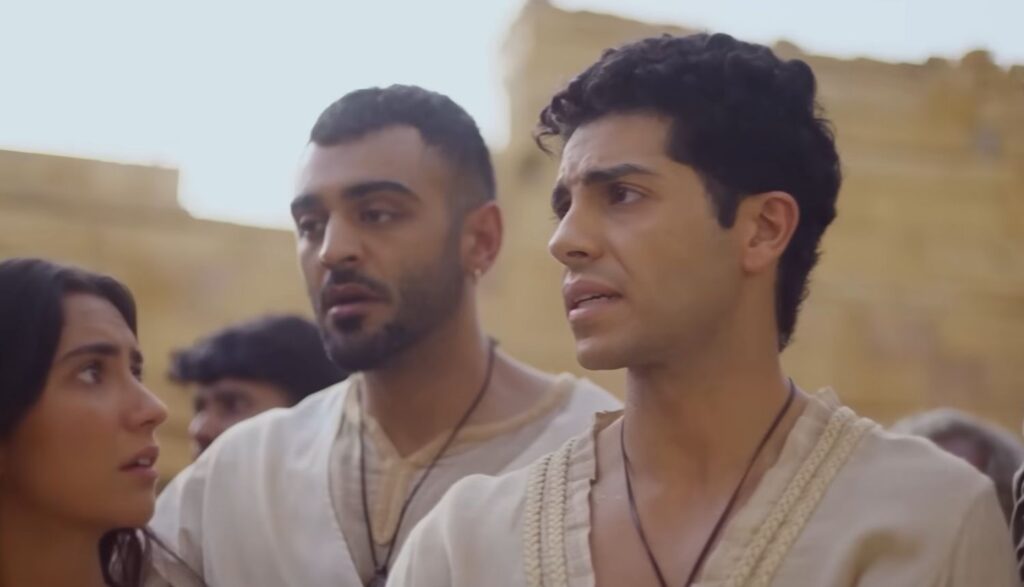
After Jerusalem falls to King Nebuchadnezzar, Daniel and three of his closest friends are shipped off to Babylon to face perhaps the biggest challenge imaginable to their lives and faith. Daniel and the Fiery Furnace takes some liberties with the original text and comes with some violence and discomforting scenes. But it does showcase the power of faith under fire.
You think you have troubles? Try living in the Fertile Crescent circa 600 B.C.
Jeremiah saw trouble coming, of course. As God’s true prophet, it was his job. His calling. He tried to warn his king, Jehoiakim. But did Jehoiakim listen? Noooo. “Jehoiakim despised the true prophet and God’s Word,” we’re told, and he set about burning the scroll, bit by bit.
Next thing he and the people of Jerusalem knew, the Babylonian army was at the walls—led by none other than King Nebuchadnezzar himself.
“You have been weighed and measured and been found wanting,” Nebuchadnezzar tells Jehoiakim, in a nifty bit of foreshadowing. And with that, Jehoiakim was no more. Moreover, Nebuchadnezzar decides to take a whole bunch of Jerusalem’s residents back to Babylon.
But this, too, Jeremiah foresaw, with God’s help. And he prepared some especially promising young men for the trip: Daniel, Hananiah, Mishael and Azariah.
These four men got themselves ready, sewing Scripture into their tunics so they’d have the Word of God with them as they entered Babylon’s gates. They were being sent to those unholy streets with a holy purpose: to keep God’s Word alive in a place seemingly so distant—and perhaps to impress upon Babylon’s own mighty king how frail, how fragile, his kingdom truly is.
But Nebuchadnezzar, like Jehoiakim, doesn’t listen well. As Daniel and his crew will discover, God will set aside His still, small voice for the king: He’ll shout with some mighty demonstrations instead.
Daniel and his three friends—friends who are now perhaps better known by their Babylonian names, Shadrach, Meshach and Abednego—have a ticklish job indeed: They must serve a tyrannical dictator and cater to his unbridled ego, all while staying true to their true sovereign—almighty God.
And for the most part, they serve both of these masters well. They hold true to their values and God’s precepts while repeatedly proving their value to Nebuchadnezzar. They sacrifice a lot to serve their king—and I mean a lot. (Stay tuned for our Sexual Content section to see how much.) But when events conspire to force them to choose between Nebuchadnezzar and their true Lord, they don’t waver, even when it almost certainly means death.
The entire story of Daniel and the Fiery Furnace is told in one large flashback, with a man in the desert recounting the tale to his own followers. While he’s narrating, a thief sneaks in and tries to pilfer some goods: The mysterious man has the thief tied up, but he later forgives him and releases him. The thief, in gratitude and wonder, follows the man and his posse to the next stage of their journey.
Daniel and the Fiery Furnace is based (sometimes loosely) on the first three chapters of Daniel. However, even when the movie departs from Scripture, it leans into the sovereignty of God and the devotion of His followers.
The movie begins by quoting Jeremiah 20:4 on a title screen: Thus says the Lord: I will give all Judah into the hand of the king of Babylon. He shall carry them captive to Babylon, and shall strike them down with the sword. It’s not the last verse included here. Indeed, much of the dialogue is plucked straight from Scripture.
We certainly see plenty of biblical episodes play out, too. Jeremiah walks around with a heavy yoke to illustrate where his fellow Jerusalem residents will wind up. Daniel and his friends refuse to eat Nebuchadnezzar’s food or participate in Babylon’s overflowing cauldron of sins. (“We have never defiled ourselves according to our own laws at any point in our lives,” Daniel tells his Babylonian instructor. “We cannot compromise ourselves by eating meat sacrificed to idols or sinning against God with … women.”) And, of course, Daniel interprets a dream sent to Nebuchadnezzar by God under pretty dire circumstances. (“No one on earth can explain to the king the mystery he has asked about,” Daniel tells the king. “But there is a God in heaven who reveals mysteries.”)
And, of course, we see the fiery furnace story play out as we’d expect it to: Nebuchadnezzar has a massive golden statue (in the movie, a statue of himself) built, and he expects everyone to bow down to it. Hananiah, Mishael and Azariah are conspicuous in their very un-bowed stance, and as such, the king demands the three be chucked into the fiery furnace.
“Can your God rescue you then from my hand?” Nebuchadnezzar gloats.
Spoiler warning: Turns out, God can. Hananiah, Mishael and Azarish remain unscathed. In the midst of that fiery furnace, Nebuchadnezzar spies a fourth man—one described in the Bible and by Nebuchadnezzar here as someone who “looks like the son of the gods,” which many Christians take to mean Jesus.
We hear references to Job, Samson and other biblical figures. Characters pray frequently and at length.
The movie winds down with another quote from the book of Jeremiah—this time a mostly accurate quote of Jeremiah 29:10-11: “When seventy years are completed for Babylon, I will come to you and fulfill my good promise to bring you back to Jerusalem. For I know the plans I have for you,” declares the Lord, “plans to prosper you and not to harm you, plans to give you hope and a future.”
We see other religions at work, too. Nebuchadnezzar prays before a statue of Babylon’s favorite deity, Marduk. (He asks to be shaped into an “instrument” for Marduk’s power. “Glory to your name,” he concludes. “And to mine.”) We see ghastly human sacrifices—those of children—made to the bull-headed Moloch (not a Babylonian god, but a Canaanite one). The name of Baal is mentioned, too. And, of course, there’s an implication that Nebuchadnezzar, through his golden statue, wishes to be worshipped as a god, too. The king’s wise men, sorcerers and diviners are hard at work as well. And a few of them plot against Daniel and his friends even when the Israelites literally save their lives.
Nebuchadnezzar’s golden statue is meant to resemble the statue from his dream—only very much in his own likeness. He orders Daniel to have it built, and so Daniel does, using pillaged gold from the temple of Jerusalem. (We see a menorah among the items of gold Daniel plans to melt down.) Daniel’s three friends take him to task for putting his talents to work on this project, and perhaps with reason. “Why are we participating in the creation of an image for a pagan king?” one asks. Daniel says that, while he’ll make the statue, he’ll never bow to it.
We see the Ark of the Covenant in Jerusalem. At one point, Nebuchadnezzar says that Daniel is “my angel.” “In him I am well pleased,” he adds, echoing a famous quote from the Gospels.
[Spoiler Warning] The mysterious man who narrates the events of the film turns out to be a Magi on his way to Bethlehem, about 600 years after Nebuchadnezzar and Daniel lived. And he carries in his trove of gifts a cross of gold. “We are on our way [to Bethlehem] to bring a gift to the King,” he says.
Daniel and Jeremiah’s daughter, Susanna, appear to be courting before both are whisked away to Babylon. That courtship, however, is doomed.
“To join his majesty’s services,” Daniel and his friends are told, “we’ll remove your … temptations. You’ll have to sacrifice your body as I have.” That is, they’ll need to become eunuchs—which they all agree to do.
But before they submit themselves to castration, they’re permitted to spend several days and nights in the palace harem. Daniel is led through a gauntlet of dancing, alluring women—some of which dance with exposed bellies and do their best to entrance Daniel. Daniel avoids their touch, though.
We see a few men go shirtless. Babylon is referred to as “the great prostitute,” while Jerusalem is called “the chosen bride.”
The Babylonian army meets some resistance in Jerusalem. We see plenty of fighting (including some by Daniel, Hananiah, Mishael and Azariah). Swords are swung and sometimes find their mark (off camera). Horrific atrocities are apparently committed—including the smashing of a baby against a wall (Again, we see nothing, but the suggestion is there.)
Israel’s king, Jehoiakim, is punched in the stomach, thrown down a flight of stairs and dragged behind a chariot until he’s very bloody. Nebuchadnezzar dispatches him with a sword (again, off camera). “I would say go to your God,” Nebuchadnezzar says, “but He doesn’t want you.”
Prowling lions stalk a procession of prisoners and their guards as they’re led on the long walk to Babylon. A few people are attacked and killed by the beasts. When guards dig a grave for one of the victims, they’re told not to make the hole too deep. “The body can lure other animals over there.” One lion is stabbed with a spear and lies dead in the Babylonian camp.
Nebuchadnezzar pours hot wax on the face of one of his chief sorcerers. (That man wears a bandage over his eye for much of the movie thereafter.) The sorcerer and others are nearly executed by order of the king. In a dream, we see a hand that seems to be engulfed in flames.
The furnace is indeed as fiery as the title suggests. One man tending to the blaze gets caught in its flames. He screams and, we assume, dies off camera. Other soldiers are hurt as they walk Hananiah, Mishael and Azariah toward its gaping opening.
Daniel, Hananiah, Mishael and Azariah are castrated. We see them strapped to a table as they prepare to undergo the procedure. For some time afterward, they grimace and hobble as they walk, clearly in pain.
None.
Nebuchadnezzar likes his wine, and he seems to be inebriated when a couple of his sorcerers come in for a strategic visit. They tell him to order everyone in his kingdom to bow before his golden image—and anyone who doesn’t will be, by law, chucked into the furnace. Nebuchadnezzar, filled with his wine, agrees.
None.
When Hananiah, Mishael and Azariah hear about the king’s proclamation—that anyone who doesn’t bow before Nebuchadnezzar’s statue will be thrown into the furnace—they’re understandably upset. They know they can’t bow, and so the threat of a very painful death is very much in their minds. Why would God take them out of Jerusalem and into the service of the king to simply die? And if this is merely a test, why such a terrible one?
“If it was easy, we would not be the ones here,” Daniel reminds them. “He does not put you through the fire to test you. He puts you through the fire to refine you.”
That is the core message of Daniel and the Fiery Furnace—and a strong mark of praise in this sometimes uneven movie.
This crowd-funded movie features some nice moments and good acting. Elijah Alexander, who plays Nebuchadnezzar, is a powerful presence on screen—one moment a king mad with power, the next a supplicant who’s just beginning to understand where real power lies. But the movie, like Daniel, is trying to serve two masters: the movie’s inspiring spiritual message and would-be moviegoers looking for an entertaining movie. As such, it can feel a little imbalanced.
But let me also take myself to task a bit.
Daniel and the Fiery Furnace is filled with prayer. Lots of prayer. Passionate prayer. Sincere prayer. Prayer said with tear-filled eyes and beaming smiles. It’s during these prayerful scenes when many characters—characters who can feel dour and even wooden as they talk with the king—come alive with emotion and depth.
As a reviewer, I thought that the film included a bit too much prayer for my taste. It slowed down the narrative and drew me away from the more compelling, action-oriented parts of the story. The prayers could feel a little overwrought to my cynical, 21st-century eyes.
But then I thought, Isn’t that an example of what prayer should be in your own life? Shouldn’t that be where and when you feel most alive? Most aware? Perhaps the fact that I wasn’t drawn into the movie’s prayerful moments isn’t the movie’s fault. Perhaps it’s more my own.
Objectively, Daniel and the Fiery Furnace has its weaknesses. But it comes with an inspiring message that, living in an age that has its own stresses and struggles, is an important one for us to remember: He puts you through the fire to refine you.

Paul Asay has been part of the Plugged In staff since 2007, watching and reviewing roughly 15 quintillion movies and television shows. He’s written for a number of other publications, too, including Time, The Washington Post and Christianity Today. The author of several books, Paul loves to find spirituality in unexpected places, including popular entertainment, and he loves all things superhero. His vices include James Bond films, Mountain Dew and terrible B-grade movies. He’s married, has two children and a neurotic dog, runs marathons on occasion and hopes to someday own his own tuxedo. Feel free to follow him on Twitter @AsayPaul.