

A trio of super soldiers literally programmed to kill break out of their super-secret facility and start doing what they do best. As you might imagine, the R-rated violence, sex and language here is not for families.
“Today will be a good day.”
So Hanna Kammler tells her husband—the brilliant, but certainly mad, scientist Hans Kammler—as he climbs into a waiting helicopter and flies off to work.
Turns out, it kinda depends on what sort of day you were aiming for.
Dr. Kammler had hoped that today would be the culmination of his life’s work. For decades, he’s been working on what he deemed the perfect super soldier, one without morals or qualms and with a nearly supernatural ability to stay alive and kill everyone else. And by “everyone else,” I mean everyone else. Kammler’s programming ensures that his soldiers (just three at this point, but he hopes to foster many, many more) will kill and kill until their programming terminates or the soldiers themselves are.
And sure enough, the soldiers perform well, slaughtering every single expendable soldier they face in the laboratory’s off-the-books trial. Kammler is thrilled—right up to the point when his creations collapse, necessitating Kammler’s own squadron of doctors to rush in and save them.
Psych! The super soldiers, suddenly feeling ever so much better, promptly kill the doctors. And hey, the doors to Kammler’s super-secret bunker lab are … left conveniently unlocked?
Yes, today is a great day for those super soldiers—they of the mysteriously glowing eyes and bullet-stopping muscles and morally vacuous brains. Finally, they’re off the chain. Their programming is still ticking right along, and they’re literally free to kill, kill, kill.
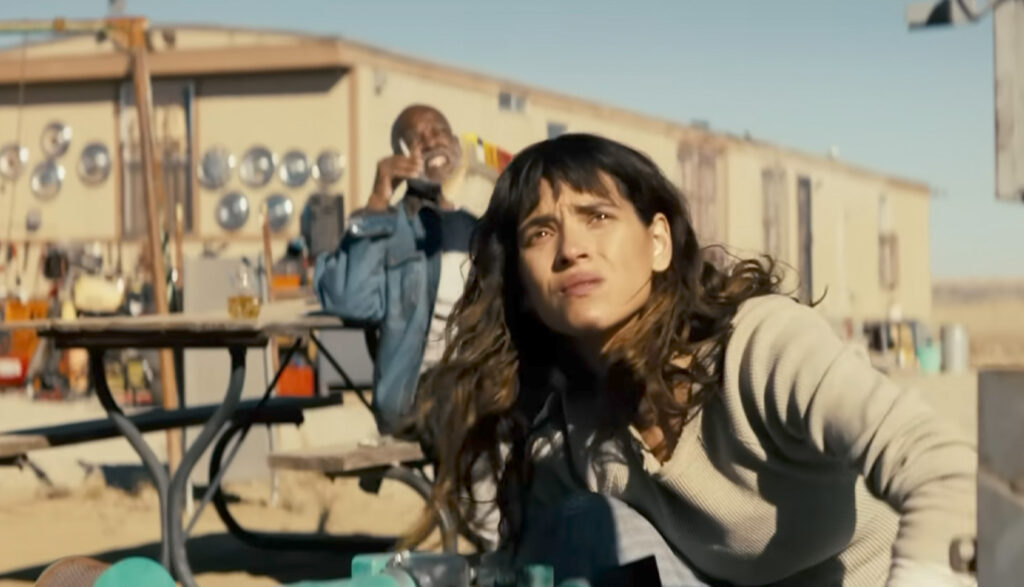
But it’ll require a road trip, given that the bunker is (appropriately) in the middle of nowhere. First stop: A convenience store. And the next? A mobile home park, filled with vagabonds, self-described losers and folks just struggling to make it through another day. Oh, and one former military mom named Celeste who just got an unexpected weekend visit from her little daughter, Daisy.
Today will be a good day, Hanna said. But for most of the people we’ve mentioned so far, today will be their worst (and last) day.
Celeste is a bit of a mess. And when Daisy’s father unexpectedly drops Daisy off for a visit, she’s not happy. But Celeste clearly loves her daughter. And when the film’s villainous soldiers pay a visit to the trailer park, Celeste does everything in her power to keep Daisy safe.
But in a lot of ways, Daisy—who looks like she might be around 6 or 7 years old—is the more responsible of the two. As Celeste argues with Daisy’s father outside, Daisy walks into Celeste’s trailer home, starts playing some soothing music (to better drown out the shouting) and starts washing Celeste’s sink full of dirty dishes. Whenever Celeste tells her to do something, Daisy says, “Yes Ma’am”—a habit that drives the more casual Celeste a little crazy, but it illustrates that Daisy’s dad takes his own role as a father quite seriously. Even Celeste (who rarely has much good to say about anyone) acknowledges that he’s a pretty good father.
We meet a handful of other trailer park residents. Josiah’s an old Vietnam War vet who proves to be particularly brave and resourceful in the inevitable clash with the super soldiers. When it looks as though the battle might go against them, Celeste makes Josiah promise that he’ll get Daisy to her father should Celeste not make it. Josiah agrees—and forces Celeste to promise that she’ll return Josiah’s overdue library books. Another neighbor demonstrates some unexpected bravery during a critical moment.
We hear a rendition of “The Battle Hymn of the Republic” as the credits roll, with an emphasis on the “Glory, Glory, Hallelujah” chorus.
A completely unnecessary thread of sadomasochism runs through the film—most graphically when a character visits a secret sex lair.
The women in this S&M brothel are “dressed” in identical leather get-ups that leave breasts, buttocks and hints of even more critical body parts uncovered. The camera takes a strong interest in all the exposed breasts. A man in attendance is enraptured by these ladies, but he’s called away before anything can happen.
Dr. Kammler seems to have a similar S&M relationship with his wife. Hanna interrupts her food prep to demand Kammler attend to her. He does, crawling on his hands and knees to Hanna’s stiletto-covered feet. Once there, he licks her shoes before Hanna removes one of them and places her bare heel on Kammler’s head, pressing it into the ground. (Again, they’re interrupted before whatever this is can go further.)
In flashbacks, we see Celeste in a top or sports bra that exposes midriff.
The sole purpose of Kammler’s soldiers is to kill, kill and kill some more. They’re literally not interested in anything else.
Kammler started with some lethal raw materials. We hear (and see) a bit of these soldiers’ backstories before they were so mentally mangled. One gunned down 17 civilians while weeping. (He’s nicknamed “Crybaby.”) Another was shot 47 times and didn’t die. (“Cockroach.”) As far as the “Butcher” goes—well, his name is fairly self-explanatory, but we see some of his butchery before Kammler gave him a new brain and glowing eyes.
Once Kammler gets ahold of them, these guys move to another level of wickedness. The goal of Kammler’s program is to develop a soldier suitable to deploy against the government’s own citizens—soldiers that will not hesitate to kill a fellow American man, or woman, or child. They demonstrate the effectiveness of Kammler’s programming throughout the film.
Before these soldiers reach the trailer park, they attack a convenience store. Perhaps a dozen or more people are killed there, most via automatic gunfire. But at least one victim is hacked to death with a meat cleaver (the actual blows shielded by a countertop). The corpses are left on the floor, lying in pools of their own blood, as the soldiers move on. One survivor remains, wallowing in blood and gasping for air when some apparent “authorities” arrive. But when he asks for help, the authorities shoot him in the head. (The assassin slips around in the victim’s blood, which the movie plays for laughs.)
“Make sure that everyone is fully dead before they start the fire,” the assassin tells a lackey as he walks away.
Once at the trailer park, the violence kicks up a notch.
Someone is slaughtered while hanging clothes—his blood spatters across a white sheet. Another is grilling food outside when he’s killed: The upper part of his body roasts on that grill for the remainder of the film. Someone crashes through a car windshield, and blood and brain matter cover the hood. A character gets shot in the head and falls on a running chainsaw, the machine grinding through the body. Someone else suffers their demise from the same chainsaw.
Multiple people are stabbed repeatedly and die from the wounds. A man’s face is shoved against a glass window, cracking the window and staining it with blood. A leg gets lopped off, spraying plenty of blood. A couple of people appear to suffer seizures. Poisoned gas pours into a training facility. Necks are snapped. People run away from soldiers and presumably meet their doom off camera. We see an explosion or two. A male character is kicked in the groin.
In black-and-white flashbacks, we see a couple of battle sequences that feature gunplay, explosions and soldiers bleeding and writhing on the ground in agony. In another flashback, two soldiers (one male, one female) engage in a boxing match.
And, of course, you’ve got a little girl imperiled throughout much of the film—which, for some, might be hard to stomach.
Nearly 65 f-words, about a dozen s-words and at least two c-words. We hear abuses of God’s name paired with “d–n,” as well as uses of “a–,” “b–ch,” “d–n” and “h—.”
“Those things are gonna kill you,” Celeste tells Josiah as he lights a cigarette. He’s not the only character who smokes, but he especially is rarely without a cig in his mouth.
Celeste’s trailer has a few empty beer bottles scattered about (which she hides when she sees that Daisy is on her way). She drinks another after she puts Daisy to bed.
A police officer who lives at the trailer park drives his squad car while, apparently, drunk. He hauls a huge bag of aluminum cans out of the vehicle; how many once contained alcohol, we can’t be sure.
In terms of the development of these morally bereft super soldiers, Onslaught connects the United States with Nazi Germany. Kammler’s program seems to have at least some sort of approval within the folds of the government—though it’s noted that Kammler’s facilities have very little oversight, so it’s likely that other wings of the government are unaware. We hear that Kammler’s family has long been engaged in this work, and Kammler himself speaks with a thick German accent. The opening credits play up those connections as well, including a scene where the Reichsadler (the Nazi’s symbolic eagle) transforms into the United States’ familiar Great Seal (that sports a bald eagle as its main image).
Someone vomits.
When it came to the blood in Onslaught, not just any ol’ red would do.
“I think the whole budget of this movie just went to fake blood,” the movie’s star, Adria Arjona, told Screen Rant. “But the fake blood was a whole challenge because [director Adam Wingard] really wanted it to be the exact same blood that [Quentin] Tarantino used for Kill Bill. It’s a very specific color, and he wanted that in the movie.”
Perhaps it makes sense, given how much was splashed in Onslaught. If something’s going to be on screen more than most of the actors, you gotta do it right.
Onslaught is not a film with a lot of nuance. Oh, sure, Wingard knows what he’s doing: Onslaught comes to the screen with more aesthetic oomph than you might imagine. Anchored by Arjona’s strong performance, some clever writing and strong pacing, Onslaught is more than just a slasher flick.
Except that, paradoxically, it is just a slasher flick.
This film knows what it is and makes no pretensions of being more. All that solid acting and writing is done in service to a straightforward, rather outlandish tale of bloodshed and butchery. Like the movie’s own Dr. Kammler, Onslaught’s unexpectedly deft craftsmanship grovels at the feet of its violence, practically licking its boots.
Onslaught has a bit of heart to it, yes, but that heart beats for the blood—and it won’t ever let you forget it.

Paul Asay has been part of the Plugged In staff since 2007, watching and reviewing roughly 15 quintillion movies and television shows. He’s written for a number of other publications, too, including Time, The Washington Post and Christianity Today. The author of several books, Paul loves to find spirituality in unexpected places, including popular entertainment, and he loves all things superhero. His vices include James Bond films, Mountain Dew and terrible B-grade movies. He’s married, has two children and a neurotic dog, runs marathons on occasion and hopes to someday own his own tuxedo. Feel free to follow him on Twitter @AsayPaul.