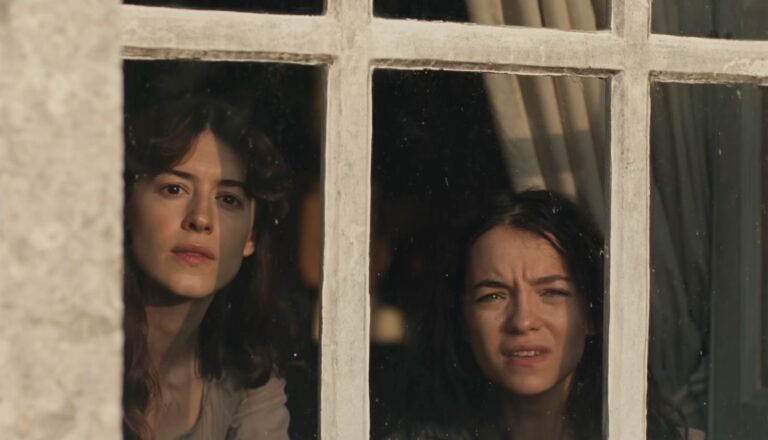


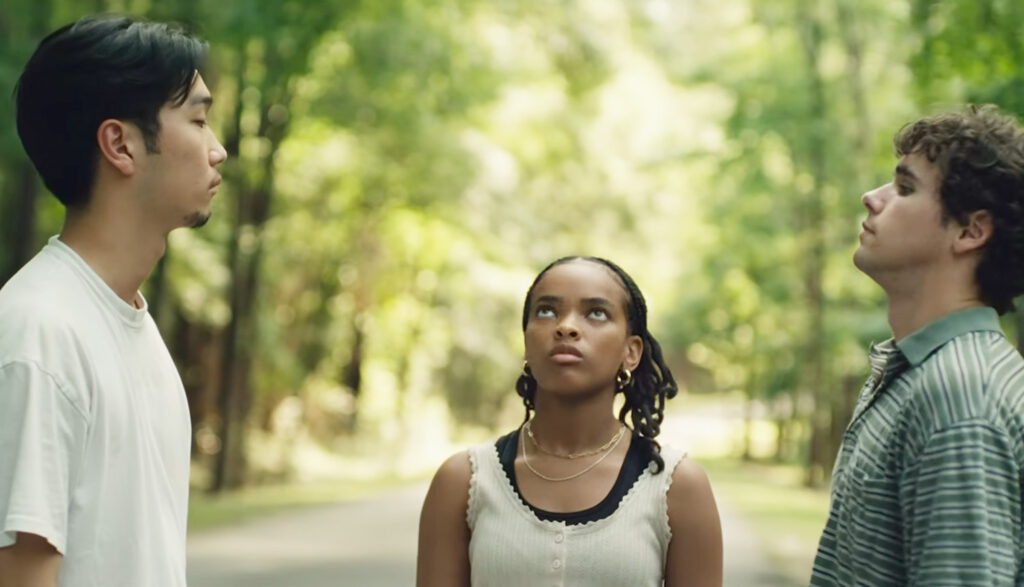
Four friends find themselves on a road with, apparently, no end. Can they stand each other for this interminable road trip? Or will the forest-dwellers surrounding the road get them first? This film contains a gruesome injury and some harrowing violence, but it earns its R rating for its never-ending stream of profanities.
Everything felt so normal.
Longtime friends riding in Tyler’s old Jeep Cherokee. Same banter, same friction. James and Fisher arguing over a truly pointless question. Tyler driving with stoic reserve. Day keeping the peace, asking questions, rolling her eyes.
They hadn’t seen each other in more than a year. The last year of college was busy for three of them, and Tyler had his own military career to think about. But they’re back together now, just like before. Just like always. They’re heading home, finally, before they head off in different directions. Different careers. Different lives.
But first, a quick detour. Day wants some food, and she’s heard of a great place right off the highway. Just turn there and follow the road ‘til—
‘Til where, exactly? Tyler drives and watches the miles flash by. “Sure about this turn, Day?” he asks. A few more miles and Tyler spins the Cherokee around. He must’ve missed the turn. He must’ve.
They drive back from whence they came, Tyler’s eyes fixed to the side of the road, looking for the turnoff. Nothing. Nothing. And—
Trees.
Tyler hits the brakes. Hard. Through the windshield, he sees trees. Trees where the highway had been. The road just … ends.
The friends spill out of the Jeep, taking stock. Did they miss a turn? (Tyler insists they didn’t.) Where are they? Can they get back?
And then, through the trees, the people come. Running. Screaming. Pleading. Clawing. One tears flesh from Fisher’s arm before the crew finds the safety of the car and squeals away.
Who are these people? Where did they come from?
“It doesn’t matter where they came from,” Tyler says. “We gotta keep driving anyways.”
And so they do.
They keep driving. And driving. And driving. The road comes with no turnoffs, no off ramps, no variation in vegetation. The world these friends find themselves in is a road of straight asphalt and endless trees. Theirs is a world without food, without sleep, without distraction … except for each other.
It’s a good thing that the four folks here are such good friends. Otherwise, this endless road trip might’ve been even more miserable.
They’re not the type to get all sappy with one another. Most of the time, you’d think they can barely stand each other. But all their snide insults and banter hide genuine affection. And it’s James—the most cynical and biting of the bunch—who openly confesses that he loves them all.
It Ends is filled with anger, hurt and loss as well, of course. And not everyone makes it to the final credits. But the movie seems to suggest that love and friendship are the elements that can make our own difficult journeys more bearable.
When you get stuck on an impossibly endless road, you’re bound to ask questions about how you got there.
James suggests that perhaps they crashed and died, and they’re now in some sort of afterlife. (“I did not kill us,” Tyler growls.) James admits later that there are other possibilities—wormholes or an ancient curse, perhaps—but he and the others circle back to the idea that they might be in some sort of purgatorial realm.
“You think we might’ve caused this?” Fisher asks. “Something that we did?”
They wonder whether they’ve all committed sins or wrongdoings that would land them here. James wonders whether one of them committed something super-serious, and they’re all being punished for that one sin.
But if they are in a version of purgatory, there’s a lot of uncertainty how to get out of it. “It feels like you have to repent or something, or you have to be judged,” Fisher says before putting his head in his hands. “I can’t remember! I never should’ve told my mother I wasn’t religious anymore!” He frets that, if his mom thought that he was dead, “she would genuinely believe that I was in hell.”
James looks around and figures that if this an afterlife, it does indeed feel pretty infernal. “You can give your parents some props,” he jokes with Fisher.
When James’ vehicle-mates ask James what sort of sin he might’ve committed, James says, “Maybe I took my life for granted or didn’t commit to the right deity.” But this sort of punishment, he says, “feels like overkill.”
All those theosophical musings fade as the ride goes on. But certainly, the trip forces the characters—and the movie’s viewers—to consider bigger questions. Toward the end of the film, James insists that this experience must have meaning. He seeks signs of meaning everywhere. And when the Jeep is turned off at one point, James screams out a sort of profane prayer. “I will do anything!” he shouts. “Just turn it on!” Fisher wonders who James is even talking to, and perhaps James himself doesn’t know. (The prayer, interestingly enough, seems to work.)
There’s a reference to evolution—and how the ocean was such a horrible place to be that humans grew legs to get out of it.
The Cherokee’s passengers all seem to be friends and nothing more—though there is a suggestion toward the end that Fisher and Day have drawn closer during the long car ride. Fisher tells Day that he’s willing to do something dangerous “for us,” but the two never do anything more than hug.
We do hear some stories and jokes about the friends’ own romances and sexual encounters. James jokes that the people in the forest (who are, by the way, both male and female) are former sexual partners. (Fisher tells him that, if that was the case, the forest would be empty—and Jade quips that she sure wouldn’t be lost in this forest if that was the case.)
Tyler says that he broke up with his longtime girlfriend because she wanted him to drive three hours to “pick pumpkins.” That was, apparently, just too much for Tyler.
The people in the forest are terrifying and desperate. As mentioned, one rakes her fingernails across Fisher’s skin, causing a really gruesome injury. They bang on the Jeep, too, but they’re not really after the friends. They’re after the Jeep, and we see them hit and bite and choke each other in a desperate attempt to get in it.
But it takes time for these people to grow aware of the Jeep’s presence—about 90 seconds, in fact. If you see them before they’re fully clicked in, they simply lie on the ground, practically comatose. Tyler and James capture one of these bleary folks and tie her to a tree. Tyler threatens to hit her unless she explains what’s going on, but she can’t or won’t say.
Day confesses that she tried to kill herself once. Characters wrestle each other to the ground. Tyler, frustrated, drives the Jeep extremely fast for a short stint, terrifying his fellow passengers.
The group engages in an extensive argument that runs as follows: You can choose among a guy with a gun, five gorillas, 50 hawks or 10,000 rats. Two groups will defend you to the death, the other two will try to kill you. Which will you choose? (One character wonders whether the guy’s gun would multiply if you gave it to the five gorillas.)
Well, into their trip, Day and Fisher hear someone in the forest screaming, “Help me!” Day mocks the voice, suggesting that they’ve heard similar calls a lot. There’s nothing they can do to help, but they’ve also become pretty desensitized: Their world—the world they care about, anyway—begins and ends at the Jeep’s doors.
[Spoiler warning] While this is not violent, exactly, It Ends deals with the notion of just giving up—and leaving people behind. We ultimately see this dynamic play out when the road proves to be just too long for some. “I’m not living my life in 90-second breaks,” one person says. And characters that move on can deal with doubt and guilt as to whether they should’ve allowed that person to leave—and whether they should eventually go back and try to “save” that character.
About 115 f-words and at least 30 s-words. We also hear “a–,” “b–ch,” “b–tard, “d–n,” “h—” and “d–k.” God’s name is misused about eight times—five of those with the word “d–n”—and Jesus’ name is abused once.
We hear a high school-era story of when Tyler used a fake ID to buy $80 worth of “vapes and Smirnoff [vodka].” James snidely suggests that he’d like to be in a “medically induced coma, hooked up to a serotonin/oxy cocktail.”
The friends do not experience sleep or hunger on their journey. Good thing, as the Jeep contains just one solitary Clif Bar. When someone debates whether to eat it or not, James advises against it: “We’d probably be digesting it forever,” he says.
A character leaves others behind.
You could take It Ends as a straightforward horror comedy: Four friends find themselves on an inescapable road that goes nowhere, where dread grows with each passing mile.
But the film clearly has much more on its mind.
It’s perhaps telling that most of the friends here just graduated from college, with honest-to-goodness adulthood staring them in the face. They’re all looking ahead, in their own ways, to what their lives will look like: 40 years of 40-hour workweeks and all-too-short weekends. You could easily read the movie as a Gen Z take on “adulting,” a road that takes them away from their friends, from meaning, from life itself.
But then the movie begs the question: What is life? What is meaning?
The film expresses some nihilism on this point. Perhaps there is none, it whispers.
And yet, It Ends holds hints that perhaps not all is as bleak as it needs to be.
When Fisher looks at his phone much later in the trip, he marvels, “I barely have any photos of my family in here—just a bunch of meaningless bulls—.” Characters listen to old voicemails just to hear the sound of their mothers. Sisters. Friends.
“Maybe I took my life for granted,” James says at one point (as we quoted earlier in this review). And maybe that’s the nugget that It Ends wants us to take off the Jeep seat and carry out of the theater. Perhaps in the movie’s eyes, the title It Ends doesn’t refer to the road, or to friendship, or to the movie itself (which ends in a tidy 90 minutes). Rather, it’s a reminder: Life can feel long sometimes, but it ends. Remember to not take it for granted. Remember to treasure the things that matter.
This, of course, holds out little hope for an afterlife (even though our characters feel like they’re in the middle of a very depressing one). The film doesn’t close the door on God, but it doesn’t exactly fling it wide open, either. This is about finding meaning in a meaningless world—not a fallen one. And that’s a critical distinction that Christians should keep in mind.
Would-be viewers must also be aware of the language. Oh, the language. Had the script scrapped say, 113 f-words or so, this film could’ve landed a PG-13 rating. But it didn’t. And that’s too bad. This is a movie with plenty to say—but a foul way of saying it.

Paul Asay has been part of the Plugged In staff since 2007, watching and reviewing roughly 15 quintillion movies and television shows. He’s written for a number of other publications, too, including Time, The Washington Post and Christianity Today. The author of several books, Paul loves to find spirituality in unexpected places, including popular entertainment, and he loves all things superhero. His vices include James Bond films, Mountain Dew and terrible B-grade movies. He’s married, has two children and a neurotic dog, runs marathons on occasion and hopes to someday own his own tuxedo. Feel free to follow him on Twitter @AsayPaul.