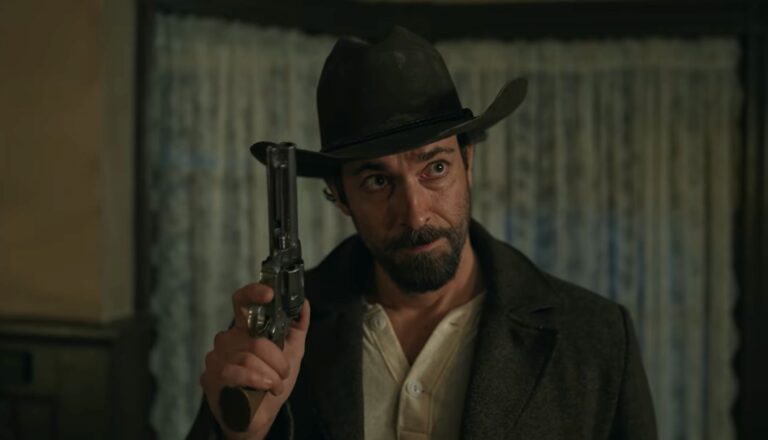


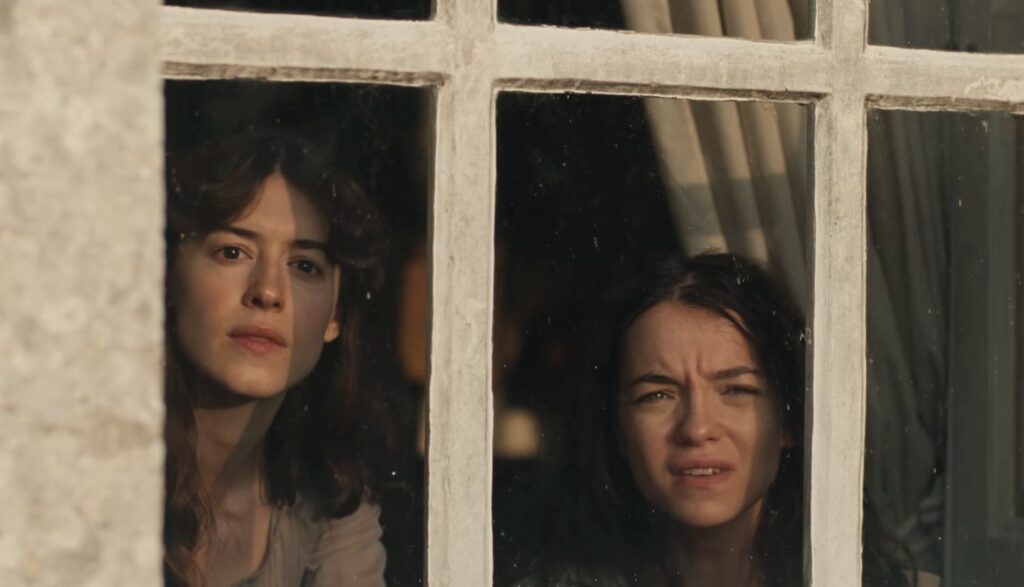
After their father’s untimely death, the Dashwood sisters find themselves looking for husbands to support themselves and their family members. The characters work through hardships and heartache and learn lessons of passion and earnest love. Some drinking and deception are at the forefront of content issues.
The Dashwood family—Mr. and Mrs. Henry Dashwood and their three daughters, Elinor, Marianne and Margaret—were comfortable enough on their large family estate in Sussex, Norland Park. However, that all changed after Henry Dashwood’s sudden death.
As, of course, is the custom and law in 1790’s Britain, the Dashwood estate and fortune is left to the eldest son from Henry Dashwood’s first marriage, John Dashwood. Which leaves the deceased man’s current family with little more than a very sparse annuity to live on.
Of course, that’s not to suggest that Henry was a heartless man. As his health waned, he had asked his son to care for the women. And John had promised his father that, indeed, he would do so. But John is, unfortunately, a milquetoast sort who’s led by the nose by his money-hungry and grasping wife, Fanny. So what he originally intended to gift the women with shrinks with each passing day.
Fanny does, after all, know best.
So the Dashwood women are sent away from the grand estate. They lean on the generosity of a distant cousin, Mrs. Jennings, and end up renting a small cottage in Devonshire. Money is quite tight, though, with no means to bring in income and no husbands to sustain them.
However, Elinor and Marianne are both comely young women. And in 1790, that can be of benefit. Perhaps they might be able to attract suitably wealthy husbands who can care for them and support the others in their family as well. And it just so happens that there are some potential suitors in the Dashwoods’ circle.
As John and Fanny were sweeping in to take control of the Norland estate, Fanny’s brother, Edward Ferrars, came to offer his assistance. He and Elinor were instant fits. Whereas Fanny is somewhat obnoxious and flinty, Edward is kind and honorable. Like Elinor, he is a practical person of sound judgement.
However, there seems to be something that Edward is not saying. He and Elinor are a perfect match, but something is wrong. And when the Dashwoods move to Devonshire, Edward does not write. He does not visit.
There is also Colonel Brandon, an unruffled and earnest man who is very taken by the pretty and life-loving Marianne. He’s drawn to her like a quiet moth to a vibrant flame. However, Marianne is someone who desires passion in full bloom. “The man who loves me must burn with it,” Marianne tells Elinor. And Brandon is far too dour for her tastes. Yes, he’s good-looking enough and wealthy enough. But where’s the fire?
Someone like Mr. Willoughby is more to Marianne’s taste: He’s handsome, carefree—a man who equally enjoys the beauty of nature, the beauty of the written word and the beauty of the flesh. There are some rumors about this dashing man’s past, but that’s pishposh in Marianne’s estimation.
It seems that the Dashwood women have a journey set before them. They must navigate the poverty that’s been cruelly imposed upon them and see their way through love and heartache. And they must learn to use both their sense and their sensibilities.
[The following sections contain spoilers.]
Elinor and Marianne are loving sisters who both care for and support their family members. And though these two sisters clash because of their distinctly different personalities, they also run to each other’s side at the slightest problem. They earnestly help each other through tearful heartaches. In fact, by movie’s end, the two women learn from one another that a happy life requires a balance of both sound judgement (sense) and life-loving exuberance (sensibility).
Edward turns out to be an honorable, upright individual. However, his mother set him up in an engagement with Lucy Steele without his knowledge. And, even though, his heart is with Elinor, Edward attempts to stand by his commitments, so as not to embarrass or dishonor Lucy. Elinor actually praises his honor and calls his choice admirable. He is eventually freed from those commitments, though, when Lucy decides to abandon him for a wealthier suitor.
Colonel Brandon also proves himself to be a trustworthy, good man. He’s a bit at odds with Marianne, suggesting that displays of passion are little more than “affectations.” Even still, he declares: “I cannot desire any change in Marianne. Such spirit is all too rare.”
Through several later events, Brandon shows that he is not only very passionate in his feelings for Marianne, but willing to put his life on the line to protect her from those he believes are misusing her affections. Brandon is even willing to put his own feelings aside if it might lead to Marianne’s happiness. Upon observing Marianne’s feelings for Mr. Willoughby, for instance, Brandon says, “To you, I wish all imaginable happiness. And to Mr. Willoughby, that he endeavor to deserve you.”
Elinor and Marianne’s mother gives her daughters all the care and support she can. She even endangers herself and rides through a storm to be by Marianne’s side when the young woman falls ill.
Mrs. Jennings is an outgoing woman who sees herself as a helpful matchmaker, though others tend to see her as rather self-promoting. Though in the end we see that she has very earnest feelings behind the choices she makes.
Early on, after Elinor and Edward first meet, she asks him about his ambitions in life. He tells her that he hopes to be happy. “The church perhaps. A parish in the countryside. A family which I was proud to be a part of,” Edward muses. And later on, Edward is offered a vicarage.
A dress of Marianne’s reveals a bit of cleavage. We also see her full bare back as she kneels down to wash herself in a tub. (The camera angle only captures her back and the side of one leg.)
Whereas most of the women’s dresses are made up of flowing skirts and fully covering linens, Mrs. Jennings is a boisterous older lady who aims to sport a very boosted cleavage in a bodiced dress. Other women display some cleavage to a lesser degree.
Marianne and Mr. Willoughby walk through fields, holding hands. They lounge about in a cozy manner, reading poetry together. Edward and Elinor dance together—and that’s the first time we see the couple touch. However, their emotional connection is almost physically palpable from nearly the first time they meet.
We eventually learn that Mr. Willoughby seduced a widow and then abandoned her when the relationship became inconvenient. It also becomes evident that his seductions are a common part of his life.
After Edward is finally able to voice his feelings for Elinor, he tells her: “I love you, Elinor. I have since we first met. I know it’s not much—.” “It’s all I’ve ever wanted,” Elinor quickly responds. They kiss.
A woman who identifies as nonbinary in real life portrays a male character here.
Marianne runs in the rain through a wooded area and is almost knocked down by a passing rider on horseback. Much later in the story, when Marianne is emotionally distraught, she runs out into a powerful rainstorm once again. Soaked to the skin, she screams out her frustrations on a hillside. Soon after this outing, she falls dreadfully ill with a fever that a doctor calls “dire,” warning that she may not survive.
An enraged Colonel Brandon drags a deceitful man out into a field where they face off in a duel for Marianne’s honor. When the two turn to fire, the Colonel discharges his pistol into the air and allows his foe to shoot at him.
Marianne falls and twists her ankle while walking on a rock-strewn beach. A passerby picks her up and carries her back to her family cottage.
One exclamation of “Good God!”
Many individuals drink small glasses of wine, port and brandy in various scenes, ranging from dinners to sitting rooms. Mrs. Jennings, however, is very open to throwing back quite a bit of drink in one form or another. In one instance, a drunken man visits someone who is ill.
Early on, Fanny sneers at the idea of Edward and Elinor being a couple. And she makes it plain that their wealthy mother would disown him in such an event. With time, we see that Edward’s mother has made a matrimonial move on Edward’s behalf, without his knowledge.
Edward has a very difficult time expressing his true feelings. And he repeatedly pulls back from doing so for what he believes to be honorable reasons. But that hesitancy to freely speak his mind ends up hurting both himself and others around him.
Sense and Sensibility was the debut novel of Jane Austen all the way back in 1811. There have been many literary spin-offs and sequels, movies, comedy spoofs and TV shows that have used the novel for story fodder ever since. So, it’s no mystery why some fans of the original classic might wonder what Hollywood has up its linen sleeves with this newest movie rendition.
That’s particularly true in light of the movie’s director, Georgia Oakley, making the interview rounds and—as today’s directors are wont to do—speaking ebulliently about her personal LGBT sensibilities and how they play into the characters and themes of this film. Oakley even went so far as to state that she believes Marianne Dashwood had an “inherent kind of queerness” about her character, and that Marianne would likely be a member of the LGBT community if she were real and alive today.
Do those sorts of well-proliferated internet comments mean that you can expect this latest Sense and Sensibility to be the progressive Bridgerton of Jane Austen tales?
No. You need not fret on that account.
There is a periphery male character, Mr. Palmer, who’s played without explanation by someone who identifies as nonbinary, but the character stays very much in the periphery, without fanfare. That inclusion and a brief scene showing Marianne’s bare back as she kneels to wash in a tub are the only moments that seem oddly out of character for a period piece of this stripe.
The rest of the film is much like you might expect. Director Oakley has created an English countryside that feels very authentic, with muted color schemes, sweeping moments of scenic beauty and character interactions that point to the tangible hardships at play in the story. This world of unspoken words and intense, bottled-up emotions feels palpably realistic and immersive.
Much of that realism can also be laid at the feet of the two central actresses, Daisy Edgar-Jones and Esmé Creed-Miles, who drive this story through its poverty and heartbreak. Their Dashwood sisters love and learn from each other and guide us to an incredibly emotional and lovely ending. The story remains one of honor, passion and earnest love.
Negative content? Well, there are scenes peppered with wine and brandy drinking, some cleavage boosting outfits, some emotional manipulation and lies and the romantic infidelity of a womanizer. All the sorts of things you might expect from a Jane Austen tale.
In fact, as Austen might say, it’s to that single point that all our deliberations must inevitably lead. For it’s Jane Austen’s Sense and Sensibility that graces the screen. And it’s a very nicely played version of that classic story, indeed.

After spending more than two decades touring, directing, writing and producing for Christian theater and radio (most recently for Adventures in Odyssey, which he still contributes to), Bob joined the Plugged In staff to help us focus more heavily on video games. He is also one of our primary movie reviewers.