



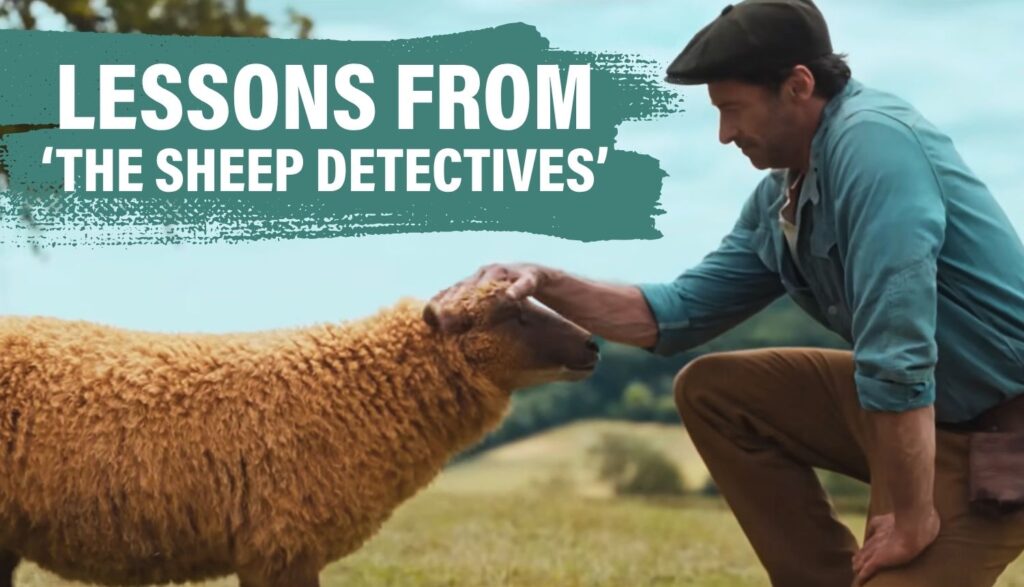
The Sheep Detectives officially lands in theaters today, and if you look at Bob Hoose’s excellent review, you’ll see that we liked it quite a bit. Though a bit perilous and potentially sad in places, it’s sweet and funny and comes with some nice messages.
And, if you ask me, it comes with some depth that you’d not necessarily expect from a kids’ movie about talking sheep.
The Sheep Detectives made me smile, but it also made me think. I wanted to share a few of those thoughts with you. Let me offer five of ‘em—some of which even come with a whiff of Christian faith.
One quick word of warning, though: While we’ll not spoil the core mystery here, we’ll need to touch on some overall themes. So if you’d like to keep the movie completely spoiler free, see The Sheep Detectives first and then visit this blog afterward.
Be Nice (and Pay Attention) to the Winter Sheep
Sheep seem nice and all, but in The Sheep Detectives, they can get a bit judgmental. Their biggest blind spot? The so-called “winter sheep,” born outside the nice, cozy season of spring when most sheep are born. Winter sheep are “different,” we’re told, and they’re shunned by the rest of the flock. And that ostracization does a number on their sheepy self-image.
A tiny, speckled lamb is the first winter sheep we meet, and sure enough, the poor thing is roundly shunned—at first. But when the flock’s shepherd, George, gets murdered, the lamb sees and smells things that the rest of the flock don’t notice. And in the end, this lowly lamb becomes a prime catalyst for setting things right.
The “winter sheep” theme is perhaps the movie’s most obvious takeaway: It’s a reminder to be kind to those who are different than we are—those whom we might tend to look away from. And that’s a really good message. But I think this theme can also give us an opportunity to talk about the Bible, too.
The lamb in question is speckled and spotted—hardly the poster child for what a sheep should look like. It reminded me of Jacob and the flock that he negotiated to take from his father-in-law in Genesis 30. As you recall, Jacob took all the spotted and speckled sheep—sheep that were thought of as inferior. But in reality, they wound up being the strongest sheep in the flock.
And that in itself reminds me of another biblical theme: When you look at the Bible’s greatest heroes—the people who God used most to tell His own story—they were often society’s imperfect “winter sheep.” The second (or seventh) sons. The guys who stuttered. Women. Lowly fishermen and, yes, shepherds. God has used plenty of society’s own “winter sheep” to fulfill His glorious purposes.
Don’t Forget (Even the Bad Things)
Turns out, sheep (at least those in The Sheep Detectives) have a remarkable ability: Most of them can close their eyes, count to three and forget anything they want to. And that can come in handy if you want to forget something particularly painful. For most of those sheep, the death of their beloved shepherd is painful indeed. But forgetting that your shepherd ever even existed isn’t particularly conducive to honoring his memory—much less solving his murder.
We humans also have moments that would be easier to forget. But pain, loss and grief are a part of life. The Bible acknowledged as much. But it also reminds us that there is life beyond that grief and pain. “The Lord is near to the brokenhearted and saves the crushed in spirit,” we read in Psalms 34:18. And with God’s help, we eventually move into a place of healing—and even one of rejoicing. We feel grateful to have had the ones we’ve lost in our lives at all.
Being Smart Isn’t the Same as Being Wise
Lily is, without question, the flock’s smartest sheep. When George reads his flock a detective novel (as he regularly does), Lily figures out the culprit before the last chapter without fail. But while Lily is extraordinarily clever, she needs help to see this mystery to the end. She needs the help of Mopple, a sheep that never forgets. A sheep that knows what loss feels like. A sheep that learns from life’s sometimes painful lessons.
It’s interesting that Mopple’s superpower, essentially, is his memory and experience. That’s a nice little echo of Job 12:12: “Wisdom is with the aged, and understanding in length of days,” it reads, implying that our experiences, not our brain matter, make us wise. We all probably know people who are incredibly smart but can sometimes miss the truth. And while knowledge and lots of IQ points can be great, intelligence can sometimes become a little bit of an idol.
The Good Shepherd
We get to know George before the shepherd is unceremoniously murdered—and we especially know how he relates to his wooly charges. He does more than just care for their basic needs, as one might expect. He cares for them as individual sheep. He knows each one and gives each a name. He loves them, in fact, and he extolls just how much in a letter. And there’s more: In a flashback, we see how George sweeps in and rescues a ram—an unloved critter knocked around by life—and carries him home.
For Christians, the scene (consciously or not) feels like a visual echo of the Parable of the Lost Sheep, wherein the good shepherd rescues that wayward animal, places it on his shoulders and heads back to the pasture. And that’s not the only echo we’ll find here: Given the number of times that the Bible compares us to sheep and God to a shepherd, it’d be hard to avoid them. But the thing that struck me most powerfully in The Sheep Detectives was how well George knew his sheep—to the point of naming each one. It reminds me of John 10:14-15: “I am the good shepherd. I know my own and my own know me, just as the Father knows me and I know the Father; and I lay down my life for the sheep.”
Finding Meaning in the Chaos
It’s no secret that the sheep in The Sheep Detectives are after a killer, using everything they’ve learned from the murder mysteries that George read to them every day. As the case goes on, Lily and her fellow sheep realize that it’s not quite as easy as it is in the books: Real life is confusing, and tracking down a clever killer will stretch these sheep to the limit.
But ultimately, the sheep succeed. They clear the innocent, bring the guilty to judgment and bring order out of chaos.
And all of that, I believe, is inherently spiritual. Even Christian.
I’ve written before about how murder mysteries contain a hint of divine purpose within them. They’re about bringing order out of chaos, just as God did at the hour of Creation. Murder mysteries are about questioning assumptions (1 Thessalonians 5:21), exposing lies (Mark 4:22), punishing the guilty (Proverbs 19:9), upholding the law (1 John 3:4) and embracing the truth (Ephesians 4:25).
You’ll find those (often unstated) spiritual notes in most murder mysteries, be they from Agatha Christie or Rian Johnson. But one of the things I love about The Sheep Detectives? It’s not a super-smart sleuth who solves this. No Sherlock Holmes swoops in with all the answers. The sheep who solve this feel a lot like … us. God’s sheep. Imperfect. Myopic. Blessed with some incredible gifts but hampered by our own weaknesses and, as such, in need of a community of others to help us along the way.
The Sheep Detectives is not likely a future Best Picture contender. It won’t knock you over with its multilayered aesthetic brilliance. But for my money, this kids’ film comes with more depth than you’d expect—and depth that just might help you consider our own Shepherd through a different lens.

3 Responses
I love the bit you included about how detective stories contain a hint of divine purpose. My favorite anime (in fact, my favorite show of all time) is Detective Conan. And as a Christian weeb, I’ve made multiple biblical memes out of it.
One of my favorites is from the scene where Shinichi Kudo (the main character of the series) solves a murder before his detective rival Heiji Hattori, who came to a very close but ultimately inaccurate conclusion. Heiji admits defeat, telling Shinichi that it was his win this time. Shinichi stops him dead in his tracks with the retort, “Idiot. There’s no win or lose in this. No higher or lower to it. There is always, only, one truth.” I captioned that one with 2 Timothy 2:15.
As a matter of fact, that’s the tagline of the entire series: “Shinjitsu wa itsumo hitotsu.” There is always, only, one truth. And it’s our job as Christians to rightly divide that truth and point everyone else to the Author of that truth. And I think that’s why detective stories tend to stick with us as Christians especially.
Those are some great points. I watched that and it was so good. I have read plenty of whodunnits but this one actually hits to the heart. It lets you realize just how devastating death is, but that you must bring a murderer to justice
Many biblical allusions, however, not sure if intended: George’s paying money for the trapped ram in a circus is obviously our Redeemer’s work in us, the other sheep from Caleb’s sheepfold coming into the flock hints of John 10:16. The parable of the lost sheep is told in the context of the calling of Levi: an ironic twist -more joy in Heaven over one ‘sinner’ who repents rather than 99 ‘righteous’ who have no neee or repentance