

Eight years after her abduction, young Katie Cannon is discovered alive. But she’s quite different than she used to be—perhaps because she now plays host to an ancient Egyptian demon. Lee Cronin’s The Mummy is a bloody, grotesque and dispiriting affair, filled with supernatural ook and plenty of profanity to boot. This is one film you might want to bury.
They thought their nightmare was over.
Jack and Larissa Cannon were living in Cairo when their daughter, Katie, was abducted, vanishing into the Egyptian sands.
Eight years later, they’ve never lost hope that their little girl might be found. Both know that such stories rarely end happily. Still, when they moved to Albuquerque to live with Larissa’s mother, Carmen, they made sure to give Katie her very own room—just in case.
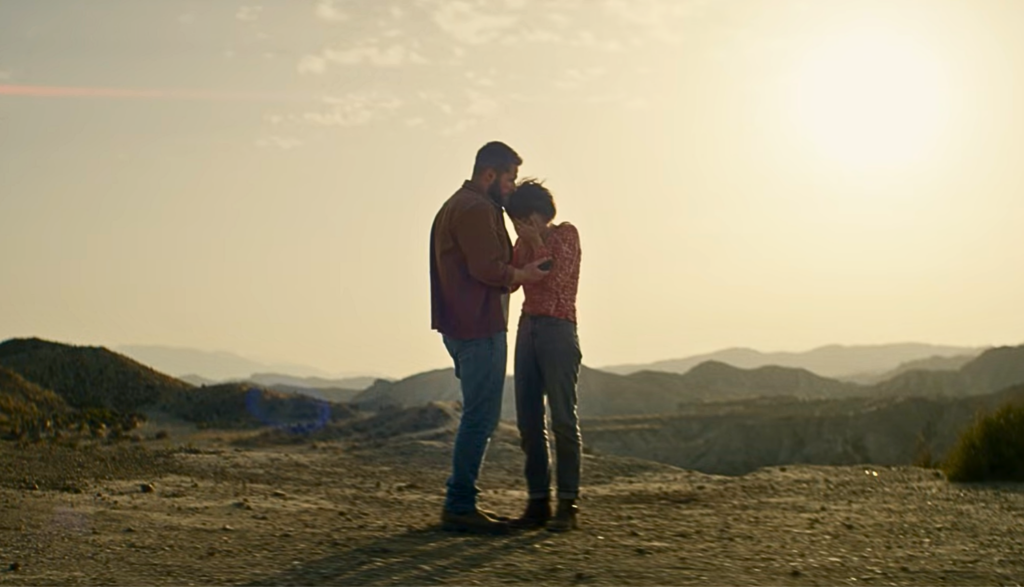
Then the call comes from Cairo. Katie’s been found. And she’s alive.
But she’s … different.
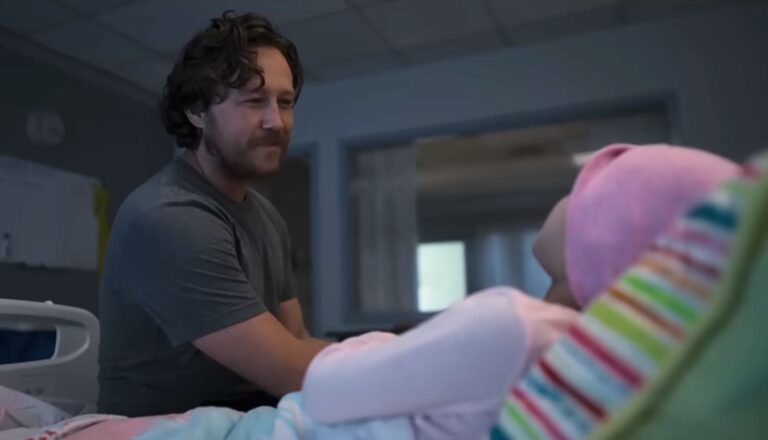
Katie was found wrapped in bandages inside a 3,000-year-old coffin. She can’t say where she’s been for the last eight years; she’s unable, or unwilling, to talk. Doctors keep her under heavy sedation. When she’s fully aware, Katie grows agitated. Uncontrollable.
It’s to be expected, perhaps. Katie’s been gone for eight years—half her lifetime. She’s been subjected, surely, to unspeakable trauma. All the girl needs, the doctor suggests, is a loving family around her. It’ll take time: weeks, perhaps months, perhaps longer. But they’ll find their little girl again, underneath all that barely recognizable skin and scar. Katie will come back to them.
But in the meantime, the doctor tells them, they should speak softly. Make no sudden moves.
To have a child taken from you would be, for most parents, an unimaginable terror. Jack and Larissa have lived with that terror for far too long. With Katie now back, that nightmare is over.
But another nightmare is just beginning.
Jack and Larissa both clearly love their kids, including the newly returned Katie. Certainly, she’s a bit of (ahem) a challenge when she comes back. But even when Jack suggests that they’re in over their heads—that perhaps finding an outside facility to house her for a bit wouldn’t be the worst idea in the world—Larissa insists that what Katie most needs is a mom, a dad and a loving home. “She’s not going anywhere,” Larissa says. And while that’s probably the wrong choice here, you can’t fault the love at the heart of it.
But let’s not fault Jack for his suggestion, either. He loves Katie, too. He wants what’s best for her. And in the midst of a rather trying night, he commits an act of sacrifice worth a bit of praise.
Finally, let’s laud Dalia Zaki, a Cairo detective, for doggedly pursuing Katie’s case and searching for her abductor(s). Sure, it’s her job. But she proves to be pretty good at it.
[Spoilers are contained in this section.]
Katie had a rough go of it during her eight years of captivity. Turns out, she was possessed by an ancient Egyptian demon known as the Nasmaranian. When left to its own devices, this demon possesses people—flitting from one host to another. (It also seems to control others—both alive and dead—within its sphere of influence.)
But the Nasmaranian has been under lock and key for the last few thousand years, thanks to one family that has, until now, kept the thing imprisoned inside a host body and an ancient coffin. For countless generations, the family members have served as both the demon’s and the hosts’ jailers. But once a host body is used up, the jailer—the current one is a woman we know only as “The Magician”—must round up a new body. Any body will do, she notes, but the young and innocent just last longer.
The Magician feels bad about taking Katie, but she feels as though she must. She gives the girl an infected tangerine (a bug crawls out of it and into the girl’s mouth) and recites some magic words. Then she whisks Katie into the sub, sub-basement of her house where a well-attended rite is conducted. Once the demon transfers itself from the old host into the new one, the body is wrapped in bandages inscribed with ancient, protective spells and buried alive.
We hear a number of people recite those same magic words above a couple of times with supernatural consequences. People levitate, and inanimate objects slide across the floor. Coyotes show up for no reason and loiter about menacingly.
Christianity appears to be little more than an annoyance to the Nasmaranian. Carmen, Katie’s grandmother, is pretty religious: When Katie first comes home, Carmen says a prayer over the girl. And as soon as the word “amen” escapes Carmen’s lips, Katie headbutts her. But worse is yet to come.
Later, Carmen prays for Katie’s safety and salvation in her own bedroom. Katie levitates into that room, tells her grandma that it’s “fun to be dead” and telekinetically chokes the woman with her own crucifix necklace.
Cairo is, of course, a predominantly Muslim city. And as such, we do see some women wearing hijabs. Some folks offer praise to Allah. But otherwise, Islam is barely referenced.
As many horror films do, The Mummy tries to subvert what we tend to think of as good or innocent whenever it can. For instance, “Katie” (who’s about 16) asks her younger brother, Sebastian, whether he’d like to help her get undressed. Sebastian—under the influence of the demon in Katie’s body, says yes. But it’s worth noting that Katie wants Sebastian to, apparently, strip off swaths of skin, not clothes.
On a similar note, Carmen’s animated corpse grotesquely comes on to Jack (who, in life, was her son-in-law) and seemingly asks him to perform a sexual act on her. (Again, it seems the demonic presence here isn’t really serious; it wants to gross Jack out.)
Jack and Larissa kiss gently.
The Mummy has been classified by some as a “body horror” movie, and I get why. It engages in a bunch of mutilation—much of it self-inflicted.
We get hints of that early on. Katie, when she’s recovered, has a number of cuts and scratches on her skin: The doctor says she’s been scratching and tearing at herself, and it’s one reason why they keep her under sedation. Later, Katie seems to drill and burrow into her own wounded leg with a knife or pick. And, as mentioned above, she and her brother rip and tear off chunks of her own flesh.
Another girl rips out most of her own teeth, dropping them on the floor. A guy smashes his head repeatedly into what looks like a bedframe.
A woman gets bitten, choked and tossed out a window and onto a car. We see her bloodied face through a bloodied-and-broken windshield, but her body is dragged off the top of the car by coyotes, who begin eating the still-living woman. (There’s still enough flesh on the corpse for Katie to later take a nibble herself—and lick up some of the blood.) A man gets skewered through the head and jaw by a massive hook. A plane crashes, killing two people. One gets stuck to a tree—a sharp branch jabbed through the skull and protruding out of his eye socket. (The boy who discovers the wreck sees an eyeball on the ground.) Another, more typical, mutilated body lies in the wreckage. A swallowed scorpion nearly rips apart someone’s throat. The critter gets removed, but the wound forces the victim to cover her larynx in order to speak.
When Katie’s taken home, Larissa tries to trim her daughter’s toenails and accidentally rips one off. In another instance, the nail seems to still be connected to the skin; it peels off the girl’s shin like a thick egg membrane, exposing a trail of blood and raw flesh behind. Larissa plucks a tooth out of her daughter’s mouth, as well. Katie’s unresponsive to these indignities at first. But later on, when she shakes off the drugged stupor she’s been under, Katie is certainly in a great deal of distress: She screams and her back arches and contorts unnaturally.
When Katie gets kidnapped, there’s certainly a lot of speculation as to what happened to her—and Cairo’s lead detective at the time believes the parents might be at fault. When she’s found, the new lead detective, Dalia, says that it’s not so unusual to find a human trafficking victim buried in an ancient sarcophagus. The best way to traffic someone in Egypt is to utilize the country’s own history against it.
The process of demonic possession is quite grotesque and inherently invasive. Characters are locked in coffins and chests, and they’re sometimes tied up or chained down. A woman displays the stump of her severed tongue, managing to tell someone that her own mother did the deed. We see a lifeless and bleeding bird in a cage. (A woman picks up the bird and crushes it between her fingers.) Someone gets shot in the chest. People get beaten, bitten and gouged elsewhere, too.
Part of the floor and rug in Katie’s room is, without explanation, covered in blood.
At least 17 f-words and two s-words. An 8-year-old girl says the c-word once (to her teacher) and then seems to whisper it to herself later. We also hear “h—,” “d–k” and two misuses of God’s name.
People drink alcohol at a wake. A strong sedative gets injected into a couple of people—in one case knocking out the recipient.
Her first night home, Katie spends a good chunk of time scrambling through the spaces between walls. Once her parents track her down and corner her, they see her eating something. (The critter’s legs or tail stick out of Katie’s mouth.) Larissa forces her to disgorge the thing, and Katie messily vomits over the floor.
Lee Cronin’s The Mummy is a dark, dark movie.
First of all, it’s dark physically. Even in an era in which most horror movies feel like they’ve been filmed from the inside of a filing cabinet, The Mummy takes the cake. In this cinematic version of Cairo and Albuquerque, lightbulbs are as scarce as Fender guitars, and everyone prefers their rooms to look as if they’re illuminated by single birthday candles.
One would think that, if you’re being attacked by a demon-possessed kid, you’d turn on some lights. But you’d also think that you’d check on your other children occasionally, too. This seems not to have occurred to Jack and Larissa—even though they both blame each other for leaving Katie alone too much before her abduction.
And that brings us to another sort of darkness the film brings with it: Its own inky, cinematic soul.
The Mummy revels in not only throwing kids into danger, but forcing them to maim themselves, too. I can’t think of too many people who’d say, “You know what movies need? More 8-year-olds who pull out their own teeth.” But that’s what this film gives us. It revels in forcing its young actors to lob the vilest curses and laugh at the most disgusting mutilations possible. I hope that, if this movie turns a profit, those proceeds will all go to the inevitable therapy bills of its youngest performers.
This movie, like its prime antagonist, delights in inflicting pain—not on its characters, but on its viewers. It wants us to gasp and squirm and wince until we’re finally numb to it all. Instead of being sedated against the story’s injustices, as Katie is, we’re ultimately sedated by them—insensate to the atrocities we see on-screen.
Katie may have been entombed alive, but the movie itself seems to seek to kill a little bit of each of its viewers, one pulled tooth at a time.

Paul Asay has been part of the Plugged In staff since 2007, watching and reviewing roughly 15 quintillion movies and television shows. He’s written for a number of other publications, too, including Time, The Washington Post and Christianity Today. The author of several books, Paul loves to find spirituality in unexpected places, including popular entertainment, and he loves all things superhero. His vices include James Bond films, Mountain Dew and terrible B-grade movies. He’s married, has two children and a neurotic dog, runs marathons on occasion and hopes to someday own his own tuxedo. Feel free to follow him on Twitter @AsayPaul.