
I Love Boosters is a crime dramedy about a group of women who steal high-fashion clothing. But the film quickly spins into a surreal sci-fi/fantasy satire. Boosters has plenty of creative flair, but it’s also packed with gratuitous sexual content and nudity, a bevy of vulgar language, some violence and drug use.
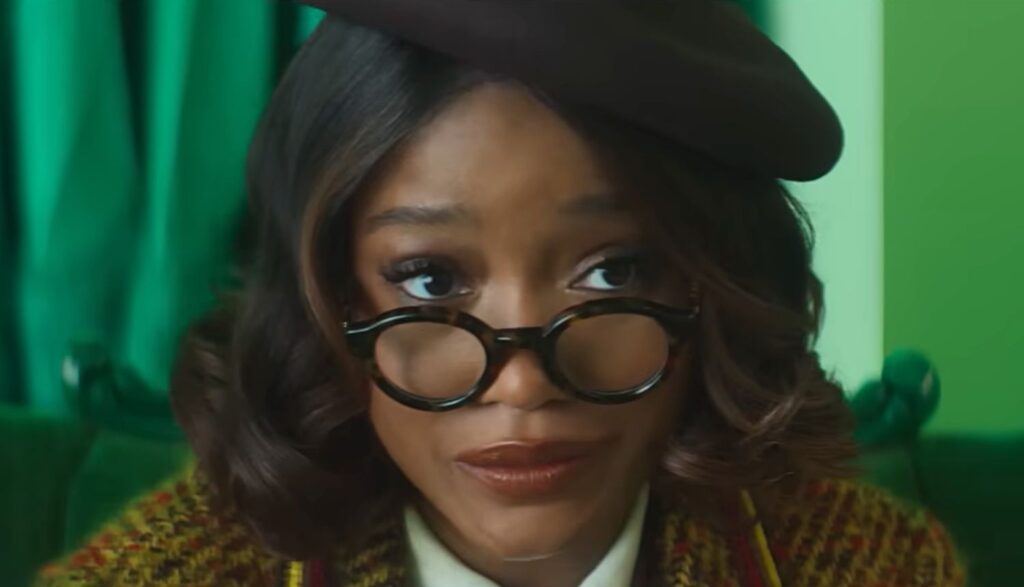
Corvette is a Bay Area booster. She and her friends, Sade and Mariah, steal high-fashion clothing and resell it on the street at a discounted price—which they dub “fashion-forward philanthropy.”
Unfortunately for them, the authorities aren’t as eager to equate theft with altruism. So Corvette and the rest are stuck squatting in an abandoned chicken restaurant full of their boosted clothes.
Christie Smith also wouldn’t be mistaken for a humanitarian, though she’s on the other end of the financial spectrum. She’s a billionaire fashion mogul who makes the clothes that Corvette boosts. Well, that’s not technically true: Christie designs the clothes, but it’s her sweatshop employees in China who make them.
In many ways, Corvette idolizes Christie—for the fashion, not the sweatshop bit. Corvette dreams that, one day, she might become a designer herself.
But when Corvette learns that Christie has stolen one of her own designs, well, that’s too much to take. Instead of simply boosting Christie’s clothes for a profit, Corvette decides to up the ante to make the couture tycoon hurt.
Soon enough, the boosters bump into Jianhu, another person with an ax to grind against Christie Smith. Jianhu was a worker in Christie’s overseas sweatshop. Her family is still stuck there, working in poor conditions for meager pay.
Together, they’ll team up to take Christie Smith down. Their increasingly bizarre quest will include pyramid schemes, monochromatic clothing stores, teleportation devices and a literal demon.
Buckle up. It’s going to be a bumpy ride.
People push for better working conditions for those who work in sweatshops.
A man says that he is actually a demon. While he most often appears as a normal human being, one scene reveals his disturbing, snakelike form. He also claims that he can take souls from people, and we see that happen in one scene. (More on that in Sexual & Romantic Content.)
Thanks to Jianhu, the boosters acquire a teleportation device that can also deconstruct or accelerate matter. The film essentially hand waves this device with rapid-fire technobabble that is framed around the Marxist philosophy of dialectical materialism. Functionally, it’s a magic device that can produce whatever bizarre outcome I Love Boosters wishes to put onscreen.
Someone considers the Teletransportation Paradox: Upon using a teleportation device, she wonders if her original self was killed and replaced by a perfect clone.
At one point, Corvette briefly envisions herself falling into an infernal dimension.
We hear that the Greek figure Damocles lost his faith in, presumably, the Greek gods.
I Love Boosters contains a handful of explicit sexual moments. As mentioned above, a demon says he “sucks the souls” out of both men and women, which he does through sexual means. One extended scene shows the character having graphic sex with a woman. He then sucks out her soul through her private parts—the horrifying process paired with the woman’s exaggerated (and graphic) response.
This demon also tries to initiate a romantic relationship with Corvette, but she declines.
A techno-fantasy device allows people to “deconstruct” an object to its genesis; for instance, a wooden door could be reverted to a tree. When the device is used on a person, she reverts to her mother and father having sex, which includes nudity, sexual movements and moans.
Nudity is frequently present, during sex scenes and otherwise. The film shows full-frontal male nudity and all but full-frontal female nudity. The reproductive organs of skinless male characters (more on that in Violent Content) are clearly visible in a handful of scenes. A woman wears a piece of clothing that mimics large, bare breasts.
This film also includes plenty of suggestive dialogue tied to sexual acts and male and female anatomy.
Characters peel the skin from their own bodies to reveal the muscle underneath. A car chase results in a lot of property damage. People shoot guns at a fleeing woman. The sexual scene with the demon detailed above is portrayed, in part, as violent (though consensual).
A woman gets kidnapped and roughly tossed into a van. People are threatened with violence.
Corvette and her friends destroy swathes of clothing, sometimes while human models are still wearing the garments. (Fortunately, it seems the people who were wearing those clothes come away relatively unscathed.)
I Love Boosters contains perhaps the most profane use of Jesus’ name that I have ever heard in a film, pairing the abuse with a crude use of “d–k.” God’s name is abused six times, once paired with “d–n.”
The f-word is used nearly 100 times. We hear the s-word more than 75 times. “B–ch” is used more than 20 times, referring to both women and men. Additional profanity includes uses of “d–n,” “a–,” “a–hole,” “h—,” “p—y,” “d–k,” “whores” and “p-ss.”
Someone uses the word “retarded.” There are some additional crude references to male anatomy.
Characters smoke a marijuana cigarette. Others are seen snorting a white powder. One woman frequently vapes. People drink throughout the film.
When Corvette’s friend suggests that she go to see someone named Dr. Jack, Corvette says she’s “not trying to get drugged.”
Christie is an incredibly deluded and vindictive person who values human life much less than her “art.”
Dr. Jack is a dubious individual who promotes a pyramid scheme. Either corporations or the government (or both, since they might be one and the same in this satirical flick) use the news as a tool to suppress the masses—communicating on-the-nose messages like “your boss knows best” and “you should be grateful to accept less pay.”
A Black woman holds her breath to make her skin “whiter.” (As a result, she appears, comically, as a totally different person.) A woman is said to have contracted lung cancer from the poor conditions at a sweatshop. We hear that widespread labor strikes have shut down entire industries. Someone makes a disparaging comment about her children.
I Love Boosters is easily the most bizarre film I have seen this year. Director Boots Riley, no stranger to satire, has constructed a film that starts as a crime dramedy and morphs into a surrealist sci-fi plea for unionization and de-corporatization.
The film reminds me (somewhat) of Everything, Everywhere All at Once, with a dash of Wes Anderson’s visual palette and the satirical acidity of something like RoboCop. That combination of elements could have resulted in an effective—if not family-friendly—film.
Unfortunately, I Love Boosters is undone, primarily, by two things: its insistent, hallucinatory eccentricity and its grotesque content.
To be fair, grotesquerie is often a big part of satire. These spoofs take something (a philosophy, an economic system, etc.) and extrapolate it to its meanest, ugliest extremity to make a point.
But I Love Boosters presents its “modest proposal” through many unnecessarily immodest means: Its heroes are thieves, and little critical thought is given to their criminal activities; Riley is content to hold them up as a crew of fashion-minded Robin Hoods with whom we’re meant to sympathize. The film is stuffed with explicit nudity and graphic sexual content. Harsh and profane dialogue fill the runtime. And to top it all off, recreational drug use makes an appearance, too. A biting parody could have still been made without these problematic excesses.
I Love Boosters doesn’t lack creativity. What it lacks is decency. And coherence.

Bret loves a good story—be it a movie, show, or video game—and enjoys geeking out about things like plot and story structure. He has a blast reading and writing fiction and has penned several short stories and screenplays. He and his wife love to kayak the many beautiful Colorado lakes with their dog.