Stranger Things
The newest season of Netflix’s Stranger Things continues to blend ’80s nostalgia with ever-darker spiritual content and horrific violence.
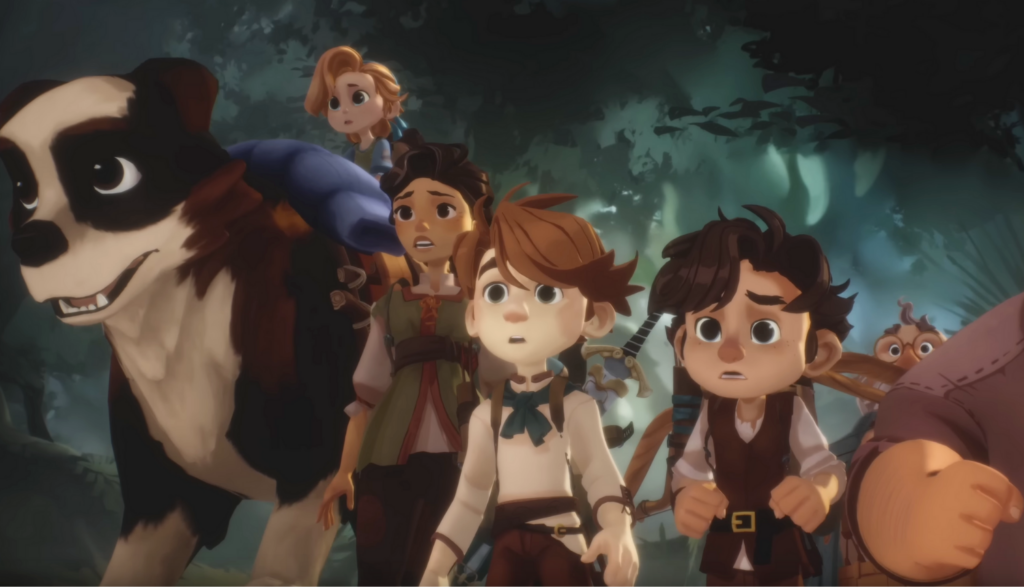
The land of Skree has seen better days.
Granted, it’s always been home to its share of oddities: bumpy digtoads with their stabby elbows; fazzle doves with their (ahem) stenchy habits; toothy cows, which would be more likely to eat you than you to eat them.
But ever since the land was taken over by the Fangs of Dang (lizard-like folk who’d love the sound of claws on chalkboards), Skree has suffered under their leathery, clawed thumbs. In the township of Glipwood, they swipe family heirlooms as taxes, confiscate garden hoes as weapons and sometimes take people—even children—in the dead of night.
But such is the fate of the people of Skree, and most have learned to endure.
Take, for instance, the Igibys.
Nia Igiby is one of the few humans whom the Fangs seem to appreciate. Why? She just happens to make the best maggotloaf around—even adding extra rats’ tails to the noxious stew to please them.
The rest of the family is not so well-tolerated, though.
Podo Helmer (Nia’s father) is a beefy ex-pirate whom the Fangs keep a close eye on. And there’s something subversive about the kids, too—something, perhaps, even dangerous.
Oh, they look harmless enough. Oldest son Janner always has his nose in a book. Kalmar (who sometimes goes by Tink), the middle child, is a mischief-prone lad, but his older brother keeps him in line … well, at least some of the time. And then there’s Leeli, the youngest. She’s certainly no threat. How could she be? Because of her twisted leg, she needs a crutch to get around. She’s hardly a threat to the Fangs.
Or is she?
Turns out the Igibys aren’t the Igibys after all—they’re the Wingfeathers, the rightful rulers of the Shining Isle of Anniera. But Nia (former queen of Anniera) changed their surname to her mother’s maiden name to hide them all after her husband, High King Esben, was killed in the fall of Anniera.
And the kids? Well, as the three eldest children born into the royal family, they’ve got some pretty nifty roles. Traditionally, the crown passes over the oldest child and goes to the second—in this case, Kalmar. But Janner is the Throne Warden, destined to protect his younger brother. And while Leeli won’t fight many battles with her injured leg, her role as the Song Maiden grants her other powers—powers that seem to connect her and her brothers to the sea dragons just off the coast.
Together, they’re the legendary Jewels of Anniera that Gnag the Nameless (the leader of the Fangs) has been searching for. For what? That remains to be seen. But Nia and Podo will do just about anything to keep the kids safe and together.
The Wingfeather Saga began its own saga as a series of books—the first of which, On the Edge of the Dark Sea of Darkness, was published in 2008. Its author, Andrew Peterson (who’s also a well-known Christian musician), is serving as an executive producer for the series, too. In an interview with Plugged In, Peterson said that the show gives him a chance to tell the story from a different angle—adding elements that just aren’t possible to add in written form.
The series, like Angel Studios’ The Chosen, is crowdfunded. And if all goes well, Peterson and showrunner J. Chris Wall say that they hope to chronicle all four books over the course of seven seasons.
The Wingfeather Saga is an adventure story at its core—filled with dastardly villains, scary animals (my favorite is the toothy cow) and perilous situations. Threats lurk around every corner, and many characters perish, so it might not be suitable for the youngest of viewers. There’s just a wee bit of bathroom humor in the mix, too.
But those are about the only tiny quibbles to be had in this charming, engrossing show.
The Wingfeather Saga gives viewers a powerful story beautifully told. Part of that can be credited to the show’s unique animation style, which finds a middle path between polished Pixar-style CGI and 2D animation and feels almost like living watercolor. The other part can be credited to Peterson’s likeable protagonists and the saga’s majestic scope.
While The Wingfeather Saga isn’t overtly Christian, it carries with it a Christian ethos. It follows in the tradition of C.S. Lewis’ The Chronicles of Narnia in a way, using a fantastical world to explore deeper themes: love, sacrifice, hope and the eternal struggle between good and evil. And sometimes, our heroes find the time to pray.
Jesus talked about how we are like farmers, sowing the seeds of the Good News in the world. Some of those seeds find good soil. Others do not.
But it seems that, every so often, storytellers sow seeds—seeds meant for children but accessible to adults, too—that grow like lampposts in a new world. These stories that talk about eternal truths in creative ways capture the imaginations of their young readers or viewers and become not just a part of their lives, but sometimes inspiration for them to grow up and tell their own stories.
The bestselling Wingfeather Saga has done its own share of sowing on fertile ground. Will the show do the same? Only time will tell. But I kinda hope so.
(Editor’s Note: Plugged In is rarely able to watch every episode of a given series for review. As such, there’s always a chance that you might see a problem that we didn’t. If you notice content that you feel should be included in our review, send us an email at letters@pluggedin.com, or contact us via Facebook or Instagram, and be sure to let us know the episode number, title and season so that we can check it out.)
As Janner treks through the Stony Mountains in search of his family, Kalmar finds himself imprisoned in the dungeons of the Phoob Islands. Meanwhile, Leeli, Nia, Podo and their friend Oskar travel across the Ice Prairies in search of a hidden city.
Janner is accompanied by a brave young girl named Maraly. She uses her knife-throwing skills to take down a buzzard for their dinner. Later, the pair sneak into the cave of a Bomnubble—a large and dangerous creature that will kill and eat just about anything—hoping to steal some animal pelts to keep them warm. The Bomnubble discovers and chases them, but they manage to escape.
Kalmar steals the keys off one of his guards to free himself and another boy from their cell. They wind up getting chased through the dungeon’s tunnels before they’re recaptured on the surface.
Creepy creatures grab at Kalmar and his cellmate as they flee through the prison. Janner and Maraly fend off several less-than-friendly beasts. (Janner gets stuck by the quills of a porcupine-like animal.) Guards are armed with spears. A man slips on ice and falls, but he’s unharmed. Kalmar’s cellmate has an eyepatch over a badly scarred eye. A man accidentally pokes his comrade in the eye. Children are imprisoned and enslaved. Animal skulls and bones litter the Bomnubble’s cave. The Bomnubble eats an animal carcass.
Threats and insults are exchanged. Some bird-like creatures flatulate. Someone says something that sounds like “dangflabbit.” A girl says a mountain looks like a witch’s nose. Janner exclaims, “Maker help us.”
Janner feels like it’s his fault that Kalmar was sent to the Phoob Islands, but Maraly reassures him that isn’t true. Captors punish a young girl by rationing her already measly food portions. But other enslaved children show camaraderie by each offering her a scoop of their own food—the combined total ensuring she has enough to eat. Nia worries whether Janner and Kalmar will find them, but Podo and Leeli comfort her.
Podo, Nia, Oskar (a friend of the Igiby children who owns a bookshop in Glipwood) and Peet the Sock Man (really the children’s uncle Artham, whom Nia and Podo thought died in Anniera) flee with the kids from Gnorm, a Fang commander who has been instructed to capture the children.
The Igibys battle against the Fangs, slaughtering many with arrows and swords. The Igibys’ pet dog, Nugget (who grew to the size of a pony after some magical water was used to heal him), takes out a few Fangs and other Skree creatures, too. Oskar bleeds through bandages covering an old wound until the Igibys heal him with magical water.
A rockroach (a giant buglike creature) snatches several animals and creatures from the woods, devouring them in the shadows. Podo and Janner fight it off when it attacks them. And it kills many Fangs after magical water causes it to grow to the size of a building.
Fangs tear Glipwood apart, breaking windows and burning buildings, while searching for the Igibys. One Fang holds the innkeeper’s wife down with his foot before tossing her and her husband into the Black Carriage—a carriage from which there is typically no return.
Nugget is temporarily paralyzed by a magical mist. Artham is kidnapped by trolls working for the Fangs. Gnorm threatens to burn Skree to the ground and kill Artham unless the Igibys surrender.
We hear that Leeli’s leg was damaged by a Fang trying to tear her from her mother’s arms as they were escaping Anniera. Artham beat the creature back, but while he was distracted, Nia’s mother was killed by an arrow, and Podo never forgave Artham for failing to protect her.
A former friend of the Igiby children betrays their location to Gnorm. Podo gets frustrated with his family when they take Oskar’s advice instead of his. Someone says, “thank the Maker,” which is what folks in the Wingfeather Saga call God.
It’s Dragon Day: a massive festival in which residents of Glipwood gather to eat, play games and listen to the majestic sea dragons from the cliffside. It’s a day that not even Glipwood’s overlords—the dastardly Fangs—can wholly spoil. But for the Igiby children—bookish Janner, athletic Tink and sweet little Leeli—Dragon Day turns especially interesting. First, they have an unfortunate run-in with a particularly vile Fang. Then, they discover that all three seem to have an unusual connection with the sea dragons themselves.
The day before, Janner and Tink find themselves threatened by one of the region’s most fearsome animals, the carnivorous “toothy cow.” The animal forces the two boys to find refuge in a tree: Only when Tink sticks a “gloop fruit” on an arrow and shoots it into the forest do they find the space to escape. Meanwhile, Leeli and Podo (the children’s grandfather) round up nasty, weasel-like creatures who threaten their garden. (Podo reluctantly promises Leela that he won’t kill them.)
Elsewhere, we see a man taken away by a mysterious black carriage (and hear that other villagers, including children, have been spirited away in the night). A Fang nearly swallows a puppy. Kids battle the lizard-like creature, and it’s eventually buried underneath a falling chimney. (The fang survives relatively unharmed.) Podo’s forced to turn over a garden hoe, which the Fangs classify as weapons.
We see a fazzle dove, a creature known for its nasty flatulence. Fangs seem to like food that the rest of us would consider noxious and quease-inducing (as well as terrible music). There’s a story told about someone’s propensity to pick his nose. People and Fangs hang out at what appears to be a pub, drinking various beverages. (The Fang takes his without paying, of course.) Fangs also force Glipwood’s citizens to hand over valuables to cover their mysteriously flexible taxes. Tink has no problems breaking rules, and he encourages others to do the same.
Janner is sweet on a girl named Sarah Cobbler. The Digiby family prays around the dinner table, thanking the “Maker” for their blessings.
Paul Asay has been part of the Plugged In staff since 2007, watching and reviewing roughly 15 quintillion movies and television shows. He’s written for a number of other publications, too, including Time, The Washington Post and Christianity Today. The author of several books, Paul loves to find spirituality in unexpected places, including popular entertainment, and he loves all things superhero. His vices include James Bond films, Mountain Dew and terrible B-grade movies. He’s married, has two children and a neurotic dog, runs marathons on occasion and hopes to someday own his own tuxedo. Feel free to follow him on Twitter @AsayPaul.
Emily studied film and writing when she was in college. And when she isn’t being way too competitive while playing board games, she enjoys food, sleep, and geeking out with her husband indulging in their “nerdoms,” which is the collective fan cultures of everything they love, such as Star Wars, Star Trek, Stargate and Lord of the Rings.

The newest season of Netflix’s Stranger Things continues to blend ’80s nostalgia with ever-darker spiritual content and horrific violence.

After a seven-year hiatus, the wacky town of Elmore is back, as Gumball and his family embark on even more weird adventures.

The Amazing Digital Circus places its digitized humans under the terrorism of a maniacal AI ringmaster and his chaotic adventures.

The self-centered hedonistic approach of every character in Emily in Paris only seems to increase, and the praises for it are doubled.