TV Series Review
Over two decades ago, the World Government’s Marines captured Gol D. Roger, the self-proclaimed “King of the Pirates.”
But the Marines overseeing his public execution could never have guessed the fervor Roger’s final words would unleash upon the world.
“You wanna know where my treasure is? I’ll tell you,” Roger said. “Wealth. Fame. Power. I found everything this world has to offer. Free yourselves. Take to the seas. My treasure is yours to find.”
And the whole world went crazy.
Ever since that fateful day, thousands upon thousands have embraced the pirate way of life, hoping to one day discover Roger’s treasure, which quickly became known as the “One Piece.” Likewise, thousands upon thousands have died trying to obtain it.
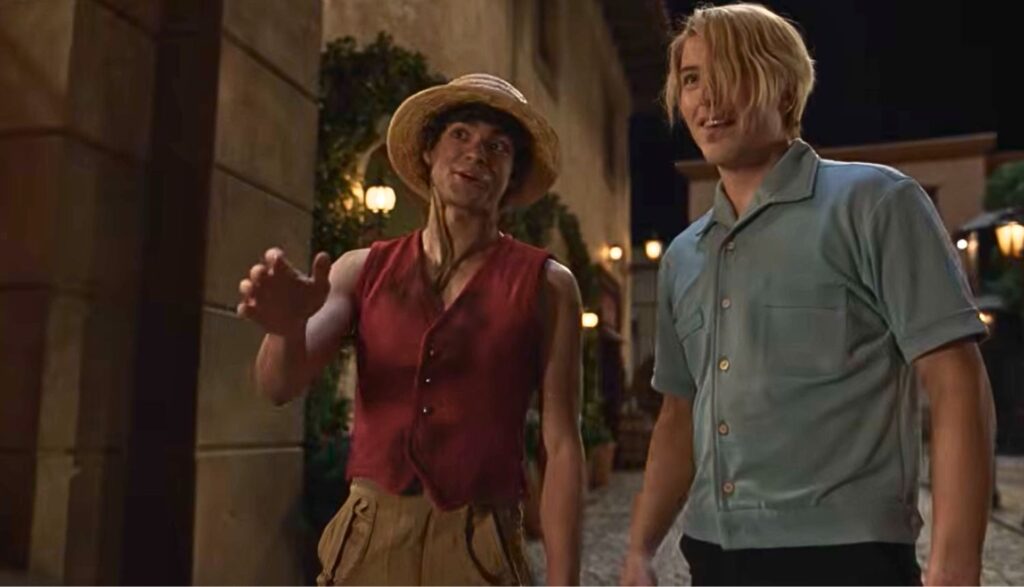
But the world has yet to take on Monkey D. Luffy.
Raise Anchor and Set Sail
Luffy might not look like much, sporting a straw hat and the physique akin to a bean sprout. But he’s also got a secret weapon, quite literally up his sleeve.
You see, when he was little, he bit into a Devil Fruit—an extremely rare food that gives the consumer unique powers. For Luffy, it turned his body into rubber, making him extremely stretchy and immune to all forms of blunt weaponry, bullets included.
The downside? Anyone who eats a Devil Fruit is rejected by the sea and loses the ability to swim—making pirating quite the precarious adventure.
Of course, that doesn’t deter Luffy. Actually, very little can stop the smile on his face. But the new pirate does understand that if he wants to find the One Piece and claim the title King of the Pirates, he’s going to need a pirate crew.
And … well, he’ll need to figure out where the One Piece is.
And depending on how artistically animated your version of Luffy is, that could take a really long time.
A Bit of a Stretch
Perhaps it’s fitting that the anime about the rubber-based pirate stretches over 1,000 episodes. One Piece, based on the manga of the same name by Eiichirô Oda, had its television debut in 1999 and, until January 2026, released a new episode every week. It’s still going, mind you—they’ve just cut back on that weekly schedule.
You may or may not have had your eye on the series, but perhaps that level of episodic commitment was a bit too daunting to tackle. Well, you might be in luck, since Director Marc Jobst (along with the heavy involvement of Oda himself) rebooted the story. These hour-long episodes, which strive to stay true to the source material, will take viewers through roughly the first 45 episodes of plot found in the original anime, and Season 2 will catch viewers up to around the 90th episode.
And if you know anything about pirates, that means that we’ll get plenty of fight scenes along the way.
That’ll be the biggest concern for families hoping to watch this live-action version. People die with quick splatters of blood. It’s revealed that a starving man had to eat his own leg, bit by bit, in order to stay alive. One character (who has also eaten a Devil Fruit) has the ability to separate his body into floating pieces at will—and those severed bits can look at bit gruesome. Another person who doesn’t have that ability is just sliced in half, dead. After all, these are pirates. Not everyone is as chipper and friendly as Luffy.
Likewise, plenty of these pirates drink and swear—but because the show has a TV-14 rating, the s-word is the worst we hear. And in terms of sexual content, a man’s naked rear is seen in the first episode.
But if the anime gives a foretaste of what’s to come (and, because this is a faithful adaptation, it likely will), there’s a bit more audiences may have to deal with in future seasons: Some characters identify as transgender, and a group of people called the Okama (Japanese for homosexual or crossdresser) is made up of such people. Some of the main female characters are objectified (one character has even used an “attack” called “happiness punch,” in which she flashes people to knock them to the ground). And in terms of spirituality, characters use Haki, a method of using spiritual energy in supernatural ways.
Perhaps a live-action One Piece will help people who want to dive into this ocean of a story. But there’s certainly some content that lurks below these waves.
(Editor’s Note: Plugged In is rarely able to watch every episode of a given series for review. As such, there’s always a chance that you might see a problem that we didn’t. If you notice content that you feel should be included in our review, send us an email at letters@pluggedin.com, or contact us via Facebook or Instagram, and be sure to let us know the episode number, title and season so that we can check it out.)