


Willy Wonka & the Chocolate Factory

Content Caution

MediumKids
LightTeens
LightAdults

Credits

In Theaters

Cast

Home Release Date

Director

Distributor

Reviewer

Jonah Parker

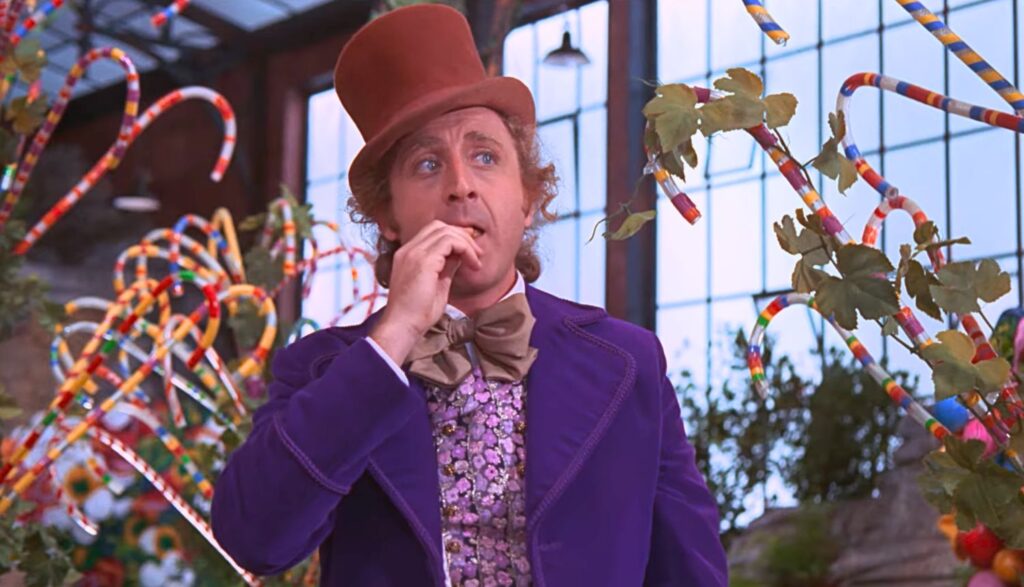
Willy Wonka & the Chocolate Factory is just as creative, colorful, and whimsical as parents may remember from their youth. What they might not fully recall are some disturbing scenes and bizarre visuals that must be traversed to get to the sweet core of the film.

  • Previous
  • Next

Movie Review

As a kid, it’s easy to have a one-track mind fixated solely on a temporary pleasure. Maybe that comes in the form of a dessert that you’ll receive only after you eat the rest of your dinner—especially if that meal includes a dreaded helping of vegetables. Perhaps it’s a new toy that “everyone else has.” Or you might have to wait an entire day for your allotted 30 minutes of screen time to renew.

Personally, I remember being consumed by which Star Wars spaceship would be turned into a Lego kit next—and whether I might be able to scrape together enough birthday cash to buy it.

The difference between those situations and the one Charlie Bucket is experiencing is that, usually, it’s a childish desire, and you’re the only person hyperfixated on it … not everyone on earth.

That’s right, Charlie has his eyes on the same prize as everyone within earshot of a television does: Reclusive chocolate auteur Willy Wonka has hidden five golden tickets among his popular, aptly titled Wonka bars. These tickets will grant the receiver and a guest of their choosing a tour within the walls of the elusive candy maker’s factory.

The potential of this exclusive offer has sent the public, adults and children alike, into a manic frenzy. Charlie’s classmates are buying bars by the hundreds. Wealthy families are enlisting assembly lines of workers to open them for hours on end. And in at least one case, a man has been kidnapped with the only ransom being a case of the sweet treats.

After finding the last of the five tickets, Charlie and his Grandpa Joe set off to see what sugary wonders Wonka has kept behind closed doors.

But Wonka’s true intentions have yet to be revealed, as Charlie and the other lucky ticket holders are about to learn some less than sweet life lessons.


Positive Elements

Charlie’s family is close-knit and supportive of one another, despite years of financial hardship. Charlie’s mom is kind and encouraging to Charlie as he experiences the initial disappointment of believing every golden ticket has been found. Charlie uses his meager earnings from his paper route to buy bread for his family, and he shares his coveted Wonka bars with his Grandpa Joe.

Wonka secretly tests the characters of the five children who are granted access to his factory. While his methods are questionable at best, he does teach the kids valuable lessons about the importance of integrity and honesty. The film itself teaches viewers a lesson about excess and how good things are often best enjoyed in moderation. Charlie is given the opportunity to take a piece of Wonka’s candy to Wonka’s rival for a cash reward—something that would undoubtedly help his family—but he instead chooses to give the treat back to its creator. Charlie is rewarded for this display of integrity.

Wonka claims to have saved his factory helpers—the bright-orange, green-haired Oompa Loompas—from a dangerous situation in Loompaland. While the details of their laborious arrangement are a bit murky, he seems to treat them well.

Spiritual Elements

In a scene showcasing the widespread hysteria that the golden tickets have caused, a man tells his therapist that an archangel whispered to him in a dream regarding the location of one of the tickets.

Wonka yells a line about “the fires of hell glowing.” Elsewhere, he quips, “If the good Lord intended us to walk, He wouldn’t have invented roller skates.”

Sexual & Romantic Content

None.

Violent Content

In what is easily the most disturbing scene of the film, Wonka takes his guests on a bizarre, psychedelic boat ride that increases in speed as he yells at them (and the camera). The background images of this perturbing trip include a chicken getting beheaded, bugs crawling over each other and a black snake slithering across the frame. While these clips are brief, they add to the disorienting nature of the scene.

At one point or another, all the main children get put into situations that seem dangerous, if not fatal—although Wonka reveals at the end of the film that none of the children were in true danger, and each child survived. Still, one child nearly drowns after falling into a chocolate river. When a girl turns into a giant blueberry, her father is warned that she’ll “pop” unless they immediately squeeze the juice out of her. Another another girl and her father are dropped down a shoot that Wonka says leads to a furnace that turns on every other day (and he’s not sure if this is a furnace day or not).

Elsewhere, two characters panic when a giant fan threatens to chop them up. One kid is digitally split into a million pieces and then reassembled behind the screen of a TV, but the process seems painless. A child is launched partially across a room by a small explosion.

One kid has a toy revolver by his side throughout the movie, sporadically pretending to shoot the adults around him. He watches a black-and-white Western on a TV, which features a brief bloodless shootout. And he talks about a TV show where a husband “bumped his wife off.” His dad says that his toy gun will have to tide him over until he can get a real one at the age of 12.

Crude or Profane Language

An adult says “bull,” possibly a shortening of “bulls—.” Children use the words “nit,” “twit” and “nitwit.” There’s also one use of “bloody.”

Drug & Alcohol Content

Charlie offers to buy Grandpa Joe tobacco, an offer that Joe refuses as he is trying to quit. Wonka briefly smokes a cigar. Smoking is referenced in one of the Oompa Loompa’s songs.

A parent inquires about a container labeled “butter gin,” to which Wonka replies, “Candy is dandy, but liquor is quicker!”

Other Noteworthy Elements

While the general public’s level of desperation to find the golden tickets is clearly farcical, this element of the plot may require an explanation to younger viewers. For instance, when a woman’s husband gets kidnapped, she tells the detective assigned to his case that she’ll needs to think about whether she’ll pay the ransom of chocolate Wonka bars. A newscaster says there are more important things than finding a golden ticket, although he “can’t think of what they are.”

Wonka seems to purposely allow the children visiting his factory to fall into dangerous situations to teach them (and their parents) valuable lessons about their foul behaviors. And while this is effective, his methods are, again, questionable at best.

Viewers catch plenty of attitude from the children throughout the runtime. Pretty much every child except Charlie is rude to his or her parents, as well as other adults. Kids tell their parents to “shut up”, screaming demands and mild insults. In one case, one girl thrusts an elbow into the stomach of her father. Her tendency to demand any material item she sees gets especially tedious in comparison to the other children.

Grandpa Joe attempts to convince Charlie that he should give a piece of Wonka’s candy to Wonka’s rival, Arthur Slugworth.

Conclusion

During a winter break in late elementary school, my dad deemed it was high time my sisters and I watched what he considers to be a classic of 80’s comedy: National Lampoon’s Christmas Vacation. While he was pleasantly reminded of the dozens of quotable one-liners that film has to offer, he was less thrilled with the frequent language and sexual dialogue—most of which had faded from his memory after not seeing the film in a decade or so.

I bring up this story from my youth not to compare the two films as far as content goes: The content produced by Wonka’s factory is significantly tamer than the antics of the bumbling Griswold family. But in both cases, memory and the MPA rating system can be a bit deceiving.

With Willy Wonka & the Chocolate Factory, parents may find themselves traversing a factory tour that is more bizarre and disturbing than they remember.

While the film contains positive lessons on the dangers of excess—whether that be constant television intake or an obsession with material possessions—and the importance of integrity, younger audiences may learn these lessons out of fear rather than thoughtful reflection and conversation. The film’s most creative choices, including a career-defining turn from Gene Wilder, are also some of its most disturbing.

Don’t let nostalgia or the G rating fool you: A trip down the chocolate river of Willy Wonka’s factory may prove to be equal parts sweet and sour for young viewers.

Jonah Parker

Jonah Parker’s first interaction with Plugged In came when he was just five years old, after his parents read a review for The Chronicles of Narnia: Prince Caspian and deemed the content too intense for him. What started out as a contentious relationship between Jonah and a staff of reviewers who knew not of his existence would later turn into an appreciation for the site’s ability to present media content in a way that was accurate and fair. Jonah enjoys analyzing how our entertainment echoes the creativity of our Creator while finding glimpses of Biblical truths within every genre. He believes that Robert Pattinson’s Batmobile is the perfect mix of cool and practical.