



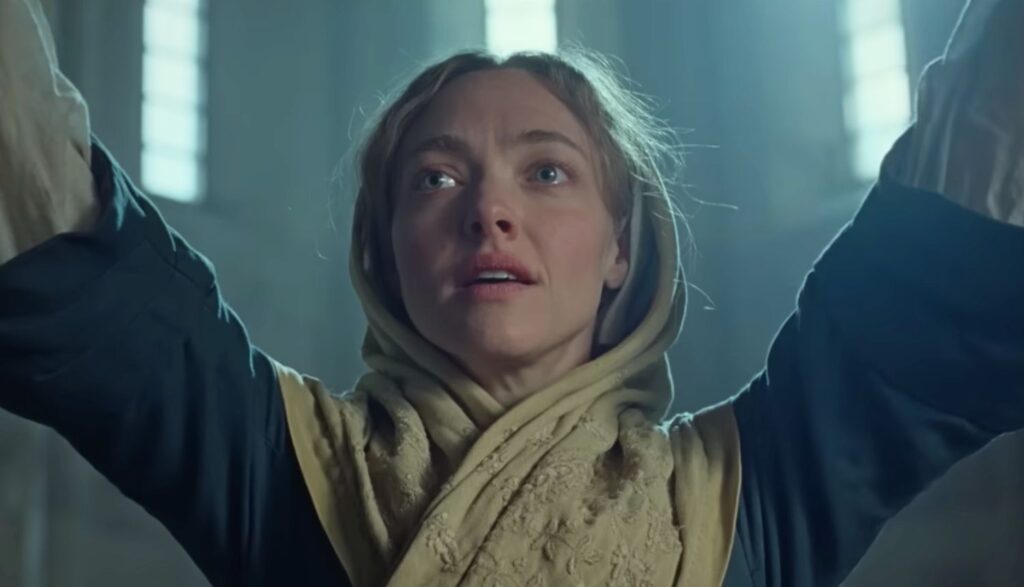
The Testament of Ann Lee chronicles the life of Ann Lee and the birth of the Shakers, the quasi-Christian sect she helped found. And while the film is both powerful and mesmerizing, its content concerns—from sex to nudity to violence to heresy—are not to be taken lightly, and it’s certainly not great family viewing.
They knew they were pilgrims, and looked not much on those things, but lifted up their eyes to the heavens, their dearest country.
So said William Bradford, a passenger aboard the Mayflower. And while he spoke specifically about his fellow travelers, his words come with broader meaning.
Countless immigrants over hundreds of years have turned their eyes to new shores, to a land of promise and freedom. They ran from persecution to new lives, new possibilities, new hope. Many sold everything they owned, risked everything they had, to begin anew. They came to America, which welcomed the world’s tired and poor, its huddled masses yearning to breathe free.
So came Ann Lee and her collection of followers in 1774, committed to finding a home in a land fresh and unfettered.
“God has not sent us to this land in vain,” she says. “He has sent us to bring the gospel to this nation which is deeply lost in sin.”
Here, she hoped, she and her flock could indeed breathe free. Here, they could build their utopia and worship God in the way they saw best.
And that worship involved a whole lot of dancing.
They were ultimately dubbed the Shakers, due to their boisterous and enthusiastic worship practices. They believed in pacifism, abstinence and that Ann Lee herself was the Second Coming of Christ.
Controversial? No doubt. Ann and her followers were not sad to leave the persecutions of their native England. Nor was England particularly broken up about seeing Ann Lee leave.
And while the Shakers knew that their faith would raise plenty of eyebrows in the American colonies, too, Ann knew that God was on her side. She’d seen it. On a parcel of land in upstate New York, she and her Shakers would set up a colony of their own. There, they could farm and pray and welcome a small stream of converts. There, they could lift their eyes to the heavens.
Such was the promise of America. Right?
We may fault Ann Lee for her theology. But her moral standards are high. As the narrator tells us, she had a “great light and conviction regarding the sinfulness and depravity of human nature.”
Certainly, you can’t fault Ann’s commitment to her morals. Ann refuses to be cowed, even when she and her followers are mocked and provoked. She and her brethren even try to help their abusers. And though the Shakers are ardent pacifists—not a popular stance during the Revolutionary War—Ann tells authority figures that her people will “do all the good for the country that we are able to do.”
When the Shakers arrive in America, they’re almost immediately confronted with the slave trade. “Shame!” Ann scolds the slavers. “Shame!”
We’re also told that Ann would never ask her followers to do things that she was unwilling to do, and we see the entire Shaker community work hard and well for one another. She and her fellow Shakers were “always striving for perfection,” to build things that might last a thousand years.
Most Christians would look at the Shakers and call them a cult. And indeed, many people thought of them as such back in the day—both in Ann’s home city of Manchester, England, and in the New World where they hoped to find religious freedom. A contemporary writer in the story writes that “Shakerism is a religion of bluff,” and he alleges that “Ann Lee is Satan in the guise of a sweet angel of light.” The writer goes on to accuse the sect of witchcraft.
While the Shakers were not witches, their beliefs deviated significantly from ours.
In Manchester, Ann Lee is introduced to “the Shaking Quakers,” who believed in radical equality. One of its leaders, Jane Wardley, turns to the Bible for justification—quoting Jeremiah 31:22 (from, of course, the King James Version): “For the Lord hath created a new thing in the earth. A woman shall compass a man.” The verse is taken out of context, but the verse leads Jane to believe that the Second Coming of Christ will come as a woman. “We are all created in [God’s] likeness,” she tells her congregants. “God must be both male and female.”
The Shakers come to believe that Ann Lee is that second coming. (One of the movie’s opening slides depicts a stick-drawn woman with a dress hanging on a cross, in fact.) And while Ann Lee acknowledges she’s a sinful human and makes no claims of actual divinity, she certainly alleges that Christ speaks through her. She takes on the title of “Mother,” and hymns are written, and sung, in her honor.
According to legend, the narrator tells us, Ann performed miracles, addressing church leaders in somewhere between 12 and 72 different languages. While locked in prison (and well into a very strict fast), Ann begins to levitate. She later says that she was covered by downy hair (we see some on her arms) that fell away as she was reborn in (what she would call) a more perfect understanding of God.
Ann and her followers experience many “divine” visions—all of which, the movie would have us believe, come true. (During a storm at sea—when disaster seems certain—Ann tells the captain that she saw a vision of two angels by the mast, protecting the ship. A divine force also, apparently, leads Ann to a woman who can help the Shakers get started in America.
Based on the deaths of her four children, Ann comes to believe that having sex is a sin. “Our unbearable tragedies are God’s judgment on me,” she claims.
The primary tenets and practices of Shakerism hinge on a few basic elements: sexual abstinence (which we’ll get into more below), radical confession and ecstatic expressions of faith—expressions that would not be completely foreign in a charismatic church today. Believers shout and wail and speak in tongues, and they move and dance in what would appear to be divine ecstasy.
More traditional forms of Christianity are seen as oppressive forces. In a flashback to Ann’s childhood, we hear that the “looming shadow of [Manchester’s] Christ Church” was the “most feared and favored place of Christian Worship.” Young Ann, however, gravitates toward a religious rabble-rouser named George Whitefield (a founder of Methodism), who alleges the Anglican Church is more concerned with power than helping its congregants.
One of Ann’s followers finds a parcel of land where they can found a Shaker colony after constant prayer, a critical vision and, finally, through what would appear to be an act of spiritual “dowsing.” (His finger seemingly becomes possessed by another power and literally points and pulls the man toward the land.)
A pastor, who prophesied the end/beginning of the world, pinning it to an eclipse, gets exasperated when it doesn’t come about. He’s later drawn to Ann’s congregation, alleging that St. Paul said there was nothing wrong with women speaking in church. People pray and sing hymns to God. We see a lot of spiritual imagery throughout the film, from crosses on walls to Satanic snakes in visions.
The Shakers notoriously thumbed their collective nose at sexual relations, and the movie makes it clear that Ann Lee was kind of disgusted by the whole thing. “There is one single cause [for] humanity’s separation from God,” she says. “Fornication.”
But the movie itself has no such qualms exposing its audience to all manner of sexual acts and content.
Ann’s loathing of physical intimacy starts at an early age, when she (and we) sees her parents having sex. (No nudity on this occasion, but plenty of movements.)
Later, Ann acquiesces to marriage: Her husband, Abraham, brings home a book with pornographic, hand-drawn S&M illustrations, which he hopes will intrigue his wife. Ann submits, and Abraham takes a switch to her bare behind before having sex with her—quoting Revelation 12 as he does so. In this scene and others, viewers are exposed to side and rear nudity and more sexual movements.
After experiencing what she sees as a divine revelation, Ann decides to live in abstinence, and she says that her followers must do the same. Abraham grudgingly accepts this at first. But after Ann’s group of Shakers moves to America, a drunken Abraham barges into Ann’s bedroom and insists that they return to living as a true husband and wife. When she refuses, he hires a prostitute, bringing her into Ann’s bedroom and asking her to gratify him in a way that Ann always refused.
William, Ann’s beloved brother, follows Ann’s lead and begins living an abstinent life himself. This is particularly significant because William enjoys the company of other men. When he decides to make the jump into celibacy, we see him crawl out of bed where another naked man lies (we see both of the men’s exposed rear ends), walk over to a mirror and cut off his long hair.
Another of Ann’s followers admits that he (presumably accidentally) looked on his underage sister as she was bathing. He, too, embraces Ann’s abstinence directive. A pair of young lovers refuses that pathway, though, after they have an intimate, graphic interlude (while we don’t see anything critical, we see enough to know what’s going on). They leave the Shakers to, apparently, get married.
Ann and her followers have visions of naked men and women engaged in erotic encounters. While not in a sexual context, we see plenty of skin elsewhere, too, including full-frontal female nudity. A woman’s posterior is visible through a gauzy shift.
Also worth noting: The movie leans into the fact that Ann Lee and her followers essentially replace sex with religious devotion. As such, many songs and dances—though directed at the Almighty—feel purposefully erotic and, at times, even climactic.
Ann Lee and her followers are often assailed for their beliefs. In one particularly brutal encounter, two men are whipped almost to the point of death. A woman gets punched in the face (and the attack blinds her in one eye). Another woman gets hit in the stomach repeatedly before her attackers run away. In another instance, Ann’s struck in the head with a rock, drawing blood.
Sailors mock Ann and her small band of followers during their voyage to America—to the point of threatening to throw them overboard. And at one point, the ship is in danger of sinking (though it completes the journey safely).
As mentioned, Ann loses four babies before they reach the age of 1. Two are born alive and later die: In one instance, Ann refuses to relinquish the child’s body. But Ann also experiences miscarriage and stillbirth, and she nearly dies giving birth to one of her children. A panicked midwife and her assistants try to pull the infant out of Ann’s body and staunch the life-threatening flow of blood. In another scene, a midwife wraps a dead child in a bloodied cloth and carries it away.
Ann’s life experiences frequently tie sex with violence. As a child, her father slaps her hands with a switch after he catches Ann watching her parents engage in sex. Abraham insists the S&M book that he shows his wife is a metaphorical treatis on how the traditional church abuses its followers (even though he then asks Ann to participate in some of the acts). The book features a priest who apparently demands sexual favors from a woman, and it alludes that an assailed woman experiences a certain divine ecstasy. Though Ann consents to marital sex, she clearly doesn’t like the act, which may have partially informed her decision to abstain.
A woman is accused of being a man, and she’s forcibly stripped in order to determine her sex.
We hear rumblings of war. Soldiers sometimes physically drag people away. Someone washes a naked corpse (which we see from behind). A few characters die.
It’s suggested that someone in an infirmary (a euphemism, it would seem, for an insane asylum) died by suicide.
None.
Wine is served at a dinner. Abraham appears to be drunk at one point.
A woman vomits over the side of a sailing ship.
Some racial attitudes are directed at Native Americans—though the movie makes it clear that the Shakers themselves were quite friendly with their Indigenous neighbors.
Ann gets thrown in prison at least two times—once in England and again in what will become the United States. (The latter is because she refuses to sign an oath of loyalty to the fledgling country.)
Ours is a world of paradox. And sometimes, that paradox is most pronounced in matters of faith.
Ann Lee was not the Second Coming of Christ. Within marital context, sex is not a sin. The views of Ann and her followers are just as heretical now as they were in the 1700s. And Ann’s theology practically doomed the Shakers from the get-go: When abstinence is a requisite of what would be deemed the “truth faith,” that inherently means that God Himself may mean for the human race to shrink, fade and disappear—just as the Shakers themselves have. Most Shaker communities only exist in museums now. And according to NPR, only three people in the U.S. still embraced Ann Lee’s path in 2025—a 33.3% increase from the year before.
And yet, this odd, wayward band of quasi-Christian separatists crafted works of real beauty. Original Shaker furniture is so well made that much of it is still around—even if it can literally cost as much as a house to buy it. The Testament of Ann Lee contains several original Shaker hymns, and many of them are almost painfully beautiful.
However, The Testament of Ann Lee might inflict a less beautiful pain on those who watch. It, too, comes with paradox. A movie about a celibate sect features scenes of raw sexuality and unflinching nudity. A story about a group of pacifists chronicles moments of violence and streams of blood. Ann Lee is herself a walking paradox here—a woman of deep, honest devotion who got so many things so, so wrong.
The film is thoughtful, powerful and, at times, mesmerizing. Amanda Seyfried is wonderful in the role and curiously terrifying. This is a film that could inspire plenty of conversations among and between Christians and non-Christians as they navigate the movie’s perplexing paradoxes.
Too bad you’d have to watch the movie to have those conversations, though. That’s a step that many might rightly avoid.

Paul Asay has been part of the Plugged In staff since 2007, watching and reviewing roughly 15 quintillion movies and television shows. He’s written for a number of other publications, too, including Time, The Washington Post and Christianity Today. The author of several books, Paul loves to find spirituality in unexpected places, including popular entertainment, and he loves all things superhero. His vices include James Bond films, Mountain Dew and terrible B-grade movies. He’s married, has two children and a neurotic dog, runs marathons on occasion and hopes to someday own his own tuxedo. Feel free to follow him on Twitter @AsayPaul.