

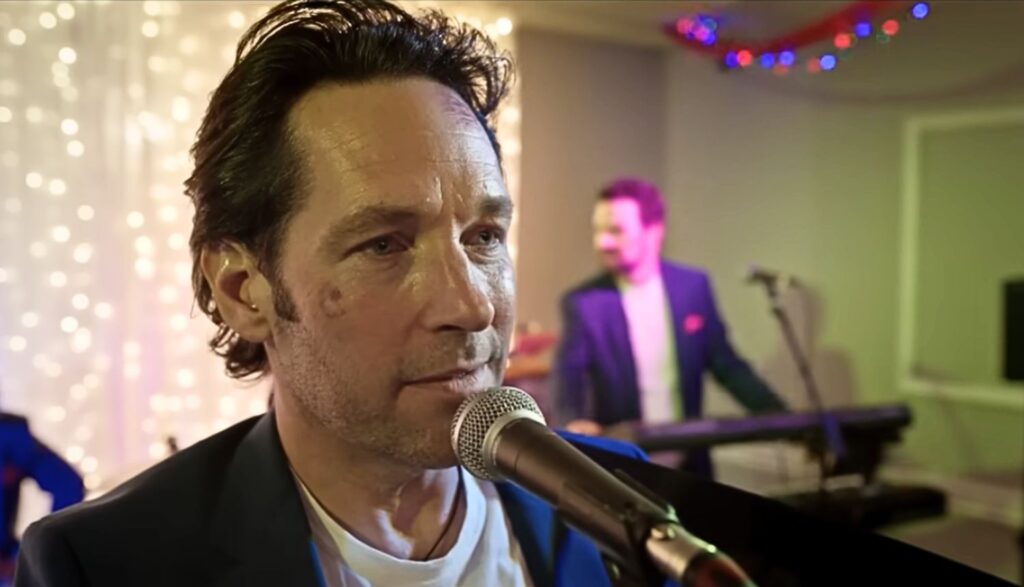
A former boy-band star steals a tune from a washed-up wedding band frontman and claims it as his own. There are some nice statements here about the value of family and warnings about the price you pay for ambition and fame. But the movie doesn’t always stay on key, and there’s a constant drumbeat of foul language.
There was a time when Rick had ambitions. His band was going places. But then, well, love came along while he was out on tour. Rick took a short “break” to start a family, and by the time he was ready to hit the road again, ambition and the record label had passed him by.
Rick now lives a small, gig-to-gig life fronting a wedding band in Crumlin, Ireland. I mean, they’re good. And they play the hits as well as anybody. But ambition? Fame? Yeah … no.
Then, however, the band does a wedding that’s a pretty big affair. It’s in a castle of all places. And they get asked to let Danny Wilson step in for a song or two. This former boy band member is still pretty well known by most. Danny’s got the glitz, the cash and the star power. But his star has been waning ever since he went out on his own as a solo act.
Anyway, Rick lets Danny join in for a song, and the two hit it off. They sing and move like two peas in a pod. (That’s if peas could sing and move.) And after the wedding reception, Rick ends up having some drinks and playing guitar with Danny in his room. Danny has been desperately trying to come up with new material for an album—an album that could make or break his career.
And wouldn’t you know it, Rick listens and even makes suggestions that improve a couple of those songs. Rick plays a few of his own compositions, too—tunes that sound good but are a bit old school. And Rick is well aware of that fact.
Through the night, Rick and Danny get suitably drunk. They laugh, slap each other on the back, and then go their separate ways. It was fun, but life back in Crumlin beckons Rick home. He goes back to his wife and daughter and life and bills. And he’s the somewhat happy man he’s been for years now. But then, months later, something happens.
While shopping for a gift at a Dublin mall, Rick hears a tune echoing through the mall’s open expanse. It sounds familiar. And when he walks out of the store, he realizes that its Danny Wilson singing. And someone notes that, yeah, this sweet ballad ringing out is an enormous hit. It’s Danny Wilson’s comeback. It’s his new tour de force.
The song also happens to be … Rick’s song. It’s a song he’s been working on for years. He wrote it for his daughter when she was 2. And he also happened to play it for Danny.
And, indeed, Rick soon finds out that “How to Write a Song,” his song,is a virally massive hit. Man, he needs to somehow get in touch with Danny. Surely, Danny will remember where he got it from. Surely, he’ll give Rick at least a bit of acknowledgement for the song. I mean just a little bit of credit might boost Rick’s own floundering songwriting career.
Surely, Danny Wilson will give Rick a tip of the hat, if nothing else.
Yeah … no.
Rick loves his family. Of course, he’s also a man who has never quite given up on his dream of becoming famous for his musical chops. But he doesn’t regret marrying his wife, Rachel, and being a dedicated father to their daughter, Aja. And eventually, he admits that they are far more important to him than any temptation of fame. “Thank God, I stayed,” Rick proclaims. “It was the best decision of my life.”
When Rick becomes obsessed over his stolen song—that he seemingly has no recorded evidence of having created—it drives a wedge between him and others. Aja herself has no memory of the tune, even though Rick wrote it for her, but she still tries to support her dad. As Rick becomes more distant, she texts his friend with the message: “Tell me Da, I believe him.” And Aja later becomes key to proving her dad’s claims.
Rick has some band-member friends who share his love for music. And they all eventually agree that sharing music together is a valuable reward all its own. Rick apologizes for hurting any of his friends.
None.
At a party, two women drag Danny upstairs for sex. We see all three in a hot tub—he’s shirtless and the two women are in bikinis. At the same party, a woman offers to sleep with Rick’s bandmate, Sandy. He chooses instead to play guitar.
Rick’s wedding band plays for a lesbian wedding. Rick and Rachel kiss. Rachel jokingly tells Rick not to have sex with any groupies before calling her.
During a scuffle, Rick accidentally pushes Danny off a rooftop (he’s not seriously injured) and then slides down into some sloping bushes and landscape himself. They both struggle and end up bloodied. Someone tells hired security to beat Rick to a pulp, which they proceed to do. Then Sandy, Rick’s bandmate, runs up and hits one of the security guys with a guitar.
Rick accidentally wrecks the band’s van, flipping it on its side.
51 f-words and nearly 10 s-words are joined in the dialogue by one or more uses each of the words “b–ch,” “d–n,” “a–” and “p-ss.” There are crude references to male and female body parts. Jesus’ and God’s names are misused a half dozen times total. (God being combined with “d–n” on one of those occasions.)
While heading out to a band gig, Rick and the guys smoke marijuana. Later, Danny bums a toke off a joint that Rick is smoking. And then the two men proceed to spend the evening smoking and drinking beer and Scotch.
We also see people smoking and drinking wine and beer at several wedding receptions. Danny drinks celebratory glasses of wine with his girlfriend. A depressed Rick drinks a glass of beer at a pub.
One of Rick’s wedding bandmates belittles Rick’s dream, saying, “We’re not rockstars, Rick. We’re human jukeboxes.” And when Rick plays one of his songs for his daughter, she adds to the slight by saying, “It’s like something mom would listen to.”
Danny lies repeatedly, claiming that he wrote the hit song and denying Rick’s involvement. And even when he’s given repeated chances to fess up, he ultimately refuses to do so. In connection with that, Danny’s manager makes threats to sue Rick, even though Rick requests nothing more than songwriting credit—without any monetary payout.
At one point, a frustrated Rick complains to his wife, “I killed my dream, and I stayed here for you and Aja!” (He later apologizes for making his outburst sound as negative as it did. And he declares his love for his family.)
Power Ballad is a small film that strums a few nice chords.
Frankly, actor Paul Rudd and several other actors here are much better than the script they were given. But they’re able to pull the band together and deliver a nice, cautionary tale about the high moral price of ambition and fame—while singing out sweet, emotional strains about the value of family and friends.
Those are the arpeggio bits worth showing up for.
That said, this dramedy never quite becomes standing-O material. The humor falls flat more often than not. The story beats don’t always jell. And the dialogue is peppered with so much foul language that it’ll leave your ears ringing.
Whether or not you’re willing to sit through those plonks and plinks to get to the good parts of the set is up to you.

After spending more than two decades touring, directing, writing and producing for Christian theater and radio (most recently for Adventures in Odyssey, which he still contributes to), Bob joined the Plugged In staff to help us focus more heavily on video games. He is also one of our primary movie reviewers.