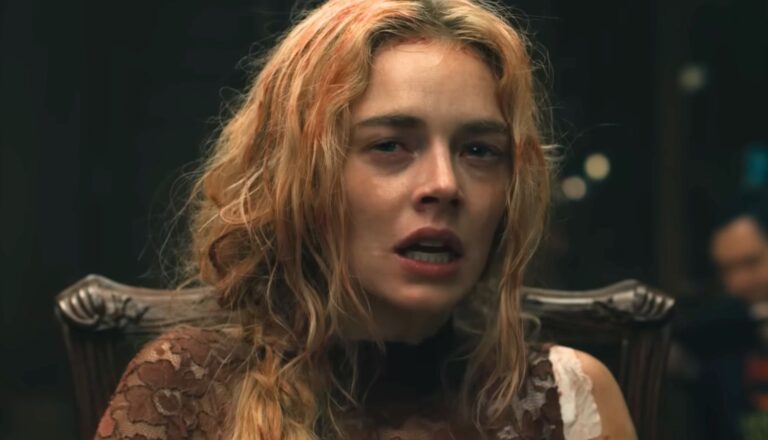



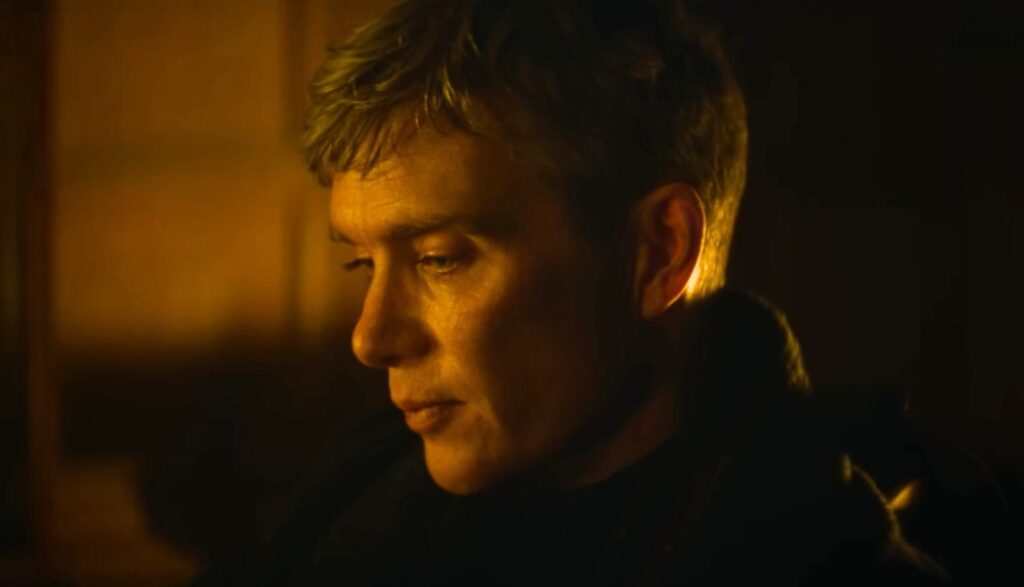
Peaky Blinders: The Immortal Man makes the leap from BBC series to film. And while its craft is impressive, the film ends up covered in problematic content just like the streets of 1940s Birmingham were covered in soot. Violence, blood and harsh language are a constant throughout The Immortal Man’s runtime, along with sexual content (including some nudity) and murky mysticism.
An old Romani proverb says, “When the road bends, you cannot walk straight.”
Tommy Shelby has spent much of his life walking crooked roads, from the tunnels of World War I to the soot-covered streets of Birmingham, England. Tommy was once top man for the Peaky Blinders, one of England’s most infamous criminal gangs. He was a bloody man who did bloody deeds and, by his own estimation, nearly got everything he ever wanted.
Now, Tommy lives in a self-imposed exile. The ghosts of dead loved ones haunt his steps, even as he shambles, specterlike, through a decaying country manor.
But the disappearance of Tommy Shelby was not the end of the Peaky Blinders. They have a new chief now: Tommy’s firstborn son, Duke.
Duke has all of his father’s ambition with none of the restraint. Case in point: He’s just made a deal with Nazi sympathizers to help flood England with counterfeit currency. It’s a traitorous act that will cripple Britain’s economy and swing World War II in Hitler’s favor. But Duke doesn’t care. He’ll scratch and claw for as much power as he can, even if the country burns around him.
The only man who might be able to change Duke’s mind is Tommy.
Kaulo knows this. She is the twin sister of Duke’s deceased mother and a Romani soothsayer—or so she claims to be. She promises Tommy that she will help him find peace if he returns to the Peaky Blinders to guide his son.
It seems Tommy Shelby has one more winding road to walk. But what peace lies at the end of this bloody road?
Tommy eventually chooses to return to the Peaky Blinders to stop the Nazi counterfeit currency scheme. He guides Duke in a better—though still criminal—direction, hoping that from his “bad,” some “good will come” of his son.
Someone risks her life to expose a criminal. Later, when that criminal has the opportunity to kill the woman before she can turn over evidence to the authorities, he refrains from doing so.
A group of women brave a bombing raid to continue their work in a munitions factory to help the British war effort.
As hinted at by its title, Peaky Blinders: The Immortal Man is steeped in spirituality. And that spirituality is about as murky as it gets. There’s plenty of Romani mysticism on display here, referred to as “gypsy magic,” with talk of curses and restless spirits.
Tommy believes that spirits show themselves to him, and the film seems to indicate that there’s some truth to his claim. For instance, he has a vision of someone immediately following their death, though Tommy himself is far from the deceased. He often sees his dead daughter, too.
Kaulo claims to be a seer who communes with the dead. She says she speaks to her deceased sister (Tommy’s former lover, Zelda) through dreams and séances. At one point, she claims to be Zelda—or rather, that Zelda has taken possession of her body. Again, the film seems to indicate that there is some truth in her words: She shares information with Tommy that she could not have known otherwise.
In one scene, Tommy asks Kaulo to read his palm. She does, describing his past and future. We see Romani funeral pyres, and there is talk of sending the dead on to the next life. Someone describes being reunited with their loved ones in the afterlife, in “whatever place will have us.”
A character makes a blasphemous comparison to the Holy Trinity. Someone uses the phrase “God help him.” Another reads a passage from Mark 13. Someone says that people in Birmingham pray both to Jesus Christ and Tommy Shelby, but that “neither answers their prayers.”
Characters reference the poem and hymn “In the Bleak Midwinter” as a way of reminding themselves that they are on borrowed time. (This reference is connected to events in the Peaky Blinders television series and has little to do with the actual substance of the poem.)
Tommy is writing an autobiography titled “The Immortal Man.”
The film contains a few instances of nudity. In one scene, men and women carouse in a bar, and a few women have their breasts exposed. A gang member strips a victim’s corpse, and we see the dead man’s buttocks.
While Kaulo is “possessed” by the spirit of Zelda, she and Tommy have sex. The scene is sensual but not explicit. (The pair kiss passionately, and there are suggestive movements.) Afterwards, we see Tommy and Kaulo in bed—Tommy’s bare torso can be seen, while Kaulo is in a revealing nightgown.
Duke was born out of wedlock, we learn. He is seen in his underwear, getting out of bed with a woman. Duke also has a vulgar tattoo that can be seen from time to time.
There is mention that a man hasn’t “been with a girl in a long time.”
Those familiar with the Peaky Blinders TV series won’t be surprised to learn that The Immortal Man, like Tommy Shelby, returns to its violent ways.
Several people get shot throughout the film, often accompanied by a spray or splatter of blood and a glimpse of their gruesome wounds. In a vision, a deceased woman has blood covering her face. Tommy has violent, grisly flashbacks to his time in the tunnels during World War I. Other characters get beaten and killed. Soldiers and civilians get killed in explosions.
Tommy and Duke have a punch-up, with the older man threatening to drown his son in mud if Duke doesn’t provide information. A man disposes of a corpse by feeding it to a herd of pigs. (We’re spared the gory sight, thankfully, but it’s clear what’s happening.)
A man stuffs a live grenade down someone’s shirt, and the explosion occurs offscreen.
We hear that a man took his own life. A gravely injured character begs another man to kill him, saying, “You’d do it for a horse.” We see the destructive result of bombing raids. Gang members steal and brutalize those who try to stop them.
The f-word is used more than 60 times. There’s one use each of the s-word, “h—” and “b–tard.”
People of Romani descent are frequently called “gypsies” in a derogatory manner.
People smoke and drink through the film. Tommy says that his brother hallucinated after taking opium. Someone says that “booze,” in part, led them to commit a violent act.
We hear that the Peaky Blinders, under Duke’s leadership, stole morphine from a hospital.
The Nazis, through fascist sympathizers in England, try to crash the British economy with counterfeit currency—a scheme based on actual events. The Nazis used Jewish prisoners in concentration camps to create the counterfeits, which the film briefly depicts.
Duke feels abandoned by his family (namely, Tommy) and initially agrees to help the Nazi sympathizers spread the counterfeit British pounds: “The world doesn’t [care] about me, I don’t [care] about the world,” he says.
In Birmingham, we see that the local police have all but resigned themselves to letting the Peaky Blinders do whatever illegal activities they want, including stealing munitions, livestock and medical supplies.
Tommy seems to have symptoms of post-traumatic stress disorder from his experiences during World War I. A few characters say, “Heil Hitler,” and give the Nazi salute.
After six seasons on the BBC (and streaming on Netflix), Peaky Blinders concludes its crime-focused period drama with a feature film, Peaky Blinders: The Immortal Man.
Peaky Blinders creator and writer Steven Knight is clearly in command of his powers here, crafting an engaging story that is as entertaining as it is thoughtful. The film, like the show before it, boasts an all-star cast, led by a commanding performance from Cillian Murphy (who plays Tommy Shelby). And the cinematography is striking, from the gray and crumbling Birmingham to the green and misty countryside.
I expect fans of the original series won’t be disappointed. And even for those who haven’t watched the show (like me), the film still stands on its own.
But, as with its progenitor, the problem with Peaky Blinders: The Immortal Man isn’t that it lacks artistic merit—it’s the rough-and-tumble content that comes with it.
Bloody violence, harsh language, sexual content and muddy spirituality cover this film like grime. So as Tommy Shelby himself once did, discerning viewers might want to saddle a white horse and leave all those content issues behind.

Bret loves a good story—be it a movie, show, or video game—and enjoys geeking out about things like plot and story structure. He has a blast reading and writing fiction and has penned several short stories and screenplays. He and his wife love to kayak the many beautiful Colorado lakes with their dog.