
A Navy pilot on a super-secret Cold War mission crashes in the heart of Soviet territory. And he must trust a surprisingly tough, American-loving Russian to help him. Apple TV’s Mayday has a few nice lessons and comes with some laughs, but it’s also violent and profane, and it comes with a bit of LGBT content, too.
Troy Kelly is happy to do just about anything for his country.
And given that it’s 1987—40 years into the Cold War—his country might ask for quite a bit.
Troy’s an American Naval pilot who practically bleeds red, white and blue. He’s grown up in a world of global extremes: On one side stands the United States, stuffed with freedom and justice and as much apple pie as you can eat. On the other hunches the Soviet Union—bastion of communism and conformity, a land that President Ronald Reagan dubbed the “evil empire.” And while some of Troy’s Navy compatriots say that Mikhail Gorbachev is changing Russia’s course, Troy’s not buying it. “He’s a died-in-the-wool communist!” he says. So there.
Now, it appears that the U.S.S.R. is up to something new. Spy satellites have detected some suspicious activity out in the Russian hinterlands, activity that the upper-ups in the U.S. military think could be missile silos. But pictures taken from circa-1987 spy satellites can be a bit grainy, so no one’s quite sure.
Those upper-ups want a closer look. Not too close, mind you: They just want to do a quick, top-secret, potentially war-starting flyby over Russia in an SR-71 Blackbird—the fastest, highest-flying aircraft ever built. The Air Force pegs its own Major Sanders to fly the Blackbird. But the Navy gets to fill the second seat, and it pegs Troy as its man.
The mission gets off to a flying start (if you will). But they encounter a lot of cloud cover, so Sanders takes the Blackbird down a few thousand feet to get a better shot. But that few thousand feet triggers a Soviet aerial response—a scrambling MiG. And even though the SR-71 can outrun everything, Sanders makes a critical error. A couple minutes later, he’s dead, the Blackbird’s toast, and Troy’s in the Siberian snow, a tree branch in his leg and a man with a gun walking toward him.
And then everything goes dark.
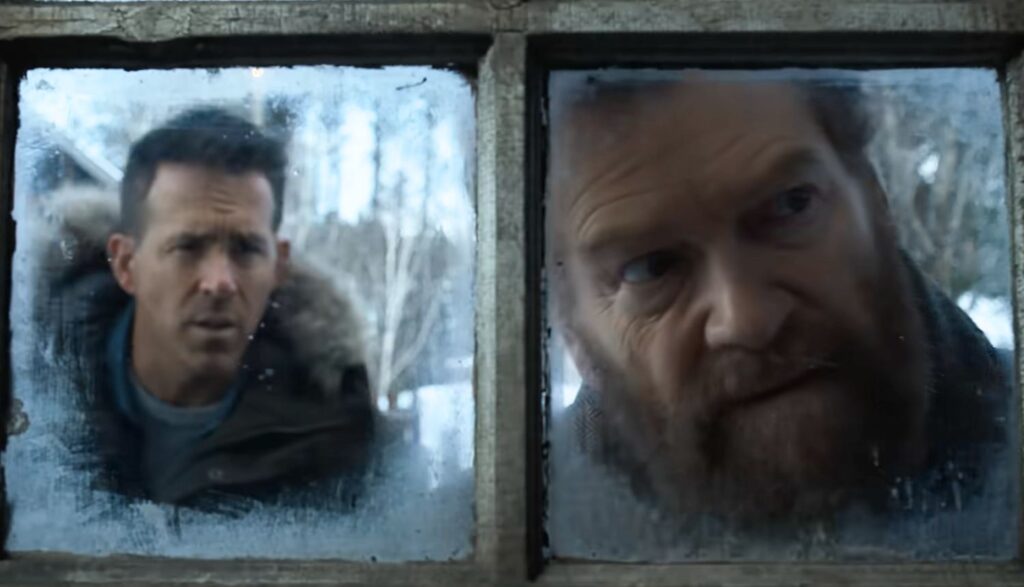
When Troy wakes up, he’s tied to a bed in a cabin as a man steps in carrying an armful of logs. The stranger, Nikolai, apologizes for the ropes and all. Troy needed to be held still while the Russian removed the branch from his leg. “You screamed a lot, but that is my fault,” Nikolai—Nick for short—says. “I do not have proper anesthesia.”
Well, Troy appreciates the emergency surgery. And, looking around the cabin, he can’t help but notice that the place is practically wallpapered with American movie posters. But a Top Gun poster ain’t enough to earn Troy’s trust, and he’s got to find a way home.
But Nick apologetically says that such a thing isn’t possible. He suggests that Troy live with him for a bit. “Just until the Cold War dies down,” he says.
Obviously, waiting until the Cold War is over isn’t a realistic option for Troy. The pilot’s desire to get home causes a bit of, shall we say, friction with his Russian host. But eventually, both decide to embark on an adventure to return Troy—and maybe even Nick—back to the States.
Mayday turns into an emergency study in cross-cultural connection. Through Nick, Troy learns that, evil empire or no, the Soviet Union is filled with some pretty decent folks. As the two trek across the Russian countryside in an effort to get Troy home, they knock on a farmhouse door and are immediately ushered in. They’re given a hot meal and a place to sleep, even though the family is at the edge of poverty. When Troy expresses disbelief, Nick says that showing kindness to strangers is something that, he assumes, people engage in everywhere.
“If someone came to a door in America and asked for help, wouldn’t they be taken in?” Nick asks Troy.
“Of course they would,” Troy insists—but he knows he’s lying. And when he and Nick say goodbye to the family the next morning, Troy takes off his expensive wristwatch and gives it to the farmer. Nick later tells Troy that the watch is worth more than the family likely makes in a year.
While Mayday never tries to defend the Soviet Union’s political apparatus, it does paint a more human picture of individuals inside the country. Troy’s moved by what he sees, and Nick is perhaps the most effective conduit to see the humanity behind the country’s hard, cold exterior.
Nick loves the United States. He tells Troy that it’s his dream to live there one day. We learn that Nick used to work for the KBG (the Soviet intelligence agency and, essentially, the state’s secret police), but he quit his job, in part, because he was too ashamed to tell his daughter what he did for a living. “When a man does something long enough, it stops being what he does,” he tells Troy. “It becomes who he is.” He left the Soviet apparatus to, in a way, save his own soul. And the minute he starts helping Troy get home, Nick’s own life becomes forfeit. But while the U.S. is not (as he and Troy will both discover) the idealistic beacon of light and hope that Nick imagined, it’s still better than Soviet communism by a country mile.
Nick and Troy have a spirited conversation about how each was raised to think about the other. And their adventures come with a dose of misunderstanding and betrayal. But the two forge a friendship in spite of it all, and they wind up risking their lives for each other.
Troy has a close relationship with his father, who appears to be gravely sick from a form of cancer. Troy clearly loves him, and he risks his career to help him. Nick clearly loves his daughter.
Troy tells Nick about why he decided to become a Navy pilot: He recalls one time, as a child, when he watched a set of pilots walk across a flight deck with their helmets in their hands. “Everybody, including my dad, looked at them like they were gods,” Troy says.
“So you wanted to be God,” Nick says.
“I wanted to serve my country,” Troy snaps back. “I think you can understand that.”
When Nick and Troy spend the night in a rural farmhouse, they meet a young boy named Gorgo, who stares at Troy with piercing, black-rimmed eyes. “He’s a demon, Nick,” Troy whispers. “He’s unusual,” Nick allows, but Troy continues to insist, mostly jokingly, about the boy’s supposedly demonic nature.
Nick says that it was “providence” that led him and Troy to meet.
Nick and Troy break into the home of a Soviet official and find themselves trapped in a closet when the official and his mistress come back home. “She is a sexual escort,” Nick whispers to Troy, who didn’t need the explanation. As the official and the escort get more romantic, Nick offers more play-by-play. “She is unclothing him,” Nick says. “Let us hope that this is merely the foreplay and they move upstairs for the act of intercourse.” (We don’t see any nudity throughout this scene; in fact, we see very little skin.) The interlude is interrupted when the official’s wife and kids arrive unexpectedly.
When a grateful farmer kisses Troy’s cheek, Troy quips, “Let’s not make the missus jealous.” He’s forced to drink from a shared bottle of vodka and says that he’s convinced that he now has herpes. When Troy visits his sick father and invites him out for dinner, Troy’s dad begs off, pointing to an elderly woman in the hall and saying that he has a date with her. “Great,” Troy says. “Dinner and a funeral.”
[Spoiler Warning] We eventually meet Nick’s daughter, who harbors them for a time. She tells Troy that she’s a lesbian, but she hasn’t told her father. “It’s against the law to be gay in the Soviet Union,” she tells him. “And that law is enforced by the KGB.” (She is suspicious that her father ever truly left.) Troy soon talks with Nick and discovers that Nick knows about his daughter’s sexual preferences: It was one reason he left the KGB. “How could I work for a system that considered my own child a criminal?” he says. The two of them eventually talk about the whole issue, and Nick is given a picture of his daughter with her girlfriend.
Major Sanders, the pilot for the SR-71, is shot and killed by enemy gunfire. The pilot of the MiG presumably also dies when it and the Blackbird collide. Troy survives and parachutes to relative safety, but the chute is set on fire by debris, which makes the descent more rapid, and more painful, than is ideal. He crashes through some evergreen trees and gets a stick (about the width of the tip of a pool cue) lodged in his leg. Nick “operates” on the wound between scenes, but the injury continues to bleed at times.
Someone is pushed out of a flying airplane—and hits his head on an unmoving propeller as he jettisons—while someone else is pushed from a moving train and plummets off a ledge.
Nick fights three or four assailants in a bar: He shoots one in the leg with an arrow or dart, spears another guy in the face with a similar projectile, breaks arms, hits people with bottles and uses a billiard triangle to hurt a couple of assailants simultaneously. He and Troy fight with other adversaries elsewhere, who shoot at them aplenty. Someone is stabbed in the neck with a pen (though the victim survives).
A massive military vehicle crushes a couple of cars. Other vehicles—mostly police cars—get into a series of wrecks while trying to pursue the vehicle.
Troy sets someone’s arm on fire. An explosion sends a few folks flying and sends flames shooting through an apartment unit. Characters get shot in the leg, the shoulder and the hand. People are thrown around a careening airplane. Nick and Troy tumble down a hillside and eventually slide to a halt in the snow. We hear that part of Nick’s job in the KGB was “interrogation,” which is given to mean that he’s pretty skilled in torture. Nick drives a car on a frozen lakebed in order to purposely sink it. Troy’s father suffers from cancer.
Troy and his fellow Navy pilots engage in a Top Gun-like exercise. Troy’s nickname (emblazoned on his helmet) is “assassin.” Nick asks about it, but Troy refuses to say how he earned the name … which proves to be rather embarrassing.
We hear one f-word and about nine s-words. We also hear “a–,” “b–tard,” “d–n,” “h—,” “d–k” and “p-ss.” God’s name is misused about seven times, twice with the word “d–n,” while Jesus’ name is abused thrice. Troy makes a crude reference to someone’s anal cavity.
Nick makes bootleg liquor out of beets. Several people drink it, and one person hides in a barrel of the stuff.
Bottles of vodka are passed around a train car filled with rowdy Soviet soldiers. Before his mission, Troy goes to the bar with some of his fellow pilots. We hear a reference to steroids. Troy discovers a cigarette dispenser in someone’s house.
People and governments lie and mislead. Nick and Troy steal several things and occasionally drive in a way that puts others in danger.
“Reagan called us the ‘evil empire,’” Nick tells Troy early in their adventures. “Do you believe we are all evil?”
“I believe you are all brainwashed,” Troy says. “Products of the system you were born in.”
“But you are not a product of your system, Troy?” Nick asks.
It’s a good point. We are, indeed, partly products of the systems we were raised in. We learn a lot from our parents, our schools, our churches … and our entertainment. It’s a big reason why Plugged In exists, after all: We learn from our environments. We can practice what we’re taught.
Mayday tries to teach us a bit, too. It reminds us that whatever we think about a government, the people under its jurisdiction may be much different than we expect. And even if we love our country, we can still find things in it worth a critical, angry eye.
Those lessons may feel a bit superficial, but Mayday isn’t aiming for profundities or life-changing takeaways. This is a throwback to the quirky buddy comedies from the 1980s and ‘90s—outlandish premises played out with bankable stars. This is movie as entertainment with few pretentions of being art.
But this bit of entertainment comes with an assortment of throwback issues, too, in the form of its violence and language. And, of course, you’ll need to parse the movie’s LGBT content—which in one family might be seen as a heartwarming demonstration of unconditional parental love, but in another might smack of justifying biblical sin.
Mayday shows us that people, regardless of the political system they’re surrounded by, are people: at turns, well-meaning and flawed. And perhaps the same could be said of Mayday itself.

Paul Asay has been part of the Plugged In staff since 2007, watching and reviewing roughly 15 quintillion movies and television shows. He’s written for a number of other publications, too, including Time, The Washington Post and Christianity Today. The author of several books, Paul loves to find spirituality in unexpected places, including popular entertainment, and he loves all things superhero. His vices include James Bond films, Mountain Dew and terrible B-grade movies. He’s married, has two children and a neurotic dog, runs marathons on occasion and hopes to someday own his own tuxedo. Feel free to follow him on Twitter @AsayPaul.