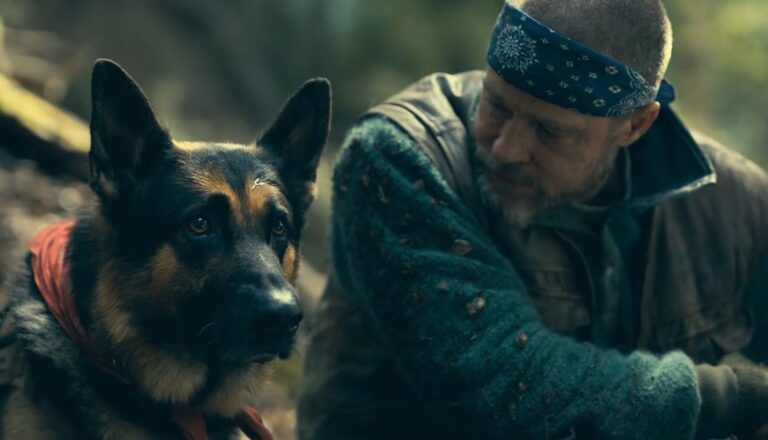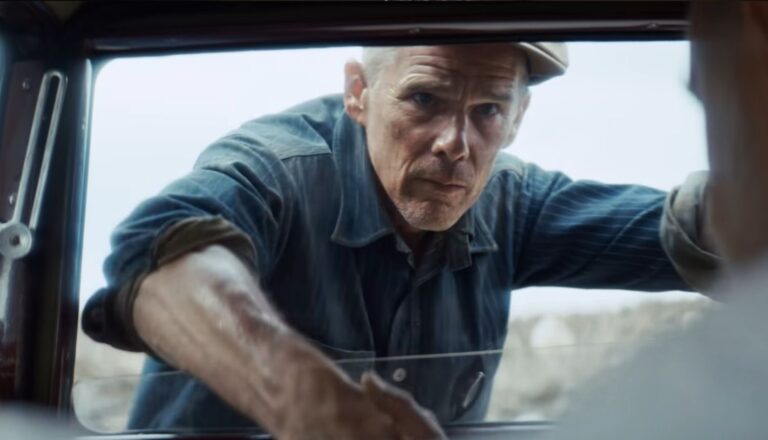


An injured man stuck behind enemy lines during World War II must walk nearly 20 miles to safety in Lucky Strike. The soldier has a chance to find that safe haven, but families watching will have no such luck. Bloody violence and its gory aftermath are the biggest concern here, but foul language is a bit of an issue, too.
Block the road.
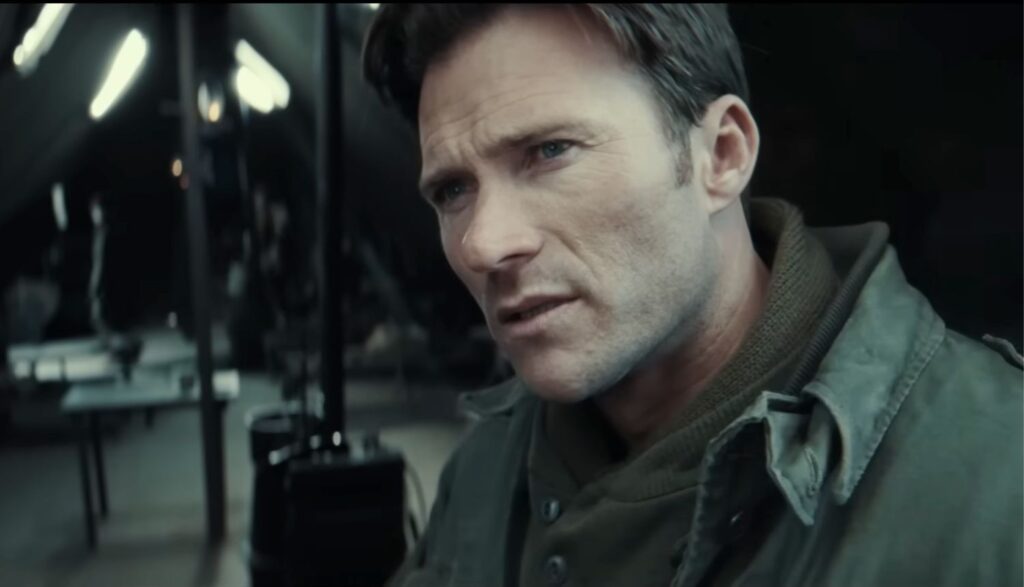
It’s a simple assignment for Capt. Castle and his men. No, strike that; it’s a straightforward assignment. No job in war is simple. Not in World War II. Not during 1944’s desperate, bloody Battle of the Bulge.
Block the road. Protect our fuel depots. Help us end this war.
So Castle and five of his men set off to do just that, even though that section of road is behind enemy lines and the Nazis are everywhere.
They find a good spot, just as the truck’s engine floods. They wire explosives to some huge trees suitable for road-blockage. And then things fall apart.
Nazis, hidden in a hill-topping foxhole, start shooting. Castle’s men begin to fall. The captain and another man slowly crawl up the hill, unseen and clutching grenades. They throw them into the foxhole.
A blast. A shower of sand and debris, and one Nazi lies dead. The other begs for death.
But as Castle’s cohort prepares to oblige, the Nazi pulls out his own grenade.
Without a thought, the soldier falls on the Nazi, covering the grenade. Castle screams, but it’s too late: The grenade explodes with a muffled thump.
Castle is alone. Alone to bring down those trees. Alone to bandage his leg, torn by a bullet and bleeding. Alone to take home the dog tags of the men. His men.
But Castle won’t be lonely for long. Nazis still swarm the area. When Castle calls headquarters with his team’s trusty radio—one they’ve nicknamed “Lassie” for its reliability—he learns the nearest safe haven is Elsenborn, more than 30 kilometers (about 19 miles by American standards) away.
His truck won’t move. He’ll have to walk those 19 miles to Elsenborn behind enemy lines with a bullet in his leg and a radio on his back.
Simple.
No matter the time, no matter the place, war is a brutal business. But in the midst of that brutality, we can find virtue. Plenty of it.
Castle shows his courage and tenacity throughout Lucky Strike. We also learn of a sacrifice he made just to be here: As an agricultural engineer, Castle could’ve asked for an exemption to help the war effort back home, where he could remain with his wife and child. Instead, he’s here, in Belgium, risking his life.
He’s also risking the lives of his men—a burden he feels quite heavily. And when many of those men are killed under his watch, he feels as though he has failed. Another officer offers a different perspective: “You job is not to keep your men alive,” he says. “Your job is to keep my mother alive. It’s to keep your mother alive. It’s to keep all of our children alive.”
Castle works hard after the war, too, to protect and honor someone who proved to be instrumental in his survival.
But Castle’s not the only one who exhibits courage and sacrifice. Before he leaves on his road-blocking mission, he argues with one of his men, Cash, who’s had three fingers blown off and still wants to continue to serve. (Castle orders him to go home, which Cash ultimately does.) The man who threw himself on top of the grenade-holding Nazi obviously sacrificed his life for that of Castle. And a Belgian family tries to hide and protect an injured Castle, even though they’re taking a massive risk in doing so.
It’s said that there are no atheists in foxholes. And while we don’t know the state of Castle’s religious life outside this crisis, he definitely sends a few petitions to God while in the midst of it.
At one point, Castle makes off with a Nazi tank, but he’s almost unable to get out of it. “Come on, Lord!” he begs. “If you’re not going to help the Yankees again, please help me!” At another juncture, he offers a more sincere prayer. “God, please,” he says, “please take me home.”
The movie seems to offer hints that, perhaps, there is a divine presence at work. A white horse appears in a couple of scenes: While the animal is quite real (Castle strokes its muzzle at one point), it also seems to come with an almost angelic-like presence—the film’s way of saying that perhaps someone is indeed watching over Castle.
A soldier kisses a cross hanging around his neck before heading off on assignment. Castle inspects the corpses of a couple of soldiers, one with a cross around his neck and another with a star of David. The movie takes place around Christmas. Soldiers talk about how SS soldiers and officers tattoo the insignia of their organization on their arms. “Imagine giving yourself the mark of the devil,” one says.
Someone asks to see a picture of Castle’s wife. “I bet she’s a looker,” he says. We see a couple of very short glimpses of Castle’s life at home before the war, including one where he and his wife appear to be in bed and engaged in some romantic relations. (The scene is less than a second, and we see the woman from the shoulders up.)
After Castle is treated for his wounds, a soldier suggests the nurse who treated Castle was good-looking. “I didn’t fare as well,” the soldier says with a grin.
“I guess rank has its privileges,” Castle jokes back.
Lucky Strike is, obviously, a war movie. And it’s a pretty brutal one at that.
Several people get shot and killed relatively quickly. Others have a much more ghastly departure. In one field filled with corpses, a barely-living casualty revives—and is immediately stabbed. We don’t see the killing blow; the camera instead focuses on the man’s expression as it morphs from surprise to pain to nothingness. Another man is immolated by a flame-thrower. We see him try to make his escape by crawling away, horrifically burned, but he’s soon shot and killed. Someone is strangled with a cord. Other people die from grenade blasts, and we see their exposed innards.
Castle smashes a Nazi soldier’s face into a steering wheel repeatedly, and he seems to try (and possibly succeed) in breaking the man’s arm using the wheel’s spokes. Off camera, someone hits a man in the face with the butt of a rifle until the man is dead.
In the movie’s opening moments, we see a group of SS soldiers and officers attack a truck full of African American servicemen, gunning them down without mercy. Blood is everywhere, and when one man tries to escape, the SS officer shoots him in the back. The officer makes a reference to the American track-and-field star Jesse Owens, who won four gold medals at the Olympic Games eight years prior. “They all look the same,” the officer says, “but they don’t all run the same.”
This massacre reminds viewers of who the Americans are fighting: Not just the Nazis, but the Waffen-SS—the elite, hyper-dedicated and utterly ruthless combat branch of Hitler’s notorious SS organization. The 1st SS Panzer Division is apparently rumbling down the road, and Castle and his men are warned about their brutal tactics and growing list of atrocities. “They’re not soldiers,” one American says. “They’re [censored] murderers.”
We see those murderers at work in a Belgian farmhouse, shooting a woman in the head while her adult daughter looks on. (The daughter’s father is later found outside the farmhouse, also shot and killed.)
Castle gets shot in the leg. Later, he suffers a shrapnel wound as well. A dog dies off camera. Bombs and shells explode. Tanks crash. Houses are torched.
Nearly 30 f-words and about half as many s-words. We also hear “a–,” “b–ch,” “b–tard,” “d–n,” “h—,” d–k” and “p-ss.” God’s name is misused at least seven times, five of those with the word “d–n.” Jesus’ name is abused twice.
The movie’s name, Lucky Strike, is taken from a brand of cigarettes popular during World War II. Pretty much everyone here smokes them (though at least one Nazi spurns them after finding a pack on a dead body), and they actually become a critical part of the story.
Castle regularly spikes his coffee with alcohol. (“You don’t mind, do you?” he asks someone as he pulls out a flask. “Old habit.”)
Someone plays dead to avoid being killed by the SS. An SS soldier is apparently fooled; he urinates on the man’s head and helmet.
As you might imagine in this wartime setting, we hear plenty of off-color jokes and references to various body parts and bodily functions. A couple of examples: Soldiers talk about how, during the Battle of Stalingrad (in Russia), people’s bowels would explode when defecating because it was so cold. Another soldier complains that the cold now might cause his testicles to drop off.
People lie. Castle cracks a raw egg and pours it into his mouth. We see plenty of racism from Nazi soldiers and sympathizers.
War is always horrible. But, in Hollywood, at least, every war comes with its own breed of awfulness. Movies about World War I tend to emphasize its cold, slogging brutality. Vietnam films stress the confusion and moral ambiguity. And World War II? Yes, the horrors of war are still on full display. But in what some have called the “last good war,” we tend to be treated to plenty of heroism, too.
Lucky Strike fits that mold—and fits it well. We find soldiers willing to brave any danger for a just and righteous cause. We’re treated to moments of courage and sacrifice, and even hints of humanity shine through. Castle is forced to make some hard choices and kill, but none of that seems to undermine the man’s basic goodness. He’s a decent man thrown into an indecent world. The same could be said for so many soldiers in so many wars.
But while Castle feels like an old-fashioned wartime hero, Lucky Strike’s content concerns are quite contemporary.
A lot of people die here, and they often die horribly and gorily. Language is an issue throughout. Even quieter times can be filled with gross stories and ribald jokes. Does all this reflect what we would’ve seen and heard in Belgium during the Battle of the Bulge? More than likely. But that doesn’t make it any easier to watch, and it certainly doesn’t make it fit for family viewing.
Lucky Strike works well as a wartime thriller. But this movie warrants caution, even for adults. Going in without forethought might be unlucky indeed.

Paul Asay has been part of the Plugged In staff since 2007, watching and reviewing roughly 15 quintillion movies and television shows. He’s written for a number of other publications, too, including Time, The Washington Post and Christianity Today. The author of several books, Paul loves to find spirituality in unexpected places, including popular entertainment, and he loves all things superhero. His vices include James Bond films, Mountain Dew and terrible B-grade movies. He’s married, has two children and a neurotic dog, runs marathons on occasion and hopes to someday own his own tuxedo. Feel free to follow him on Twitter @AsayPaul.