


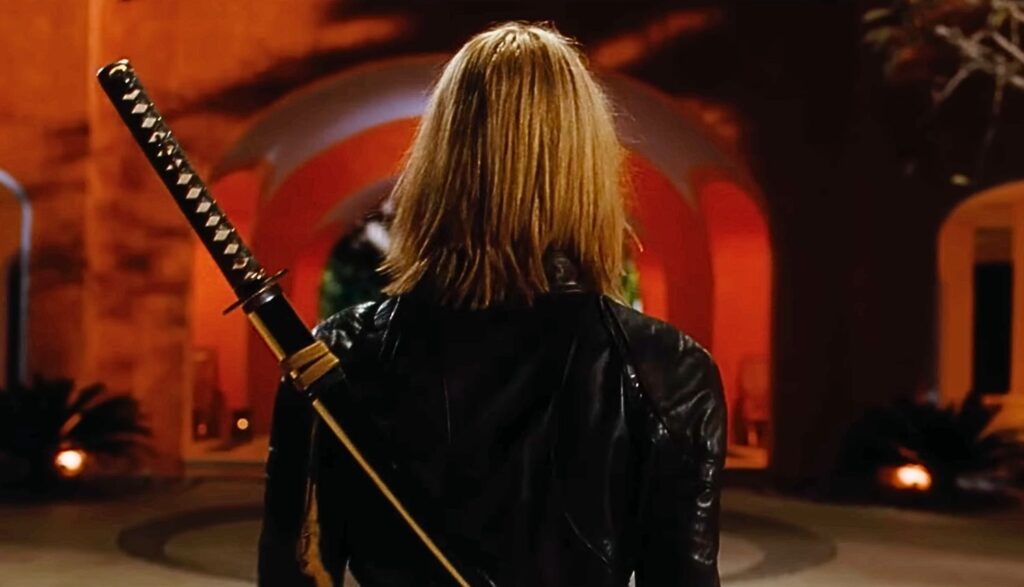
Beatrix Kiddo was shot in the head and left for dead by her boss/lover. Now she’s back—and out for blood. That’s pretty much all parents need to know about the unrated Kill Bill: The Whole Bloody Affair. There’s plenty of it—and lots of R-rated swearing, allusions to sexual abuse and other problems, too.
Beatrix Kiddo never had a chance to fill out an exit interview form. Her boss shot her in the head, after all. Not much to say after that.
But if the assassin had had a chance to say why she left Bill’s bloody business, the answers might’ve been revealing.
Did you enjoy your job? The exit interviewer might ask.
For years, Beatrix—aka The Bride, aka Black Mamba—did enjoy the red work of permanent termination. She was good at it, skilled with fist and blade and trained by the legendary Pai Mei himself. She worked with talented, dedicated coworkers, too. And if they didn’t always get along, it was nothing to die over.
Well, not yet, anyway.
Did the company make you feel valued and recognized?
Sure. Bill wasn’t just Beatrix’s boss: He was her lover. He took a special shine to Beatrix, and the two of them were as close as a bullet in a gun chamber, a sword within its sheath. And they might’ve continued to work together for years to come—if she hadn’t gotten pregnant.
Why do you want to leave the company?
The baby, of course. The jobs of assassin and mother are hardly compatible. As soon as she learned she was pregnant, Beatrix tried to make her escape. She found a new job, a new beau and a new life. And she was just about to get married when Bill and her old workmates showed up at the church’s front door. Minutes later, most everyone was dead. They left Beatrix for last—beating her bloody before Bill put that bullet in her brain.
Would you have any suggestions for improvements that the company could make?
Beatrix has a few. More than a few. But perhaps the most critical would be this: If you’re going to kill someone, best make sure they’re dead.
Beatrix wasn’t. And isn’t. She has a few scores to settle. It’s not just Bill she’s coming to kill: She plans to leave everyone, lifeless, in a puddle of their own blood.
Kill Bill: The Whole Bloody Affair comes with, admittedly, ever-so-many problems. But take away all the killing and maiming and swearing and what do you have for the film’s remaining 10 minutes? A strangely poignant salute to motherhood and an understanding of the value of a preborn child.
The moment that Beatrix learns that she’s pregnant, her whole life changes. She walks away from the hit she’s currently assigned to, finds herself a regular Joe to settle down with, and she gets set to marry him. She explains to Bill that she desperately didn’t want her daughter to be exposed to the life she had been leading, wanting her child to start with a clean slate.
“I could no longer do any of those things,” she says. “Not anymore. Because I was going to be a mother.”
The mystical “combat” creed Beatrix subscribes to includes the phrase, “Kill whoever stands in my way, even if that be the Lord God or Buddha.” Convinced that her vigilante vengeance is sanctioned by God, Black Mamba says, “You begin to believe that not only does God exist, but that you are doing His will.”
A sword maker says he made an oath to God that he would never again craft a sword destined to be a murder weapon. Once he decides Beatrix’s cause is just, however, he breaks that vow and creates for her his finest sword ever—a weapon he says would “cut God” if He got in its way. The transfer ceremony, wherein the sword’s maker gives the blade to Beatrix, feels quite spiritual.
We see candles lit in front of a picture of a saint. A wedding rehearsal (and subsequent slaughter) takes place in a church. We hear plenty of discussion about who might “deserve” to die, hinting at both a sense of universal morality and, perhaps, karmic justice.
Bill fathered Beatrix’s child, of course. When he shows up unexpectedly at Beatrix’s wedding, The Bride introduces Bill as her father—which makes the tender kisses the two share feel particularly ooky.
Beatrix visits an apparent brothel, filled with workers and their elderly pimp. One of Beatrix’s targets, Budd, works in a strip club, and dancers lounge around in lingerie-style outfits that feature a great deal of skin.
Beatrix and others sometimes wear form-fitting outfits or skin-exposing tops and shorts. In one scene, the camera watches as Beatrix pushes at her (clothed) breasts. Someone dies on what appears to be a mess of pornographic magazines. (We see plenty of flesh, but no critical body parts.)
We hear some sexually charged references to both male and female body parts.
The film also includes moments of sexual assault and pedophilia that we’ll detail below.
Plugged In sometimes quips about all the fake blood used in particularly bloody films. But in this case, it’s no joke: Director Quentin Tarantino allegedly used 450 gallons of fake blood in his Kill Bill movies. And we see it all.
The most over-the-top sequence is, unquestionably, the famous “House of the Blue Leaves” sequence—wherein Beatrix cleaves her way through scores upon scores of adversaries, all of whom end up dead, dying or (if they’re very lucky) merely dismembered. We see at least one full and one partial decapitation (the victim loses the crown of her skull, exposing the brain underneath). Seemingly dozens of hands, arms, feet and legs go flying—accompanied by outrageous levels of spurting blood. Victoriously perched high on a balcony railing, Black Mamba calls down to the moaning survivors, “Those of you who still have your lives, take them with you and depart. But leave your severed limbs. They belong to me!”
That over-the-top gore loiters shoulder-to-shoulder with less bloody but more disturbing instances of violence.
It’s learned that while comatose, Beatrix was sexually violated by an orderly. This orderly also sold the right to rape her to paying customers for $75 apiece. Moviegoers are privy to this sordid information because she wakes up right before a man comes in for his “turn.”
Beatrix kills them both: She bites the would-be assaulter on his lower lip and may pull it straight off. (We see it stretch grotesquely before the camera leaves. When the camera returns, the bloodstained man is dead on the floor and Beatrix’s hospital gown is stained red.) The orderly (who owns a pickup truck emblazoned with a vulgar sexual slogan) is killed by slamming a door against his head repeatedly.
An extended animated sequence gives us an origin story for O-Ren Ishii, one of Beatrix’s targets. O-Ren’s story begins at age 9, when her parents are killed while she hides under a bed. She sees her father die in front of her eyes. Her mother is killed on the mattress above; a blade shoots through the bed, and ultimately her mother’s blood courses down the metal and drips onto the girl.
Fast-forward two years, and 11-year-old O-Ren climbs into bed with her parents’ murderer (who is a pedophile and planning to rape her) so that she can kill him. She stabs him, then slices open his torso to leave organs exposed. Jump ahead another two years and O-Ren—now, of course, 13—goes after the pedophile’s chief lieutenant. The lieutenant tells O-Ren that he regrets not raping O-Ren’s mother the day she died, and that he plans to not make the same mistake again. O-Ren kills him (and the henchmen surrounding him) before he can make good on his threat. The man is stabbed, sliced and ultimately falls to his doom.
When a young man admits he wants to have sex with one female fighter, she stabs him to death.
Everything from bullets to swords to axes to kitchen knives are used to end lives. Beatrix kills a woman (a thrown knife lodges in her heart) while her 4-year-old stands in the doorway. O-Ren decapitates a disrespectful underling (blood gushes upwards from his neck as his head rolls across the table). Someone uses a board with nails in it to kill one attacker (a woman dressed as a schoolgirl), driving the nails into her forehead. One enemy uses a spiked ball-and-chain weapon to pummel, cut and strangle Beatrix. The slaughter at Beatrix’s wedding isn’t shown, but we do hear the cacophony of gunfire in the church and, in another flashback, we see the bloodied bodies of the nine people shot and left for dead there.
Eyes—plural—are plucked and squashed. Someone dies via snakebite, while another character succumbs to poisoned fish. A character is buried alive. We hear about a mysterious martial arts move that causes the victim’s heart to explode, and we see someone die from that very method. A goldfish suffers an ignoble end off camera.
Fight scenes are frenetic and unrelenting. People can be nearly choked to death. One woman has her face pushed into a toilet bowl, and she survives only thanks to a timely flush. The inside of a trailer is almost completely destroyed. Beatrix is shot in the chest with rock salt from a shotgun—a painful but nonlethal wound. Cuts from samurai blades leave bloody wounds.
Those blades, by the way, are treated with a deep, almost fetish-like sense of reverence. Frenetic pacing slows when a sword enters the frame, the music lilts, pulses quicken and eyes widen. Adoration for swords is a unifying and nearly spiritual experience for all those who own them.
We hear about 40 f-words, 20 s-words and three uses of the c-word. Also overheard: “a–,” “b–ch,” “b–tard,” “d–n,” “h—,” “c–ks–ker” and “p-ssy.” God’s name is misused nearly 15 times, most of those with the word “d–n.”
Beatrix orders warm sake. Others guzzle from bottles and down hard liquor at a private club. A few characters smoke cigarettes. An animated character chomps on a cigar. Booze is used to start a fire. Some disgusting-looking margaritas are blended and poured. One character, Budd, is referred to as an alcoholic at one point.
A strip-club owner and one of his “girls” snort cocaine. Beer and hard liquor make several appearances. A character is told to “go smoke some pot.” Budd injects a sedative into someone’s backside. A character is shot with a dart filled with truth serum.
A Japanese Yazuka is furious that the new head of the syndicate is part Chinese and part American. We’re told (and shown) that Beatrix’s prime tutor doesn’t like Caucasians, Americans or women.
Speaking of which, women are both glorified and objectified in Kill Bill, and the violence we see committed against women here arguably comes with a disturbing undertone. Beatrix suffers a great many outrages during the film—and we’ve learned that, during some of the most painful scenes, Tarantino himself made Uma Thurman (who plays Beatrix) suffer. Writes Sam Adams for Slate, “It’s him spitting tobacco juice in her face, not Michael Madsen’s cowboy-hatted Budd, and when the teenage assassin Gogo Yubari wraps her chains around Thurman’s neck, it’s Tarantino’s hands pulling it tight.”
As just mentioned, tobacco juice is spit and thrown. Bloody spit flies into another character’s face. When a 4-year-old is asked if she wants to watch a movie, she begs to rewatch the R-rated Shogun Assassin.
When it comes to deciding whether to watch Kill Bill: The Whole Bloody Affair, do not—repeat, do not—listen to Quentin Tarantino, circa 2003.
“If you are a 12-year-old girl or boy, you must go and see Kill Bill, and you will have a d–n good time,” Tarantino said at the London premiere of Kill Bill: Vol. 1. “Boys will have a great time; girls will have a dose of girl power. If you are a cool parent out there, go take your kids to the movie.”
Never mind that Vol. 1 narrowly escaped a dreaded NC-17 rating by turning one of its bloodiest fight scenes black and white (which, in The Whole Bloody Affair, is back in color). Never mind that it might just be Tarantino’s most violent work—and that’s saying something. Never mind that sometimes Tarantino’s “girl power” feels more akin to abuse. Go take your kids! he says. Make it a family movie night!
And now, just in time for Christmas, comes the four-and-a-half hour Kill Bill: The Whole Bloody Affair. For Tarantino, nothing screams holidays more than, well, actual screams.
Yes, The Whole Bloody Affair showcases Tarantino’s considerable talents. It’s a creative homage to the martial-arts flicks and Spaghetti Westerns that the filmmaker adores. Piecing two films into one cohesive whole works—as a movie. But it can leave viewers overwhelmed by the carnage. And for 12-year-olds? Puh-leeze. We don’t normally wag fingers here, but I think a good case could be made that taking a preteen to The Whole Bloody Affair is close to child abuse.
Tarantino’s skills are considerable. But excess might as well be his middle name.
In Beatrix’s fictional exit interview, the assassin might’ve wondered why she got into this bloody business at all. We all might want to take the hint.

Paul Asay has been part of the Plugged In staff since 2007, watching and reviewing roughly 15 quintillion movies and television shows. He’s written for a number of other publications, too, including Time, The Washington Post and Christianity Today. The author of several books, Paul loves to find spirituality in unexpected places, including popular entertainment, and he loves all things superhero. His vices include James Bond films, Mountain Dew and terrible B-grade movies. He’s married, has two children and a neurotic dog, runs marathons on occasion and hopes to someday own his own tuxedo. Feel free to follow him on Twitter @AsayPaul.