

Jinsei means “life” in Japanese, and director Ryuka Suzuki unpacks a multifaceted life in this hand-drawn, animated film. While the movie comes with moments of poignancy and power, it forces viewers to navigate moments of extreme violence, inappropriate sexual encounters, murky spirituality and a smattering of R-rated language.
Shinigami.
It’s not the boy’s given name. That’s what his classmates call him, though—derisively, fearfully. Shinigami: the Grim Reaper.
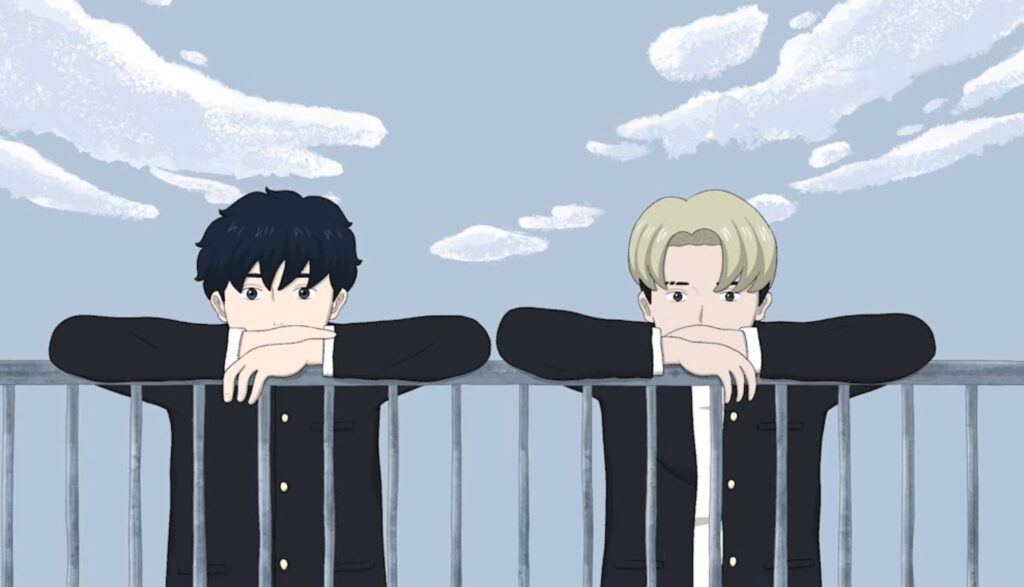
Indeed, the boy stays silent as death. He hovers around the school’s outskirts like a shadow. He has just one friend, a fellow 13-year-old named Kintaro. And when Kin first tries to speak to Shinigami, the boy punches him in the face.
Perhaps the boy’s silence is understandable. Not so long ago, a dementia-addled driver ran his truck headlong into a convenience store, killing the boy’s mother and knocking his biological father into a coma. The boy watched the whole thing. Rushed outside to save them both. Heard his mother use her dying breath to say his name.
The boy will come to have so many names: Kurose. Se-Chan. Kuro. Zen. Reito. God. Those names will bob and swirl like leaves in a stream—so many and so often as to be almost meaningless. His life will flow ever onward, taking on new currents and character as the decades pass.
They called him Shinigami as a boy, and perhaps the name came with a kernel of truth: As his life flows, death seems to follow him, its scythe cutting deep.
But out of those cuts, life creates something new. Death comes with change—continual, terrible, beautiful change. Its horrors and wonders blend together in life’s strange, swirling currents.
Such is the life of our main character. Such is the life—the jinsei—found in our own stories.
[The following sections contain spoilers.]
Our main character is almost too passive to be too positive. He rarely speaks. We hardly see him do much of anything—and when he does, he tends to be violent. (More on that below.) But some of that violence is perpetrated out of a sense of justice, punishing those who’ve inflicted their own sorts of pain on others.
Perhaps our protagonist would’ve had a different, more joyful and active sort of life had his mother lived. We see his interactions with her as the film opens: She seems both stable and loving, and the two have clearly formed a strong bond with one another.
Hiroshi, the protagonist’s stepfather, provided some stability as well. But his wife’s death crushed him, and he never really recovered. Still, Hiroshi did what he could for the protagonist as the boy was growing up. And when the protagonist’s wealthy grandparents come to claim the boy, Hiroshi acquiesces—in part because he feels it’ll be best for the protagonist. And then, when the protagonist gets the chance to become a member of an up-and-coming boy band, Hiroshi overcomes his own fear of driving and helps his stepson make it to the audition.
It might’ve been better had Hiroshi simply raised the boy himself or failed to make it to that audition. One can only wonder what sort of man our protagonist might’ve turned into had his stepfather been able to raise him and imbue him with Hiroshi’s own stoic kindness. But both giving up custody and helping the boy get to the audition were sacrificial acts made with the boy’s best interests at heart.
A couple of characters whom the protagonist meets briefly reenter his life much later. And together, they form a curious sort of family that, we presume, make up the happiest part of the protagonist’s life.
One chapter in our protagonist’s life takes place in an abandoned, crumbling factory where the protagonist was left to die. He lives in squalid isolation for five years, hunting wild pigs and crows to survive. No one knows that a human being lives there, and as a result, a sort of mythology springs up around the locale. The entrance to the building is labeled “Gateway to Death,” and two kids sneak through the gateway to petition the “god” who lives there.
“Can you hear me, god?” one says to the darkness. She details what she and her male companion want to be when they grow up and asks for his help. “God, please make our dreams come true,” she says. “Please let us stay together forever.” It’s during this conversation that our protagonist makes his presence known. (Worth noting: The trauma of being left in the building did something to the protagonist’s left eye, lending the man a supernatural quality.)
Once he’s discovered by them, the protagonist becomes an object of fascination, and a news crew interviews a couple of local farmers. “I heard rumors there was a ‘mountain god’,” one tells the crew. “I had no idea he was such a handsome man.” We learn that the protagonist often killed farm pests, which endeared him to the farmers. “He is God for us, anyway,” a farmer says.
The protagonist’s “god” phase is perhaps the most extreme form of one of Jinsei’s recurring themes: idolatry.
The protagonist’s childhood friend, Kin, is deeply into idol worship—that is, pop idol worship. Kin’s walls are covered with posters of Japanese boy bands, and he’d love nothing more than to join their ranks. The protagonist—who happens to be the biological son of one of Japan’s biggest former idols and is himself mesmerized by a VHS tape of his father dancing—doesn’t think there’s anything wrong with that. “What’s wrong with a man who’s crazy about cool stuff?” he says—perhaps the longest sentence he utters during the entire movie.
Kin gets invited to try out for a prospective boy band, and he encourages the protagonist to try out, too. It’s clear that Kin will do anything to become an idol, working with dogged abandon to improve on every level. “I’ve never seen anyone trying so hard like him,” the fledgling band’s manager says of Kin.
“You got a talent for dancing from God,” Kin tells our protagonist (known during this phase of his life as “Kuro”). “But I just love idols more than anyone!” Later, Kin confesses, “I want to be an idol who can save someone and make so many people smile.” He equates celebrity with something more salvific, almost messianic. And Kin never shakes that sense of purpose that comes from being an “idol.” Even decades later, he confesses a desire to return to the stage: “I want to sing … to my fans like before.”
Our protagonist never equates fame with godhood himself. But as we’ve already noted, others place him on a pedestal to be celebrated and, in a way, deified. During another chapter of his life, he’s called “Zen,” named after a school of Buddhism that exalts hands-on experiences over theological book learning. (Which seems narratively appropriate, given the dizzying array of experiences that made the protagonist who he is.) He’s a movie star by now—another sort of idolized figure—who’s especially lauded for his starring role in the superhero film Inazu-Man. (We see some telltale action figures in subsequent scenes, seemingly an echo of household idols from biblical times.)
In the latter stages of his life, the protagonist comes to head a sort of commune in the midst of a blighted wasteland. It’s hard to tell whether he’s considered just a respected figurehead or seen as a quasi-divine leader; the movie’s imagery suggests perhaps a bit of both.
Later on, he’s kept in a tube of fluid that is likely sustaining his life. Some shadowy figures seem to grant him some of their own insubstantial nature and give him the ability to simply … leave.
The protagonist’s teen years are spent living next to a massive statue of “the goddess of mercy.” (The statue in question may be inspired by the Sendai Daikannon statue in Sendai, made to honor the Buddhist goddess Kannon.)
The protagonist’s mother was apparently cremated: Standing outside the funeral home, the protagonist’s stepfather holds a lit cigarette to the sky, mimicking the crematorium’s smokestack and wistfully saying that perhaps they can be together forever one day.
Someone asks if heaven is bigger than our home. We see depictions of various Shinto and Buddhist gods and demons, along with a wall festooned with graffitied eyes. Characters visit graveyards. We see what appears to be household shrines in some homes. One character wears a long wig wreathed with a crown of thorns, and he boasts a stylized cross as his (or his community’s) symbol. (He dons Christ-like trappings for very un-Christ-like purposes, however.) When someone’s told that he’ll die in a horrible way (because of some sort of karmic justice, we presume), the man says, “There aren’t good or bad ways of dying. It ends when you die. That’s it.” (Turns out, he does die in a pretty horrible way, though.)
It’s not clear whether Kin just likes boy bands or whether he’s attracted to the boys in those bands. We do know that he feels some shame in showing the protagonist his room filled with their posters, and one of those posters depicts a shirtless guy. At one point, someone inquires whether the protagonist is into men.
When Kin and the protagonist are drafted into a fledgling boy band themselves, we see another band member dressed primarily in his skivvies. The band’s manager chastises the guy for being too interested in girls.
Various members of that band, including Kin and the protagonist, seemingly feel pressured to perform sexual favors to improve their status (more on that in Violent Content). We don’t see these acts onscreen, but in one chapter of the protagonist’s life—apparently after his time as a boy band star—we see our protagonist sitting on a bed in his underwear with a female benefactor. The woman sits in a provocative position that reveals her own undergarments.
We see men in showers, though nothing critical is seen. A mostly naked old man floats in a massive tube filled with fluid. A boy band member has a picture of a bikini-clad woman pinned up next to his bed. Someone asks the protagonist if he has a sexually transmitted disease.
The protagonist’s parents were married when he was born. However, they later divorced (and his mother remarried) due to his biological father’s struggles with drug abuse.
It’s insinuated that Mr. Shiratori, the head of a powerful music label, is attracted to many of his young, male charges—and he expects certain sexual returns for his favors. (It’s suggested that the protagonist’s own father may have left Shiratori’s label because of that.)
The six members of the boy band that Kin and the protagonist are a part of live in a dormitory as they undergo incredibly rigorous training for their future lives as superstars, with their manager/label CEO living in a sort of apartment above them. Two of the band’s members sneak up the flight of stairs to that apartment, and it’s suggested that they may perform sexual favors to improve their chances or status. When Kin makes the trip, another bandmate shakes his head as he does so, as if trying to dissuade him. And the next morning, as Kin showers, the protagonist notices that while the rest of Kin’s clothes are strewn across the floor, his stained underwear is already in the washer.
Later in the protagonist’s life, it seems he’s encouraged to perform sexual favors for a woman. He sits on a bed with her, clearly unable (or unwilling) to perform. Thereafter, he is horrifically beaten (off camera), stuffed in a bag and dropped in the basement of an abandoned building, apparently to die there. (We see a decapitated rat near the bagged protagonist, emphasizing his peril.)
Japan is apparently racked by war around the year 2050 (where one chapter of the protagonist’s life takes place), and our protagonist finds himself one of the few survivors who lives underground in relative safety. We see what’s happening topside, though, and it’s not pretty: One soldier’s face gets ripped off. Another gets stabbed in the neck, and blood spurts. We see dead bodies strewn about, one of which has been decapitated.
Several people get shot and killed (accompanied with flowing blood). A man is interrupted in the process of raping a woman in a bathroom. (We see them struggle and catch a bit of the guy’s bare behind.) Another man is beaten almost to death with a microphone. A character is stabbed with a knife; we see his corpse lying in a bed. Another knife—covered in what appears to be newsprint—hovers ominously around a few scenes.
Someone purposely leaps off a building and lands on someone else. It’s unclear if she meant to kill the person she lands on, but both die, and one of their heads is haloed by a pool of blood. A man dons a noose in a quick scene, apparently preparing end his life. (He doesn’t go through with it.)
We see various scattered corpses in the latter parts of the film, perhaps suggesting the planet’s inability to support life. A pig’s head lies on the ground in one scene. Our protagonist leaps off a desk and gives his teacher a flying kick during a graduation ceremony. (The kick itself doesn’t take place on camera, but we later hear that it’s a part of his story.) He slugs Kin in the face (again off camera). A guy tells a woman that he’d be quite accepting if she stabbed him in the belly. Someone points a gun at a character, forcing him to go away. Hiroshi apparently knocks out a garage attendant. A character is bullied by being hung by his wrists in a boy’s bathroom. Hiroshi seems to consider running a couple of people over with a hearse. We see a skeleton in a coffin.
We join the protagonist in witnessing the accident that claimed the life of his mother: One minute she and the protagonist’s biological father are talking outside a convenience store. The next, a truck has apparently crashed into the store wall. Once we’re taken inside the store, we see the truck’s driver (a 78-year-old man addled by dementia, we later learn) standing in confusion by the wreckage that includes two bodies. We get a closeup of the protagonist’s mother, gray blood leaking from her mouth. The protagonist’s biological father survives the accident, but he’s left in a vegetative state in a hospital until his own death. (“A feckless man,” the protagonist’s grandfather says. “Don’t hold a funeral. Don’t tell anyone he’s dead.”)
We hear the f-word about five times. We’re treated to the following profanities as well, once or twice each: “s—,” “a–,” “b–ch,” “b–tard” and “h—.” God’s name is misused about five times. We also hear “g-dd–n” eight times during the movie’s closing credits song.
As mentioned, the protagonist’s biological father, Eito, was once a Japanese pop idol, but we learned he was “cancelled” due to a drug charge. When Eito meets the protagonist’s mother, he seems to straighten up for a while. But in a montage of scenes (where the camera zooms in through the windshield of various cars), we see cans and liquor bottles pile up on the dashboard. An ashtray filled with cigarette butts sits nearby. He’s seen buying what appears to be cocaine. The next scene takes place inside a police car, where Eito’s once again in custody.
A guy sniffs what appears to be a cigarette or marijuana joint. Several characters drink. A man is shown apparently drinking whiskey and snorting cocaine. (We don’t see him consume either, but the lines of white powder and the whiskey bottle are certainly suggestive.)
A couple members of Kin’s boy band suggest he have a drink with them. Kin, determined to be the best pop idol he can be, refuses.
Two characters vomit—one with comic profusion. Several men defecate and urinate on someone. (We see the feces exit the body.) We see someone sitting on a toilet. Kids bully the protagonist.
Hiroshi never is able to escape his grief over his wife’s death. He falls deeper and deeper into depression, and by the end of his life, he seems almost incapable of coherent thought.
Director Ryuya Suzuki spent 18 months creating Jinsei, sometimes working on the hand-drawn animation for 10 hours a day—and with only the barest understanding of where his protagonist’s story might go.
“There wasn’t a shred of preparation,” he wrote to Animation Magazine. “I created everything as I went along. If I’d defined the characters upfront, I’d think, ‘I need to set up this scene so this character can appear…’ and I didn’t want to do that. Every day, people encounter each other unexpectedly: I wanted to honor that element of surprise in the filmmaking. I didn’t want to spend days on prep and stop even for a moment the hand that was running alongside this runaway train of a story.”
And that might help explain why Jinsei is so unexpected, so poignant and so strange.
Certainly, Jinsei is a visionary film—one shaped by a skilled storyteller who’s not afraid to take chances. But in terms of its content, those chances can take the film off the rails in a big way.
Jinsei is unrated. But if it was, it would unquestionably be slapped with an R rating. The main character is a man of violence surrounded by violence, and moments of shocking bloodshed can mar the screen. The movie deals with rape and sexual coercion. It alludes to LGBT trysts and deeply inappropriate relationships. Language can be coarse. The film’s spiritual ruminations can be obtuse, and its issues get more extreme as the film moves along.
All of this content comes with a purpose. Jinsei’s protagonist is so compellingly flat and emotionless that, at the beginning and near the end, he becomes literally faceless. The film itself deconstructs our celebrity-besotted culture and suggests that our current pop idols aren’t that far removed from historical ones. It’s a heartbreaking look at how the traumas we experience can impact us for years and even decades to come.
But by the time our protagonist starts riding robots while wearing a green globe on his head, all those deeper ruminations may be lost on us.

Paul Asay has been part of the Plugged In staff since 2007, watching and reviewing roughly 15 quintillion movies and television shows. He’s written for a number of other publications, too, including Time, The Washington Post and Christianity Today. The author of several books, Paul loves to find spirituality in unexpected places, including popular entertainment, and he loves all things superhero. His vices include James Bond films, Mountain Dew and terrible B-grade movies. He’s married, has two children and a neurotic dog, runs marathons on occasion and hopes to someday own his own tuxedo. Feel free to follow him on Twitter @AsayPaul.