


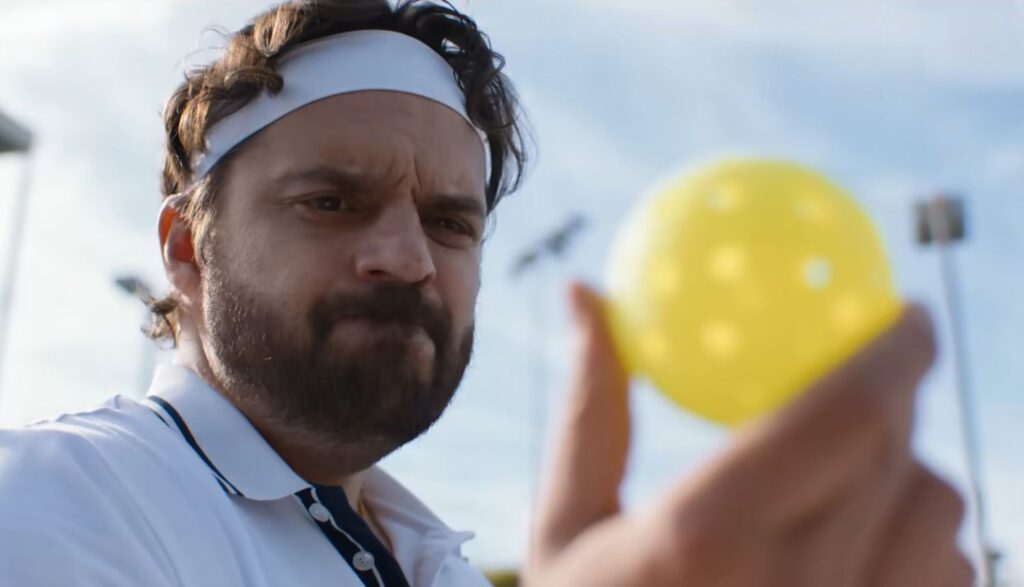
It was only a matter of time before we got a movie about pickleball. But, at first, this movie’s protagonist hates the game. Apple TV’s The Dink comes with some nice messages about friendship and family. But it comes with plenty of faults, too, including sexualized dialogue and plenty of profanity.
Chuck Boyd really hates pickleball.
Crazy, right? Who could hate pickleball, filled as it is with balls that look nothing like pickles?
(I personally love pickleball. And my love of the sport has nothing to do with fact that the person who signs my checks and the person who edited this very review both play. Nothing at all.)
But Chuck Boyd doesn’t have to worry about overly sensitive editors. No, Chuck runs a prestigious tennis club, and he signs his own checks, thanks. And in pickleball (a totally legitimate and, indeed, lovely sport), Chuck Boyd sees the thwacking paddle of impending doom. Not just the doom of tennis, but civilization itself.
“An epidemic is sweeping across our once-great nation,” Chuck intones. “And its name is pickleball.”
Indeed, that epidemic has even nosed under the tent of his very own club. Already, he has been forced to convert prime tennis real estate into a pickleball court for the club’s pickle-loving barbarians. Now they’re asking for more. Nay, they’re demanding two more courts—and the club’s members have the votes to get them.
But Chuck won’t be so easily cowed by the picklers. According to the club’s bylaws, he can scrap the vote and instead put the matter to a court-based duel. “With tennis rackets,” Chuck says.
Chuck believes that tennis players are inherently more skilled, more athletic and inherently better people than the club’s cadre of pickleball enthusiasts. The duel will be over before it begins. But just to make sure, he’ll hold a tennis tournament. The victor will face whatever ragamuffin the picklers haul up.
Dusty Boyd—Chuck’s son—aims to be that champion.
On paper, it should be easy. In a club where most members can recall the Eisenhower administration, he’s relatively young. He’s pretty good, too. In fact, Dusty used to be a professional tennis player. They called him “the Hammer” back then, and he was on his way to big things until he broke his wrist. And man, he’ll do anything—anything—to impress his dad. If that means humiliating several septuagenarians on the court, so be it.
And humiliate them Dusty does. But when he leaps over the net to gloat over his victory, he trips over it and injures his wrist. Again.
It’s a horrible turn of fortune for the Hammer. Dusty hopes to heal as quickly as he can to make his pops proud (for once). But according to his doctor, that means picking up an entirely different sort of racket.
“Listen, I know pickleball is sort of dorky,” Dusty’s doc tells him. “But it’s the fastest road back to tennis for you. And it’s really fun.”
Fun? Yeah, right. Dusty wants no part of the pickleball epidemic. But maybe a game or two won’t hurt …
When Dusty first steps onto the pickleball court, his tennis background—and more specifically, his hard-hitting style of tennis—prove to be more hindrance than help. “You don’t need to swing so hard!” Candace, his pickleball partner, tells him. And eventually, Dusty pays attention. It’s no accident that the movie’s title, The Dink, refers to a gentle pickleball drop shot.
That “dink” eventually serves Dusty well on the court. But it proves to be a metaphor off the court, too. For much of his life, we’re told, Dusty’s been clutching the racket of life with knuckle-white tension: His past struggles haunt him. His desperate desire to impress his father devours him. As the movie goes on, tennis becomes a symbol for what Dusty craves: achievement, recognition, validation. Pickleball—and everything associated with it, including Candace and some newfound friends—symbolizes what he actually loves and enjoys.
Clearly, The Dink is about more than just pickleball. Indeed, the biggest theme here isn’t so much about the sport as it is about Dusty’s dysfunctional relationship with his father. When Dusty tells Candace how much he loved tennis back when he was a kid, he amends the thought: “I really loved spending all that time with my dad.” Dusty’s desire to connect with his father forms the emotional, bittersweet spine of the story. But the movie tells us that, for Dusty to earn his father’s respect, he must first become his own man and succeed on his own terms.
As mentioned, Dusty forms some strong friendships on the pickleball court, too—especially with Candace. Throughout the film, Dusty’s dad accuses his son of failing to follow through. But when Dusty has an opportunity to support Candace during a moment of need, Dusty comes through for her. It’s a faltering step toward maturity, the first of several we see Dusty take here.
Chuck couches the threat of pickleball in existential, near-apocalyptic terms. “It’s about the decline of humanity itself,” he says.
Dusty is not romantically involved when the movie opens—but he pretends to get back together with his old girlfriend, Marisa, to make his father happy. He does so even though Marisa cheated on him (eight times with nine different guys). They attend a dinner that Chuck is hosting for a bunch of club bigwigs: When Dusty and Marisa arrive, they apologize to Chuck for being late, saying they were “trying to make you a grandson.” (Dusty follows that comment up with some more ribald references to what they were up to.)
Later, Dusty develops a crush on Candace—even though Candace is about 30 years older than he is. When Candace goes to a honky-tonk bar where she knows her ex-husband will be (with his new girlfriend), Dusty shows up, too—masquerading as Candace’s boyfriend. (Using several tawdry asides, Dusty tries to convey to Candace’s ex that he and Candace are sleeping together.) Dusty kisses Candace on the dance floor, too: Candace assumes it’s part of the ruse to make her ex jealous, and she passionately kisses him back. But when Dusty kisses her again when no one’s looking, Candace tells Dusty that she’s not attracted to him. (One of Candace’s senior-citizen friends is attracted to Dusty, and she makes some comical come-ons.)
Dusty and his doctor engage in their own raunchy dialogue, with oft-repeated references to masturbation and a website wherein you can hire a prostitute. Dusty’s best friend, PJ, confesses that he has objectophilia: that is, he loves inanimate objects. The literal object of his affection happens to be a battleship, and he claims to have had sex with it. Dusty asks how that’s even possible (using a few very descriptive terms), but the conversation is terminated before it goes too far.
Candace and Dusty play a pair of “grunters,” who let loose groans and squeals every time they hit the ball. Candace suggests the only way to defeat grunters is to become grunters, and “the more erotic you grunt, the better.” The match becomes a predictable litany of sexualized noises.
Real-life pro tennis player Andy Roddick plays himself in The Dink, and we hear some references to him kissing his wife. Candace and Dusty watch the movie The Graduate, and we hear the famous line, “Mrs. Robinson, you’re trying to seduce me.” We hear references to suggestive country music songs.
We hear about, and see glimpses of, a character’s complicated demise—one involving an angry owl, a tumble from an attic window and a car running over the man’s head. (We only see the owl attacking, however).
As mentioned, Dusty broke his wrist early in his professional tennis career. We see a couple of flashbacks to the incident, though neither is particularly grotesque.
Characters slip and fall on pickleball courts and bathroom floors. A car airbag knocks Dusty backward (forcing him to crawl out of the car’s back door, in fact). Several people are hit with tennis balls or pickleballs. A pickleball advocate notes that a pair of real-world killers were “playing tennis the day they murdered their parents.” New pickleball courts, the advocate insists, will help prevent such tragedies.
We hear one f-word—from the mouth of a 9-year-old in the first few minutes of the movie. We also hear about 14 s-words and a bevy of other profanities, including “a–,” “b–ch” (the word is used repeatedly in a song and in an oft-repeated pickleball taunt), “b–tard,” “d–n,” “h—,” “p-ss” and “d–k.” God’s name is misused about 15 times, about a third of which include the word “d–n.”
Some rude hand gestures are seen.
When Candace goes to a country-and-Western bar, she takes a bottle of beer and nearly chugs half of it in one go. Other people drink beer, wine, whiskey, martinis and champagne. We hear about someone adding liqueur to a cobbler.
When Dusty tells P.J. about a traumatic event that took place in a bathroom, P.J. gets quite distracted by the toilet mentioned in the story, asking repeated questions about the inanimate object. P.J. later suggests to Dusty that, if he should ever repeat that story, he should finish it up by saying that he washed his hands before leaving the restroom—to avoid any unpleasant, unanswered questions.
At the start of The Dink, Dusty is rabidly self-absorbed. And his relationship with his father has always been troubled. When talking about how he got his “Hammer” nickname, Dusty says, “My dad gave me that nickname before I even knew my real name!” Probably not a healthy family dynamic, that.
Dusty lies about his past.
Pickleball is the ukelele of sports: It’s easy to play and an easy target of mockery. But it’s surprisingly intricate, competitive and entertaining, too. And while it’s been around since 1965, the sport really came into its own in the last five years, when it saw a ridiculous 479% increase in player participation. More than 24 million people reportedly play pickleball these days. So it was only a matter of time before someone based a movie on it.
But perhaps fittingly, The Dink is far more about community and fun than the sport itself.
Most of those millions of pickleball players aren’t looking to become professional picklers (and yes, there is such a thing). Sure, there’s some healthy competition in the mix, but most primarily use the sport to unwind and bond with others.
Dusty desperately needs to do both—even if he doesn’t know it at first. Through this unlikely sport—one that he mercilessly mocked at first—he finds friendship, fun and, ultimately, a new and healthier sense of identity.
You don’t need pickleball to find any of those things, of course (despite what my editor says). But sometimes we all need a push of some sort to move into a healthier place. God built us to be unique reflections of himself. He built us to live in community. And when we discover new avenues to find ourselves and find our place within community, those tend to be good things.
But, of course, context is everything. Finding out who we are is great—unless we think we are meant to deal drugs and steal cars. Finding community is awesome—unless that community is bent on world destruction or the like.
The same goes for The Dink.
Though The Dink comes with some nice messages and is told in a (barely) PG-13-type way, the tawdry references and sexualized asides make this a less-than-desirable partner. The harsh language might replicate what you’d hear on a pickleball court, but perhaps not stuff with which you’d want to fill your family’s ears. And the fractious father-son relationship at the center of it all may be, for some, uncomfortable to watch.
The Dink hits some winners. But it comes with more than its fair share of faults. And in the end, it may be best to stay out of this cinematic “kitchen” from Apple TV.

Paul Asay has been part of the Plugged In staff since 2007, watching and reviewing roughly 15 quintillion movies and television shows. He’s written for a number of other publications, too, including Time, The Washington Post and Christianity Today. The author of several books, Paul loves to find spirituality in unexpected places, including popular entertainment, and he loves all things superhero. His vices include James Bond films, Mountain Dew and terrible B-grade movies. He’s married, has two children and a neurotic dog, runs marathons on occasion and hopes to someday own his own tuxedo. Feel free to follow him on Twitter @AsayPaul.