


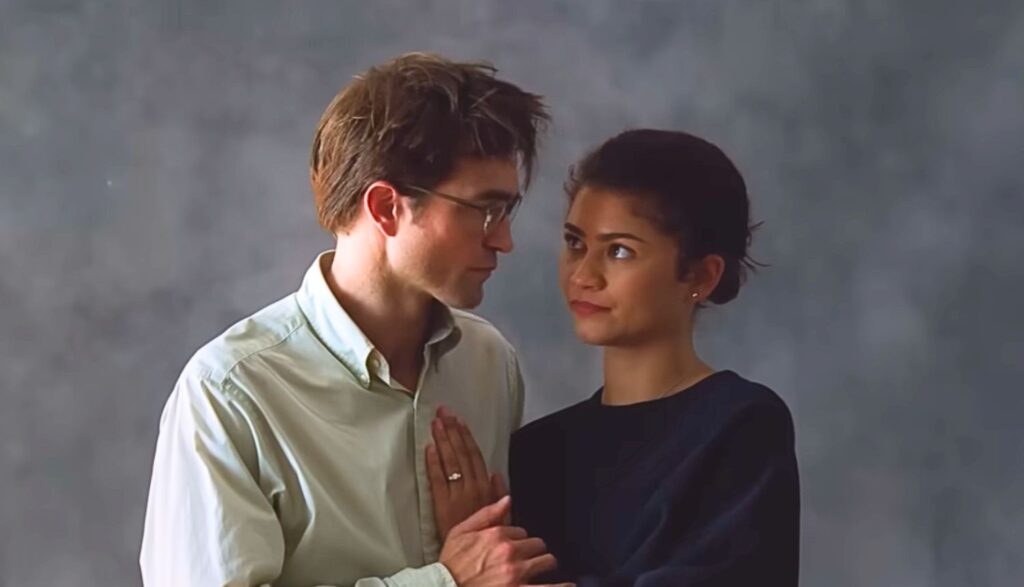
Emma and Charlie are about to get married, and they couldn’t be happier about it. Well, that is until Emma spills a secret that threatens to rip their relationship apart. While The Drama earns its R-rating primarily because of its unremitting profanity, this difficult comedy comes with a banquet-full of other issues, too.
“What’s the worst thing you’ve ever done?”
It’s the sort of question that only the best of friends would ask one another. But Mike and Charlie, Emma and Rachel, they’re clearly the best of friends.
The question comes up innocently enough as the four gather to test the food and wine for Charlie and Emma’s upcoming wedding. They select entrees, munch on hors d’oeuvres and refill their glasses just one more time.
Each promises to divulge their darkest secrets if everyone else does the same, and the results are predictably, moderately scandalous. Everyone gasps and laughs and tries to defend their own actions as not being all that bad. And all the while, Charlie tips more wine into Emma’s half-filled glass.
Then it’s Emma’s turn. She drains the glass and begins to speak.
And just like that, the fun’s over.
Well, it certainly doesn’t help that Emma throws up all over the table. That’s bound to be awkward no matter what. But that sort of mess can be easily cleaned: Some messes are harder to scrub away. And when Emma sobers up, she wonders whether Charlie—the love of her life—will ever look at her the same way again. Whether their marriage is over a week before it begins.
Charlie wonders that, too. Oh, he’d like to forget the whole thing. He still loves Emma—or, at least, he’d love to love her. But he can’t stop thinking about Emma’s “worst thing.” She seems like the same woman who Charlie proposed to not-so-long ago: the same beautiful eyes, the same sense of humor, the same outrageous laugh. But everything feels different now: Emma. Their relationship. Their pasts. Their future.
Is Emma the same person he fell in love with? Or does this “worst thing” spoil the whole thing?
Secrets can kill a marriage, and Emma spills a doozie of a secret (which we’ll spoil a little later on).
But let’s give both Emma and Charlie a little credit as they do damage control: Once Emma’s secret is out, she tries to unpack all of its wrinkles honestly and transparently. She loves Charlie, and she wants to come as clean as she can for his sake.
Charlie feels like he needs to know everything about Emma and her “worst thing,” and that’s understandable, too. It’s his effort to understand and rebuild the trust and love he had before. He doesn’t want to punish Emma; Charlie just wants to talk about the issue and move on.
But anyone who’s been married for any length of time knows a sad truth: We may want to forgive. We may want to move on. But those honorable intentions often run headlong into the brick wall of unbidden feelings of doubt, fear, anger and shame. Trust, once it’s broken, is hard to fix. None of this is positive, of course. But The Drama gives us a realistic portrayal of the havoc those unbidden feelings can make in our lives, our relationships and ourselves.
In Romans 7:15, Paul tells us, “For I do not understand my own actions. For I do not do what I want, but I do the very thing I hate.” That is so true when we willfully sin. But when we feel pain? It can be true, too. Our own (often justifiable) emotions undermine our good intentions, and it takes a lot to move past them. The film hints that Emma and Charlie do indeed do just that—but it’s not easy.
Outside a reference to sin in a song playing during the closing credits, none. It’s even unclear whether their wedding is officiated by a member of the clergy.
As Charlie considers what to say during his post-wedding banquet speech, he asks his friend, Mike, whether it would be appropriate to talk about what great sex he and Emma have. As he argues that he’d like to mention that pre-marital sex, we see a brief montage of he and Emma engaged in various forms of intimacy. We don’t see anything critical, but movements, passion and plenty of skin are on display.
Days after Emma divulges her “worst thing,” she and Charlie try to have sex. Charlie can’t respond, however. He clutches her (clothed) breast in view of the camera while he tries, unsuccessfully, to stimulate himself off of it. The two eventually give up.
Charlie, an official for a prominent art gallery, is sent a book full of photos depicting women—some in bikinis or tight-fitting clothing—holding a variety of guns. We see women in their underwear (more on that below).
Charlie’s assistant tells Charlie about her own “worst thing.” She cheated on her boyfriend with a guy who treated her like garbage. (Charlie asks her if she enjoys it when men treat her badly. The assistant doesn’t think so—but she also admits that she couldn’t stand having sex with her actual boyfriend and found that sex with her jerky lover was far more satisfying.)
Emma and Charlie both pull down each other’s pants jokingly. Charlie walks around in his dress shoes and boxers. Emma’s wedding dress reveals some cleavage. Couples kiss. Rachel tells a story about how, as a girl, someone led her into a shed filled with empty beer bottles and pornographic magazines. Pre-marital cohabitation is taken as just a matter of course.
At one point, Emma worries that she’s pregnant. She later realizes that she was simply dealing with an excess of emotion: Before Charlie, she’d never been in love before, Emma admits.
[Warning: This section contains spoilers.]
And so, we come to Emma’s “worst thing:” When she was a friendless 15-year-old, she plotted to bring her father’s rifle to school and kill people.
In flashback, we see her training for the shooting, brandishing the rifle and, at one juncture, point it at a dog. She practiced firing the weapon, too—though she accidentally blew out one of her eardrums when she held the rifle too close. (We see blood leak out of her ear. In an imaginary sequence, Charlie imagines blood gushing out of an adult Emma’s ear and coating her white dress in red; in another, we see an ear lying in the grass.)
She didn’t carry the deed out—but only because a series of happenstances prevented her from doing so. The biggest? The fact that another shooter rampaged a nearby mall around the same time that Emma was planning her own killing spree. One of the victims was a classmate of hers. And when she saw the grief that death triggered—and saw her would-be victims as truly human for the first time—she switched course and joined a school club that protested gun violence (and, by extension, guns themselves). She became one of the club’s leaders and, more critically, made some friends. When Charlie asked her whether her about-turn made her feel hypocritical, Emma said to the contrary: “It felt like finally waking up from a bad dream.”
Emma, both then and now, clearly had a strong awareness of other mass shootings—noting that girls and women do sometimes perpetrate them and that to qualify as a “mass killing,” the killer needs to murder at least four people. (The mall shooting wouldn’t qualify, she says, because only three people lost their lives.)
But that revelation doesn’t do much to assuage Charlie’s uncertainties about Emma or their future together. When they visit a wedding photographer who tells them the order in which she’ll “shoot” them, Charlie and Emma are both noticeably disturbed. When Emma walks into a room where Charlie is sitting while carrying a knife (which she was using to cut fruit for a smoothy), Charlie looks a little terrified. (When he denies his fear, Emma thrusts the knife toward him, making him flinch.) He remembers moments where she lost her cool with strangers and, at one juncture, threw something at a car—a confrontation that takes on more sinister undertones now.
When Emma was 10 years old, a neighbor girl a couple years older died in a car crash. Charlie tries to suggest that the trauma might’ve been a catalyst for Emma’s desire to kill people. Emma rejects the notion, but that doesn’t keep Charlie from using the incident as an excuse for her. He imagines the grisly scene, which we also see: A 12-year-old girl, dead in the front seat of a car, blood running from her face and head. We learn that Rachel’s cousin was injured in a school shooting, leaving her wheelchair-bound in adulthood.
Charlie eventually has a near-nervous breakdown just a day or two before the wedding. He breaks down in tears at the office. And when his assistant tries to comfort him, he kisses her. Things quickly escalate: He rips open her shirt and lifts up her skirt as he prepares to have sex with her (we see her black bra and panties) before Charlie comes back to his senses and apologizes. But the interlude comes with some serious implications.
In a public gathering, Charlie drunkenly mentions his dalliance with/sexual assault of his assistant. Not only does Emma hear about it, of course, but the assistant’s boyfriend does, too. We see the boyfriend (Blake) headbutt Charlie, knocking him to the ground. Later, we see Charlie in the aftermath—his face horrifically bruised and his white shirt covered in his own blood. (He later tells someone, as a joke, that he received his injuries from someone trying to steal a woman’s baby.)
Mike recalls that his own “worst thing” involved him using his girlfriend as a human shield as a dog attacked her.
About 80 f-words (at least two of which are paired with Jesus’ name), a dozen s-words and one c-word. We also hear “a–” and “b–ch” and “p—y.” God’s name is misused a half-dozen times, and Jesus’ name is abused about seven times.
Several middle fingers are flipped during the film.
Charlie and Emma see the woman who was supposed to be their wedding D.J. smoke what they suspect is heroin out in the street. They talk about the issue with their friends, Mike and Rachel, and argue over whether they should fire her or not. But it also reflects Charlie’s and Emma’s disparate reactions over how to deal with human failings: Charlie argues that they should get rid of her, as he’d never be able to look at the D.J. the same way again. Meanwhile, Emm says, “I don’t want to dismiss her for that one thing.”
People drink to excess here, and that drunkenness always comes with consequences. As mentioned above, Emma told her “worst thing” under the influence of alcohol. Charlie, too, admitted to a horrific act when he was drunk. Both get violently ill shortly thereafter, too.
Friends drink wine together. A wedding banquet is loaded with wine and champagne.
Both Charlie and Emma messily vomit on screen.
We hear about how Emma turned into an anti-gun advocate at 15—egging Walmart employees because the stores sold firearms. Her father, who was in the military, recalls how Emma’s stance caused some tension between the two, and he notes how his own rifle disappeared around that time. (We see Emma dump the gun into a swamp.) Other characters express a disdain for guns.
Charlie misleads Emma when they first meet. His own “worst thing,” at least when the movie begins, was an instance in high school where he cyberbullied a fellow student—causing the student to cry and perhaps forcing the whole family to move. Rachel’s own “worst thing” is when, as a kid, another boy led her to a deserted house or shed deep in the woods. Freaking out a little, Rachel says she shut the boy in a closet and ran away—even lying to the boy’s father when he asked her if she knew where he was. (Rachel says a search party was formed the next morning, and the boy was found, safe and sound.)
What’s the worst thing you’ve ever done?
That question lies not only at the heart of The Drama but the center of our faith, too. All of us know we’ve fallen short of what God would like us to be. Many of us have done things of which we may feel deeply ashamed. But if we accept God’s grace through His Son’s sacrifice, we’re given a clean slate—as if it never happened. That doesn’t mean we’ll escape the consequences of our actions. But God’s love? It holds firm. “For I will be merciful toward their iniquities, and I will remember their sins no more,” we read in Hebrews 8:12.
The Drama is in no way a Christian (or even religious) film. And yet, there’s a curious echo of this biblical sentiment when she and Charlie mess things up: Emma encourages them both, repeatedly, to start fresh. To pretend they just met. To remember their sins no more.
It’s a surprisingly touching respite amid the dark, discomforting comedy that is (paradoxically titled) The Drama.
Alas, in this forum, Plugged In cannot be so forgiving.
The Drama earns its R-rating, first and foremost, because of its language. The movie’s harsh profanity is unremitting and—even to these jaded ears—sometimes shocking. The film’s sexual scenes may be free of explicit nudity, but that makes them no less salacious. Difficult, provocative themes of violence permeate every pore of the script. And, of course, we see lots of folks behaving badly.
Zendaya and Robert Pattinson do strong work in The Drama, and the movie itself asks some interesting questions. But it’s so ooky and uncomfortable to sit through that, for many, it won’t be worth the bother.
This is one wedding party worth skipping.

Paul Asay has been part of the Plugged In staff since 2007, watching and reviewing roughly 15 quintillion movies and television shows. He’s written for a number of other publications, too, including Time, The Washington Post and Christianity Today. The author of several books, Paul loves to find spirituality in unexpected places, including popular entertainment, and he loves all things superhero. His vices include James Bond films, Mountain Dew and terrible B-grade movies. He’s married, has two children and a neurotic dog, runs marathons on occasion and hopes to someday own his own tuxedo. Feel free to follow him on Twitter @AsayPaul.