


Dracula’s origin story is once more on tap. But this time it’s a 400-yearslong romance hoping for resurrected love. The actors dole out lots of energy and the sets look nice. But it’s a gory and blasphemous mess juxtaposed with lots of sensually charged scenes that’s dead on arrival.
He warned God.
Prince Vladimir of Wallachia wasn’t shy about his desires as he headed to war with the Turks. He told the bishop who was blessing the up-coming battle, “I will fight in God’s name, but I ask Him one favor: Spare my wife.”
After all, Vlad had been pulled from his wife’s passionate embrace for this silly war. So if God wanted the Muslim attackers gone, then the prince expected to find that same passionate embrace waiting for him upon his return.
“I will pray for your request,” the bishop humbly offered.
“No! Don’t pray,” Vlad growled in reply. “Tell Him!”
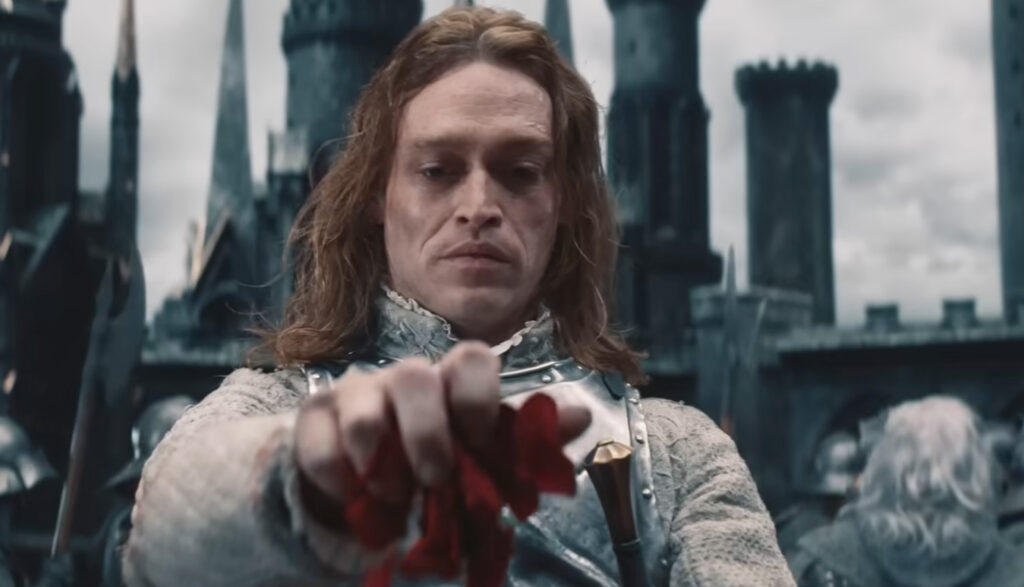
Of course, making demands of God doesn’t often go the way one would like. Rather than waiting in safety for Vlad’s return, Elisabeta was set upon and murdered by Turkish assassins. Vlad returned to the bishop, eyes ablaze with white-hot rage. And he demanded Elisabeta be given back to him. The bishop tried to explain that things just don’t work that way … just before Vlad impaled him on a cross-topped staff.
In the midst of blaspheming God’s name, the prince declared: “Tell your God that until He brings back my wife, my life no longer belongs to Him.”
That was 400 years ago. In the years since, Vladimir of Wallachia—known these days as Count Dracula—has never given up his search for Elisabeta. He lives on as a cursed soul, undying and sated only by the taste of human blood.
In the early days, Dracula searched all the courts of Europe for his wife. Then he developed a fragrance that drove women into a frenzy with but a small sniff. He fed on those hundreds of women, turning them into his never-dying servants and sending them out to scour the world for his love.
Because Dracula believes that God will give into his demands. And even if He does not, Vlad is certain that his overwhelming desire for Elisabeta will bring her back to him.
Elisabeta will be resurrected in flesh, Dracula proclaims. All her beauty and lush sensuality will be his once more. He can almost taste her kisses like blood from the edge of a knife.
He must simply find his beautiful, reincarnated beloved and remind her of all they mean to one another. For that is the inevitable outcome of a love as great as theirs.
There are people who work to help others here. An unnamed priest, for instance, is part of an order that has been searching for the source of this strange spreading vampirism for years. So when he hears of an infected woman named Maria being held in an insane asylum, he goes to see her.
The mild-mannered Priest hopes to gain information, but he also hopes to help Maria, if he can. In fact, when the Priest eventually meets up with Dracula himself, he tells the prince how he might still be forgiven and freed by God.
The Priest goes to speak with Maria’s distraught fiancé, and the man tells him, “You’re a bit like an inspector on a police investigation.” “Precisely,” the Priest replies. “Only I hope to solve a case before the murder.”
Though Dracula’s immortality and powers are never explained, it’s implied that he gained his vampirism through a curse after he desecrated a church and publicly denounced God.
The Priest supports that idea, suggesting that his studies have shown that Dracula was indeed cursed. “But God can forgive that curse in the event of true repentance,” the Priest states. And he tries to see his belief through when he faces Dracula in person.
“God sent me here to save you. Repent Dracula for your salvation,” the Priest tells the vampire. The Priest also pleads for Mina’s soul (the reincarnated Elisabeta), telling Dracula: “If you truly love her, let her return to life and you return to God.” We see the Priest praying in Latin on a couple of occasions, including when he drives a stake into a vampire’s chest.
Dracula proclaims something “in the name of the Father, the Son and the evil spirit.” He says that he believes that “pure souls” can be reincarnated. (And that appears to have indeed happened with Elisabeta.) Several people wonder if Dracula is the devil.
Dracula can move and levitate objects with his mind. He appears to have the ability to fly. He can turn others into vampires with his bite. And he has dozens of small gargoyles that serve him as minions. Later, these creatures transform back into their original states as little boys.
When a man named Jonathan arrives at the manor of an ancient-looking Dracula, his coachman gives him a crucifix to keep on his person. Jonathan scoffs and says, “Thank you, but I do not believe in God.” To which the coachman replies, “Then pray God believes in you.” After meeting Dracula, the vampire levitates Jonathan’s crucifix into the fireplace.
Early on, at the mention of war, Elisabeta sighs out, “Can’t we all live in peace as God intended?”
[Spoiler Warning] Dracula asks a resurrected Elisabeta, “Do you think God will forgive us for loving each other so much?” She replies, “God? Yes, love. He understands. And if He doesn’t, He can go to h—!”
Vlad and Elisabeta passionately kiss and caress one another in a series of quick clips. In some they are clothed but having sex. In other moments they are naked, legs and bodies entwined. (These scenes are presented in fast clips that keep the majority of their bodies unseen by the camera’s eye.) Later, we see the resurrected Elisabeta in a dress that sports a boosted, low-cut bust line.
As mentioned previously, Dracula develops a fragrance that drives women wild with a lustful fervor. The women that flock to him all remain clothed, but they writhe sensually, touching Dracula and themselves and rubbing against him in a piled-up crowd. Dracula sinks his teeth into necks and feeds on many of these enraptured women in a sexualized manner. In one scene, a large group of habit-wearing nuns become enthralled with the prince after catching a whiff of the fragrance in a Catholic sanctuary.
When a doctor introduces the pretty vampire Maria to the Priest, he notes that she was acting quite normal at a gathering but then flew into a fit, displaying “hysteria and sexual appetite beyond comprehension.” And when the Priest meets her, she tries to seductively manipulate him into setting her free, promising that he can do whatever he wants with her.
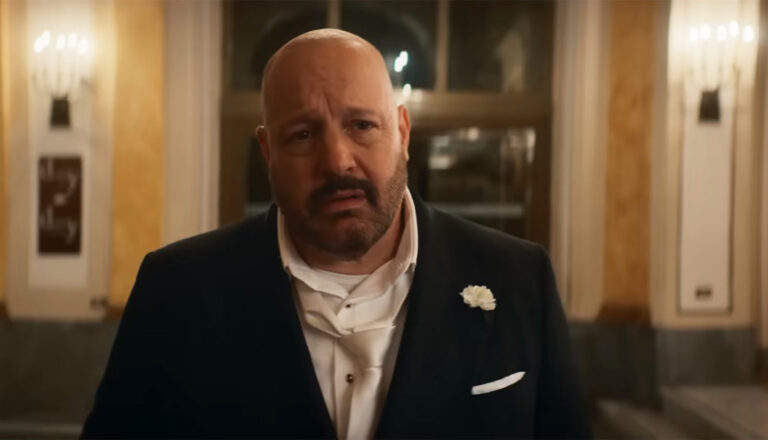
At a carnival, a performing “mermaid” is dressed in a fake tail, with only small seashells covering her chest. We see Dracula sleeping in his coffin with a woman beside him. (Both are fully dressed.)
Men are hacked at and beaten in a large-scale war scene. Swords impale. Blood spurts. After the battle, Vlad and his troops crest a hill beside the enemy’s camp, each holding a pike with a foe’s impaled head on it.
Elisabeta is chased by killers through a snowy field full of bear traps. Some of the traps snap shut on horse’s legs, crippling the animals and sending their riders crashing to the ground. When Elisabeta’s horse goes down, she steps into a trap herself, and the camera shows her torn and bloodied leg. Elisabeta and others are slashed and stabbed with blades.
We see Dracula bite scores of people in the neck throughout the film. Some of the throat tears are performed almost seductively, others with a savage anger. In all cases though, blood gushes and drips all over victims and attackers. One of Dracula’s female vampires seductively crawls into a man’s lap before proceeding to bite his neck. She also chomps down on the jugular of a much younger man that’s offered to her as a reward.
Armed soldiers battle with Dracula and his gargoyles. Bullets and canon balls rip through the count’s castle, destroying walls and killing people. A man is wounded and then tied up by his ankles. His dripping blood is gathered in a bowl and licked up by a gargoyle. The gargoyles pounce on, batter and wound people on several occasions.
Vlad spears a bishop with a long staff and slams the man’s body down on a church altar. A vampire’s head gets chopped off with a large sword, its heart stabbed. Another impaled vampire’s body decays quickly and turns to ash that drifts up into the sky. Dracula crushes a mouse and then licks the animal’s dripping gore from his fingertips.
Right after getting cursed, Vlad decides to kill himself, and he jumps from a fifth-story window onto the rocky cliffs below. But he cannot die. So he repeats the attempt over and over, his body becoming more broken and bloody with each try.
Someone says “Oh, my God.” To that, Dracula responds, “That name is not welcome here.” Jesus’ name is misused once.
The Priest drinks sacramental wine from a bottle while sitting in a chapel. We see others drinking glasses of wine.
Many years after Elisabeta’s death, Dracula breaks into her tomb and scoops up her decayed remains to hold to his face and breathe in.
How do you make a movie about Dracula feel different than, oh, some 200 other Drac pics that have been crafted over the years? You make it a heart-throbbing romance, I guess.
Or at least that’s what director Luc Besson seems to be attempting here.
Yes, there’s still lots of ripped out throats, deadliness and plasma sucking. But we’re told that it’s all driven by a soul-sucking passion that burns with a God-cursed fire. And the heartbroken Vlad’s ardor blazes faithfully over the course of a very gruesome 400 years while waiting for his true love to be miraculously reincarnated.
The vampirism, prominent fangs and never ebbing thirst for blood? Forget all that, the film seems to say. It’s love, I tell you.
Yeah, I don’t think so. This version of Dracula presents an over-the-top premise that’s pretty hard to swallow even if you do like the idea of a hearts-and-flowers story involving pretty people and an ancient vampire.
Granted, Besson has crafted a world that looks like it was pulled from classic paintings by Flemish masters. And if you could tap the high-voltage energy of cast members Caleb Landry Jones and Matilda De Angelis you could light a 19th century version of Paris.
However, this film and its doomed-romance tack is altogether lifeless. Except for all the splattering gore and blasphemy, that is. There are gobs of that.

After spending more than two decades touring, directing, writing and producing for Christian theater and radio (most recently for Adventures in Odyssey, which he still contributes to), Bob joined the Plugged In staff to help us focus more heavily on video games. He is also one of our primary movie reviewers.