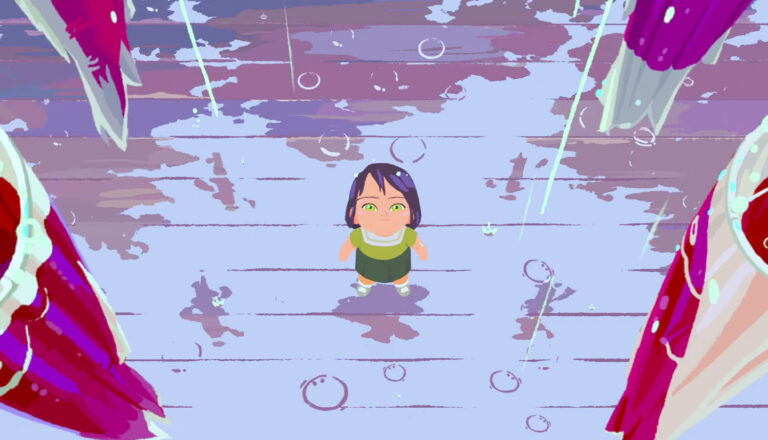



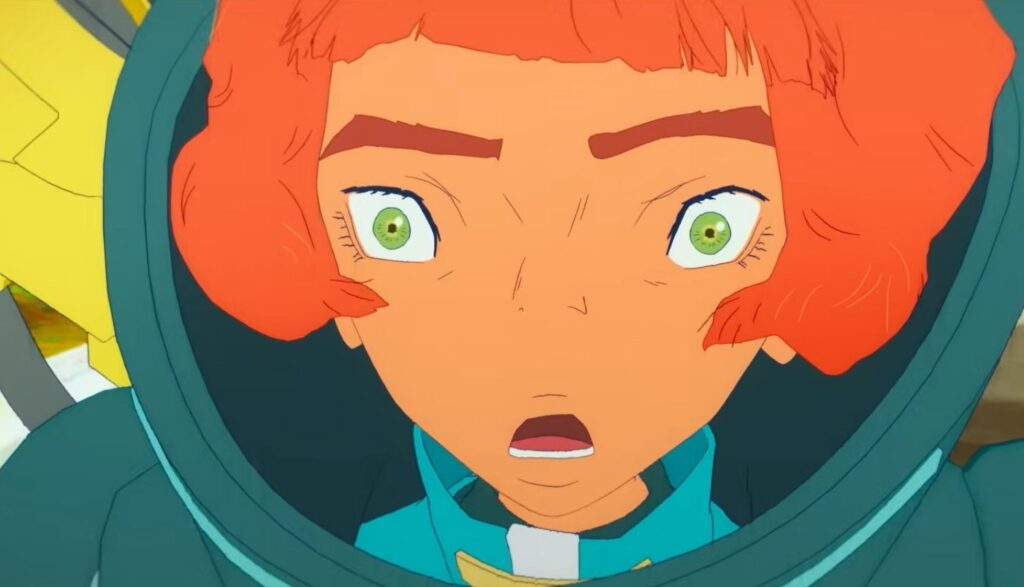
All You Need Is Kill, an anime adaptation of a popular Japanese novel, follows Rita as she battles an alien invasion by reliving the same violent day over and over again. The film has a clever concept, slick animation and some surprisingly poignant messages, but viewers will have to contend with a lot of death, plenty of animated blood and some foul language.
About a year ago, in southern Japan, a mysterious entity materializes in the form of a giant, extraterrestrial flower. Despite its alarming appearance (and the panic that followed), the entity, dubbed “Darol,” hasn’t done much since then besides take up space.
Nowadays, the only people who give Darol much thought are those who remain in its shadow.
Like Rita.
Rita spends her days in a mechanized suit, helping to clean up the mess made by the titanic alien fauna. At first, she had hoped that Darol’s arrival would spark a change in the world, in her.
But nothing changed at all.
Until now.
One bright and beautiful day, Darol suddenly emits a powerful signal. Giant seeds fall from the sky in response, crashing to the ground. And from the resulting craters emerge … monsters.
These alien creatures, which look like a mashup of a flower and spider, are deadly. Rita watches in horror as her fellow workers are slaughtered.
One of the monsters attacks Rita. But as it closes in to kill her, she wounds the creature. Their blood mingles as they die together …
Then Rita wakes up to the blare of her morning alarm.
It was all just a dream, she thinks.
But she soon finds that this new day is shockingly similar to the one she dreamed about. In fact, it’s exactly the same.
People share the same conversations. Perform the same tasks. And, at that fateful moment, Darol emits that same signal, and the killing begins all over again. Rita dies and …
She wakes up. On the same morning. Before the attack.
This is no dream, she realizes. It’s a loop.
A few more deaths (and resets) confirm it. Rita is stuck living the same horrific day over and over again. She tries to run. She tries to hide. Nothing works. She can’t escape.
So, she decides to fight. And, to Rita’s surprise, that leads her to Keiji, a young man trapped in the very same time loop. Maybe, if they team up, they’ll stand a chance of destroying Darol. Maybe they can end the loop.
Maybe they can save the world.
When Rita realizes she is stuck in a time loop, she tries to warn her fellow workers of Darol’s impending attack. (Naturally, they don’t believe her.) After several times through the loop, Rita tries to change things for the better, fighting to protect her coworkers from Darol’s monsters—often at the cost of her own life.
While Keiji initially seems weak and cowardly, we learn that he has been working to help Rita behind the scenes—such as upgrading her mechanized suit to give her a better chance at survival. Eventually, he takes a more active role in fighting alongside Rita.
Rita and Keiji are shaped by their past traumas, and though they express themselves differently because of their experiences, together they’re able help each other heal and move forward.
Obviously, this film deals heavily with the sci-fi elements of alien entities and time loops. Rita comments internally on her time-loop situation by saying, “This is h—.” A scientist speculates that Darol may have formed a symbiotic bond with Rita and Keiji.
Rita and Keiji develop a relationship that hovers at the edge of romance. Keiji, in particular, seems smitten with Rita. He makes a few comments that have a tinge of infatuation to them—such as, “I like your smile”—but it’s all pretty innocent.
Rita envisions her mother holding her as a baby, and they both appear naked. (Any critical bits are blocked from view.)
Someone is called a “pervert” and is accused of “peeping,” but that’s not the case. Two young women talk about their father leaving their mother—and their conversation suggests this a common occurrence. A shapely woman wears a midriff-baring top. Rita wears a tank top and shorts that show much of her legs.
We see many of Rita’s deaths play out onscreen. And the film suggests that she (and presumably others) dies well over a hundred times during its runtime. Characters are stabbed, slashed and crushed by Darol’s monsters.
Many deaths happen in the blink of an eye or just at the edge of the screen, sparing us from most of the gore—aside from a splash of animated blood or a squelch. However, there are some exceptions. Rita stumbles across a man who has been torn in two, and the movie lingers on his bloody remains. Another character gets an axe driven through his shoulder. Rita pictures the bloody corpses of her friends and family in another scene. A few wounded people cough up blood.
Black alien blood flows freely, sometimes in geyser-like quantities, as Rita (and later Keiji) hacks her way through the deadly horde.
During one restart, Rita kills herself in an effort to stop the time loop. (It doesn’t work.)
Flashbacks show us that Rita’s mother was physically abusive: she even goes so far as to try drowning Rita in a lake. Afterwards, Rita’s mom tries to apologize, but Rita coldly replies that if she wanted to kill her daughter, she should have “done it properly.”
Keiji was bullied growing up. In a brief flashback, we see a bully fling a throwing star into his back.
When Darol first arrived on Earth and took root, it caused widespread damage.
[Note: We reviewed the Japanese-language, English-subtitled version of this film. But an English dub will be released in the United States.]
Three s-words are used. God’s name is misused twice. There are a handful of uses of “d—,” “a–,” “a–hole,” “b–tard,” “b–ch” and “h—.”
Characters say “heck.” Someone is called a “dimwit.”
When Rita tries to warn her coworkers about Darol’s imminent attack, they jokingly wonder if she’s drunk. A character says she has “good booze” for a celebration and tells someone that they will feel better after a few drinks.
As Rita tries to destroy Darol over the course of several loops, she comes to think that “death is actually on [her] side,” giving her advantages with each subsequent reset. She compares the experience to a video game. A character says he was only ever interested in “video games and stars.”
Someone carries an enormous amount of guilt as a result of her past trauma. Rita and Keiji argue and call each other out on their faults. Rita steals a truck to try to escape Darol’s attack. Some of Rita’s coworkers are rude to her.
All You Need Is Kill is the latest adaptation of the sci-fi novel of the same name by Japanese author Hiroshi Sakurazaka. The book has been made into its own manga series and a separate graphic novel. And, perhaps most famously, it also served as the basis for 2014’s Edge of Tomorrow, starring Tom Cruise and Emily Blunt.
Now, the surprisingly fruitful IP can add an anime movie to its growing list of adaptations.
I went into All You Need Is Kill not knowing what to expect. With a premise that could be likened to an R-rated, hack-and-slash, sci-fi Groundhog Day, the film could have devolved into little more than a bloody, animated mess.
Though there’s certainly plenty of that mess here, that’s not entirely the case. In fact, the film presents a surprisingly poignant message about finding hope and courage even in seemingly impossible circumstances.
Rita and Keiji aren’t just stuck in a time loop: They’re stuck in their own internal loops of despair and fear—loops they’d been living in long before the one caused by Darol. On their own, these two heroes would have remained forever arrested by the effects of their traumas, even if the days didn’t reset. But together, Rita and Keiji can grow, they can heal, and they can face a new day together.
That said, the film earns its restricted rating thanks to a lot of violence and plenty of animated blood. Our main character dies repeatedly, and one of those deaths comes by suicide. Some harsh language filters in, too.
Considering that, families will likely decide that All You Need Is Kill is not something they need after all.

Bret loves a good story—be it a movie, show, or video game—and enjoys geeking out about things like plot and story structure. He has a blast reading and writing fiction and has penned several short stories and screenplays. He and his wife love to kayak the many beautiful Colorado lakes with their dog.