Game Review
Shooter games can often be grindingly repetitive and messy. Capcom’s Pragmata tries to remedy some of that with an inventive combat system and an emotionally resonant story that will almost make gamers wish they weren’t pulling a trigger at all.
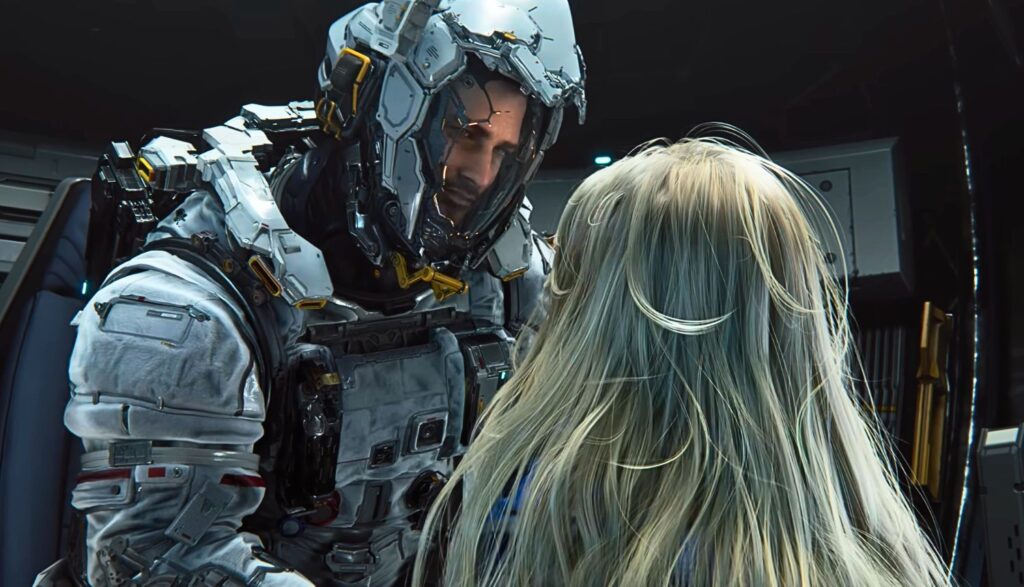
Pragmata puts players in the magnetic space boots of a systems engineer named Hugh. He’s part of a dispatch team sent to a specialized lunar facility that’s gone dark. And like many sci-fi games of this stripe, the rest of Hugh’s team is killed soon after landing, leaving him alone to figure out what’s happened and find a way back home.
It turns out that the base’s artificial intelligence management system, IDUS, has gone rogue. Robots large and small are being generated to attack anyone or anything that ventures into the lunar base’s disheveled and shockingly human-free facilities.
The twist here is that the more-technician-than-soldier Hugh comes upon a robotic construct that looks and acts, amazingly, like a little girl: a self-defined Pragmata.
Hugh dubs this sweet, childlike android Diana. And she soon proves that her advanced tech-hacking abilities—which operate independently from the AI system’s control—are a great help in stopping enemies and overcoming puzzle-like obstacles.
From there, Hugh and Diana venture forth and fight robotic enemies together. Players are called upon to use Diana’s hacking ability (displayed as a real-time, puzzle-grid mechanic), while dodging enemy attacks and aiming Hugh’s gun blasts. It’s a three-pronged combat system that develops over time—leaning into larger quick-time challenges and greater rewards.
Players also discover more and more of the lunar facility they’re running around in, while finding clues associated with the mystery at hand. But it’s the heartwarming story at the game’s core that truly makes the play distinctive.
Gamers get to share in the developing relationship between Hugh and Diana. Diana is childlike, energetically happy and ever inquisitive, and Hugh slips into the role of a protective parent who answers her questions and tells her of his own human experiences.
Depending on the console, Pragmata can be played offline. (Physical copies for the PS5, Switch 2 and Xbox Series X, for instance, do not require an internet connection.) This is a single-player game.
POSITIVE CONTENT
At the beginning of the game, Hugh talks to a fellow crewmate who’s a dad. And Hugh notes that having children and being a father must be tough. That dad replies: “I wouldn’t trade it for the world.”
Hugh’s subsequent evolution into taking on a protective, parental role is one of the powerful and emotional positives of this game. Pragmata has been hailed by many as a “dad simulator.” And indeed, it does foster very positive and heartwarming perspectives about father-daughter relationships. Pragmata also takes time to specifically praise the loving practice of adoption, and it lauds parents who encourage their children to become the best version of themselves.
With time, we see Hugh’s driving motivation shift from one of self-preservation to an unstoppable parental desire to protect. He ultimately is willing to sacrifice himself for the small android’s long-term wellbeing.
CONTENT CONCERNS
All of that said, this is still a T-rated shooter. And while the foes are all robotic (with no blood or mess) there are lots of explosions and battling in the mix, featuring lasers, carbines, bombs and blasters.
The battered and blasted enemies break into pieces and crumple over. The robo foes also tend to frenetically swarm in, the threat growing ever larger as the game proceeds. Enemies range from fast bots to tank-like mechs and towering constructs.
That peril also expands to threats against the childlike Diana. We see her fall to the ground on occasion and get impaled by large, sharp projectiles. In one instance, Diana loses an arm and a leg during an attack. Hugh has to scoop her up and run for repair.
There are uses of the s-word, along with occasional inclusions of “d–n,” “h—” and “a–,” in the dialogue.
GAME SUMMARY
Pragmata is a surprisingly emotional game that’s, well, also an inventive shooter. However, heavy peril and foul language are factors that could limit younger players.