



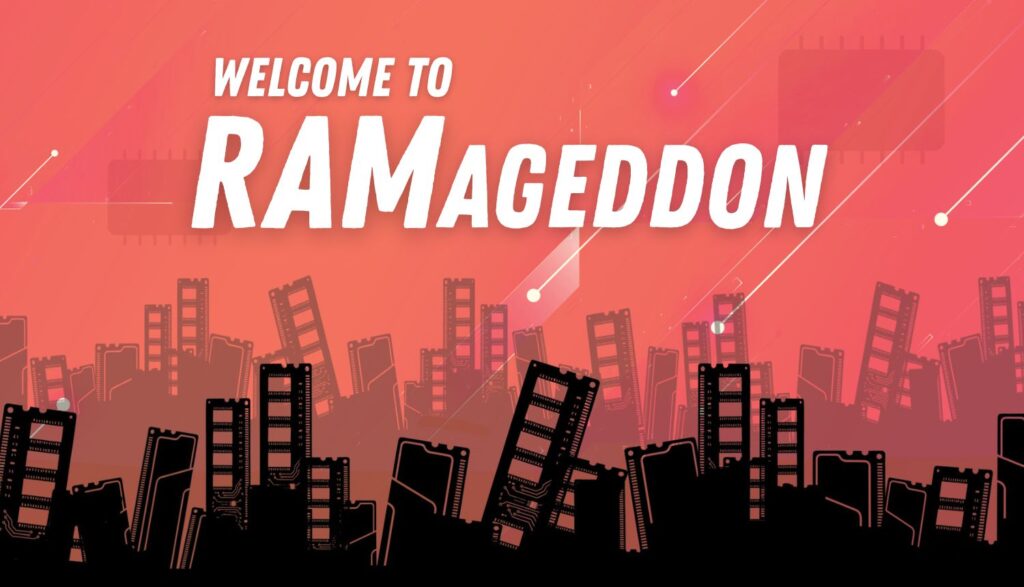
Have you heard of “RAMageddon?”
No, it’s not a new Tron-meets-Mad Max-style sci-fi action flick. (Although … dibs on the idea.)
Apparently, we’re living through RAMageddon right now. Or the RAMpocalypse. Or whatever you want to call it.
Basically, the catalyst of this colorfully named tech market upheaval is the increasingly limited availability of memory chips.
Why has their availability suddenly shrunk, you may ask? Well, the answer to that, as with many new issues we’ve been facing nowadays, can be summed up with two words: artificial intelligence.
Over the past year, AI companies have been Hoovering up as many memory chips (also known as RAM—random access memory) as they can to facilitate the construction of supercomputers and data centers to boost their AI engines.
How Does the RAM Crunch Affect You?
Those memory chips, most of which are only manufactured by a handful of companies, are used in everything from laptops to video-game consoles. As Economics 101 will tell you, when demand is high and supply is low, prices go up. And those price hikes are often passed on to the consumer.
The video-game industry provides a glimpse into the effects of RAMageddon. In the past, frugal consumers could expect the price of video-game consoles to drop the longer they were on the market. (Unless they waited too long, and the console experienced a retro-cool revival in commercial viability.) But that’s not the case in the gaming industry today.
The cost of the digital edition of the PlayStation 5, released nearly six years ago for $399, now sells for $599. The Xbox Series S, launched at $299, is now $100 more. The Nintendo Switch is more expensive now than when it launched, even though its successor game system has already been on the market for more than a year.
If the rumors are true, consoles from the next console generation could cost upward of $1,000. Valve’s Steam Machine, a newcomer to the gaming market, is already selling for $1,049. And lest you think computers are safeguarded against RAMageddon, I’ve got some bad news for you: They require those increasingly scarce (and expensive) memory chips, too.
With 3.2 billion gamers in the world today, there’s a good chance that your family is or will be affected by these price hikes. If gaming, while hugely popular, becomes prohibitively expensive, what can you or your family members do?
Conquering RAMageddon
If you’re interested in “canceling the apocalypse,” to steal a phrase from a certain kaiju-clobbering popcorn flick, then the best way to do so is to break free from excessive screen habits—including gaming—that might have you and your family looking for the newest fix in entertainment.
Here at Plugged In, we’d recommend starting with an intentional break from screen time, work and school screen work excepted—and wouldn’t you know it, we have just the thing to help you and your family do just that! Putting aside your screens can provide a fresh perspective and lead to the discovery (or rediscovery) of tech-free activities that use your God-given giftings and bring you joy.
For all the doom-and-gloom coming from the tech industry about rising costs and limited memory chips, RAMageddon could be an opportunity.
Cultivate hobbies that exist outside a screen. Pick up an old musical instrument that you haven’t played in years. Break out the pencils and brushes to sketch or paint. Join a recreational sports league. Encourage your kids to do the same. Better yet, find things to do as a family.
Unplug from your devices and distance yourself from RAMageddon. Though you may not be able to totally separate from the effects of technology’s price hikes, a screen fast can provide a number of benefits for your family, including improved sleep and mental health, all while reducing increasingly costly digital dependence.
In the tech world, memory is getting more expensive all the time. But in the real world, memories are priceless.

One Response
I just wanted to say I love love loved the Pacific Rim reference. I have some of the RAM upgrades I wanted and have thought about going on eBay for gently-used secondhands.