


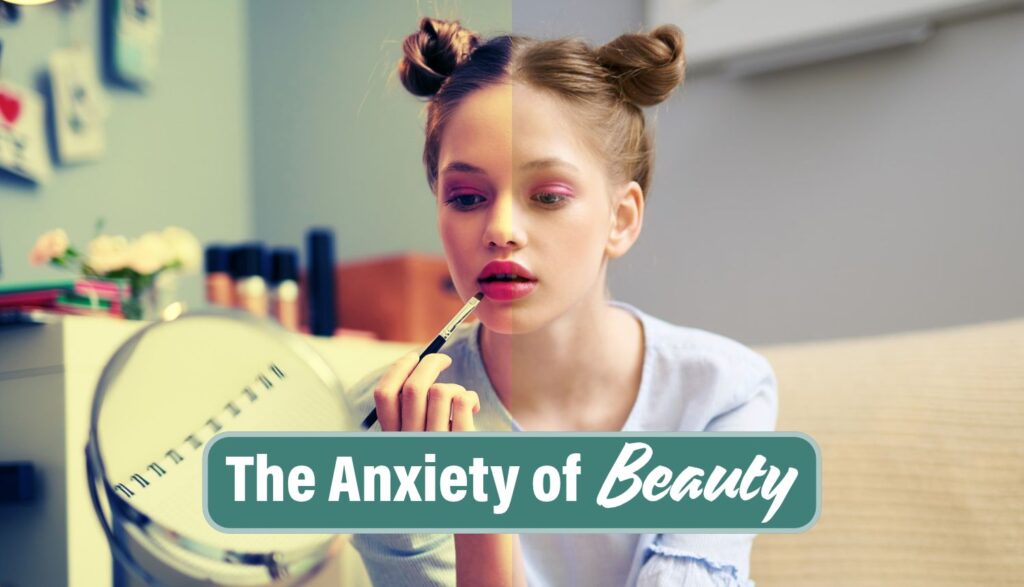
We’ve all heard that teens these days are dealing with a heightened sense of anxiety over their looks and becoming increasingly self-conscious about their bodies. But is that true? C’mon, really?
I mean, common sense and your great-uncle Fred might suggest that kids have always been sensitive about such things. Can there reallybe any reliable evidence that today’s tweens, teens and twentysomethings are fretfully struggling with anything more than what everyone has dealt with throughout the ages? Does having social media and techy new thingamajigs in your back pocket really make that much of a difference?
Both questions can be answered with a simple yes.
We See Everything Through a Filter
Your grumpy great-uncle may scoff, but there’s quite a bit of evidence pointing to the fact that today’s teens carry so much more than yesterday’s. A national poll by C.S. Mott Children’s Hospital, for instance, found that extreme appearance-related anxiety among adolescents is at something of an all-time high—impacting 73% of teen girls and 69% of teen boys.
On top of that, the researchers found that those negative personal feelings are already starting to dribble down to even younger kids. And unlike the occasional impact that magazines, TV shows or movie stars may have had on people back in the 1990s or earlier, today’s young people interact with a daily cascade of tailored algorithms, face-altering filters and personal comparisons with online AI perfection of every stripe.
Of course, good old Fred might pshaw and wonder if anybody is really dealing with all that stuff. Or is it just hype to sell newspapers? he might query with a crinkled squint. Well, first of all, newspapers? C’mon Unc. And secondly, maybe we ought to quick-fire some facts and figures on the topic for any doubters in the crowd.
Get ‘Em Young
Let’s start here: The National Institute of Health reported that nearly 95% of 13- to 17-year-olds in our country use social media platforms. Roughly 33-35% of that number use the platforms “almost constantly.” And studies such as the Dove Self-Esteem Project suggest that 80% of young girls start using an appearance-altering filter for their social media by the ripe old age of … 13!
Now, why would blossoming young kids want to do that? Simple: People, young and old, want to be attractive to others. And when everybody else in the world seems to be much better-looking than you, you start wondering what you can do about it. Appearance-tweaking filters feel like a quick solution—the apps take your image, compare it to a dataset of other faces and then slightly “redraw” your picture-pixels in “favorable” ways.
What’s Wrong With a Prettier Me?
Here’s the problem: A digital tweak may seem fun, but many find it’s rarely enough. Researchers for a Boston University study found that young people who fiddle around with beauty filters not only see themselves in an even harsher light once the filter is turned off, but they tend to look for more permanent solutions.
In fact, 62% of plastic surgeons noted that their patients sought cosmetic procedures “due to dissatisfaction with their social media profiles,” and 57% of them reported patients wanting to “improve their appearance specifically in selfies.”
In other words, all those filters on Instagram, TikTok and Snapchat tend to distort our collective perceptions of what real bodies and real faces should look like. And that correlates with low self-esteem, anxiety, depression, negative self-talk, and, potentially, body dysmorphia—particularly among young women.
The more time we spend on image-led social media, the more likely we are to seek perfection by altering our appearance.
Avoiding a Rabbit Hole and Finding a Niche
Alright, so now that we’ve established that there may well be a problem here, what can thoughtful parents do to help their teens avoid less-than-healthy choices and mental rabbit holes?
The wisest first step is to evaluate your own habits. Believe it or not, teens are watching what you do. They may pretend that they don’t care, but they’re watching. So, you should avoid any personal negative body-talk. You want your kids to accept their own bodies in healthy ways? Show them how. And you can draw back from trying to make your own social media presence look perfect, too. In fact, how about reigning in social media altogether?
Another wise choice is to start a conversation on the topic. Ask your kids their thoughts about filters and some of the crazy demands that social media can make of us. If they’re using beauty filters, ask why—not in a judgy way, but in an earnest desire to hear what they think. Ask things like: What do you like about that filter? How does it make you feel? Do you think people online have certain expectations of you? Why is that important?
It’s a plus if you can slowly shift your conversations away from appearance and more toward value. Remind your teens that their self-worth, their importance, has absolutely nothing to do with online likes, follower counts or some thumbs-up from a social media algorithm. They are loved and beautiful in many ways. After all, God tells us that we are fearfully and wonderfully made in His image. Our true worth is measured by what God made us to be and by what Christ was willing to sacrifice for us.
Now, those kinds of beautiful truths may not be on the tip of every social media user’s tongue, but they definitely should be at the forefront of every believer’s mind. And helping our loved ones (and ourselves) to remember that fact can make the demands of Instagram and Snapchat a lot less pressing. Even great-uncle Fred would have to agree with that.

Recent Comments